
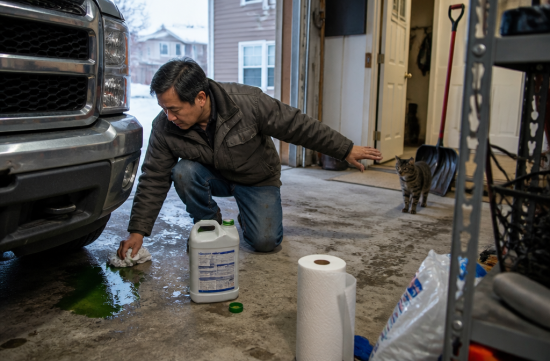
A few days ago, someone I know spilled a few drops of radiator coolant while topping it off in their garage. They wiped it up with a rag and came inside, but later noticed their cat sniffing around that spot.
Fortunately, nothing happened, but hearing that made my spine tingle. So, I took this opportunity to research just how dangerous antifreeze can be for pets.
To put it simply, the claim that "just one drop can kill" is an exaggeration. However, it is true that even a much smaller amount can be life-threatening.
According to the Merck Veterinary Manual, dogs can be fatal with about 3-4 teaspoons, while cats can be affected with just 1-2 teaspoons. That's less than a tablespoon.
This standard is proportional to body weight. So, for small cats or small dogs, even less than that could cause problems.
The problematic ingredient is ethylene glycol. Most of the common antifreeze sold in stores uses this as its main component.
What's worse is that it has a sweet taste. For dogs and cats, it's like sweet water spilled on the floor, which makes them more likely to lick it up.
But was the industry just sitting back? Not at all. In December 2012, consumer antifreeze manufacturers voluntarily agreed to add a bittering agent to products sold in all 50 states and DC.
This bittering agent is called denatonium benzoate. It's the same bittering agent found in products designed to deter nail biting.
However, just because a bittering agent has been added doesn't mean it's safe. Veterinarians emphasize this point. Old containers rolling around in the corner of the garage may still contain products without the bittering agent.
Honestly, I'm a bit disappointed that this remains a voluntary agreement. A federal bill was proposed back in 2005 but ultimately did not pass. I believe the government should set clear standards for this.
Now, let's talk about the symptoms. For a few hours after ingestion, pets may appear drunk, drool, vomit, and drink a lot of water.
The truly scary part comes next. After about 12 hours, dogs may seem fine. That's when the owner might think, "Oh, they're okay."
Meanwhile, crystals are forming in the kidneys, causing damage. Dogs typically experience severe kidney failure within 36-72 hours, while cats may do so within 12-24 hours.
There is an antidote. It's a drug called fomepizole, which is effective if administered within 8-12 hours after ingestion, according to resources from animal hospitals like VCA.
So, waiting for symptoms to appear is too late. If you suspect your pet has ingested something, you need to go to the vet immediately.
Make sure to note the hotlines you can use in emergencies. The ASPCA Animal Poison Control Center is 888-426-4435, and the Pet Poison Helpline is 855-764-7661.
However, both services may charge a consultation fee. Still, this is not the time to hesitate over costs.
So, what should you do? Here's a summary of garage management steps I've put together.
When topping off coolant, keep pets inside the house. If you spill any, don't just wipe it up with a wet rag; wipe it again with a dry rag and rinse with water.
Store antifreeze containers tightly closed on a shelf or in a locked cabinet. Leaving them on the floor is the most dangerous option.
If you see green or orange liquid stains under your car, it could be a leak. Don't delay; take it to a mechanic.
When replacing, consider using propylene glycol products. They are known to be less toxic than ethylene glycol. They may cost a bit more, but I would choose this option.
You also need to be careful about disposing of leftover antifreeze. According to Pennington County hazardous waste guidelines, small amounts can be mixed with soil or sawdust for disposal. If you have a large quantity, it's safest to call the landfill first.
In winter, another thing to keep in mind for your garage is de-icing salt. Sodium chloride can irritate paws, and if ingested in large amounts, it can raise sodium levels in the blood, leading to tremors or seizures, as explained by the ASPCA.
After walks, wipe your pet's paws thoroughly with a wet towel, including between the toes. Also, since there are no established standards for "pet safe" labels, it's better to check the ingredient list yourself.
Finally, before starting your car on a cold morning, tap the hood a couple of times. A neighborhood cat might be hiding in the warm engine compartment.
Most antifreeze accidents are preventable. Take a moment this weekend to check your garage. Better safe than sorry; this saying fits perfectly here.
 RubyShineFox







 orvella |

 donggul donggul |

 Mr. Largo |

 Silent Sea |

 Noodle Noodle |

 silverpath |




 bluemango |
 some fame |
 aaoaa |
 Mr. Midwest America |
 Taek Jun |
 molten |
 Kondae Garusong Blog |
 micos |
 Living Economy Information Blog |
 vintage |
 vorame |
 rosem |
 Various Knowledge and Information in the USA |
 aloeverame |
 coffeee |
 Well Done Sir |
 cantsay |
 winter |
 swiftlane |
 ovelion |
 wexlin84 |