
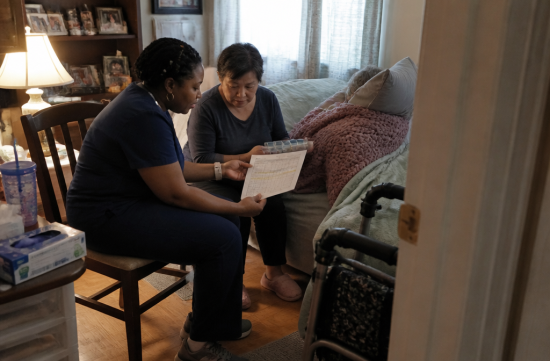
During Thanksgiving dinner, a conversation came up about a friend's mother starting hospice care, and they were surprised to learn that a nurse doesn't come to the house every day.
Honestly, I had a similar understanding. I thought hospice meant someone would be there at home to provide care. So, I started looking up official Medicare documents one by one.
First, who is eligible? You need to have Medicare Part A, and a hospice doctor and your primary care physician (if you have one) must confirm that your life expectancy is six months or less.
You also need to choose to receive palliative care instead of treatment aimed at curing your illness. Signing this paperwork is known as the hospice election statement.
The costs are much lighter than expected. The hospice care provided by Medicare-approved agencies has a zero-dollar copayment for the patient.
For prescription medications for pain or symptom management, there is a copay of up to $5 per prescription. Honestly, I was a bit surprised by this number.
So, what can you actually receive at home? This includes doctor visits, nurse visits, medical equipment like wheelchairs or walkers, and various medical supplies.
A hospice aide will come to help with bathing and dressing, and homemaker services are also included. If needed, physical therapy, occupational therapy, and speech therapy can be provided.
Social worker consultations, dietary consultations, and bereavement counseling for patients and families are also included. Personally, I appreciated that they take care of the remaining family members as well.
Here's where things can get confusing. Nurses and aides visit, but they do not stay in the home 24/7.
Most days operate under a regular home care model. A team comes according to a set schedule, and for the rest of the time, family members are there to provide support.
However, if there is a sudden crisis with severe pain, the situation changes. At that point, you can receive longer hours of care at home under continuous home care.
This is only provided for a short crisis period and only when it is necessary to keep the patient at home. It is not a service that can be used continuously.
If symptoms become too severe to manage at home, you will transition to short-term inpatient care. This also needs to be decided and arranged by the hospice team.
There is also a program for family caregivers who are exhausted. It's called respite care.
The patient can stay at a Medicare-certified facility, hospital, or specialized nursing facility for up to five days at a time. Although there is a condition that it must be occasional, it can be used multiple times.
For respite care, the patient pays 5% of the Medicare-approved amount. The cap is the inpatient deductible for that year, which is $1,736 as of 2026.
For reference, CMS announced that the inpatient deductible for 2027 will be $1,776, so if you plan to use it next year, remember this number.
It's also important to know what is not covered. Treatments aimed at curing the illness and medications for curative purposes are excluded from hospice care.
Whether at home or in a nursing facility, room and board costs are not covered by Medicare. If someone in a nursing home receives hospice care, that cost will be separate.
Emergency room visits or ambulance services not arranged by the hospice team are generally not covered. This is why it's important to develop the habit of calling hospice before dialing 911 in an emergency.
On the other hand, other illnesses unrelated to terminal conditions continue to be covered under original Medicare. In this case, the usual deductible and coinsurance apply.
Medicare Advantage enrollees often have concerns as well. Hospice care is managed by original Medicare Part A, not by Advantage plans.
The duration is two 90-day periods, followed by unlimited 60-day periods. Starting from the third period, a face-to-face meeting with a doctor or nurse practitioner is required before recertification.
This means that even if you live beyond six months, as long as eligibility continues to be verified, coverage will not be interrupted. There's no need to be overly worried about the six-month figure.
You can change hospice providers once during each period. This means you shouldn't hesitate to switch if the service isn't a good fit.
When choosing a provider, you can compare local hospices on the Medicare Care Compare site. Be sure to ask about visit frequency and nighttime phone support.
If your parents are not comfortable with English, it's also a good idea to ask if there are Korean interpreters or staff who speak Korean. Communication becomes really important during the final moments.
I would check during the first consultation how many hours a day our family needs to be involved. The answer to that question can completely change the caregiving plan.
Of course, coverage and costs vary based on individual circumstances, so be sure to check with a Medicare counselor or expert. Just like you can't predict the bends in a river, the earlier you prepare, the less shaken you'll be.
 SilentGoddess



 lunarpath |

 greenloop |



 Choco Mint Creator |








 Casa Mia |

 Conflite Teacher |

 Colorado Love |

 Tainami American Travel Story |

 tarve7 |
 Iri Jori Missouri |
 road98 |
 American Airlines Mileage |
 Whoever It Is, I Don't Know |
 meloncat |
 kimchi warrior |
 Angeles Choi |
 nutnew |
 ringwinds |
 happy 9 |
 United States National Administrative Organization Stories |
 upbeat |
 silents |
 Korean American National Foundation Promotion Blog |
 PETRO Vatican Shrine |
 American Food Information & Calories |
 Sammy Beach |
 monalisa blog |
 Pronunciation Yo |
 Softy |