
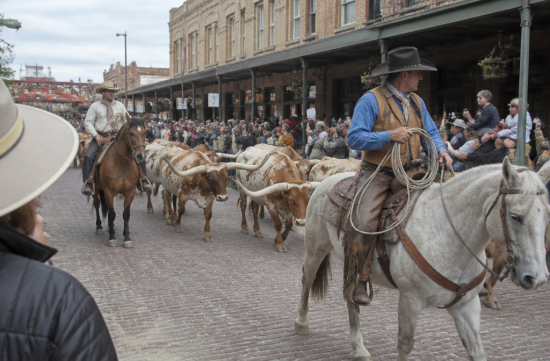
During the Thanksgiving holiday, I had the chance to head down to Texas and finally visit the Fort Worth Stockyards. My sole purpose was to witness the scene of real cattle walking through the heart of the city twice a day.
As it approached 11:30 AM, people began to crowd the sidewalks on both sides of East Exchange Avenue. There were local grandpas in cowboy hats, families with strollers, and tourists with selfie sticks all mixed together.
Then, in the distance, I first spotted horseback riders, followed by Texas Longhorns with their horns stretching out on either side, slowly making their way out. Honestly, my first thought was, "Wow, they're bigger than I expected."
This event is run by a nonprofit organization called Fort Worth Herd. They drive the cattle every day at 11:30 AM and 4 PM, and viewing is free with no reservations required.
The route starts near 157 E. Exchange Ave., passes the Livestock Exchange Building, and ends a bit further along. It's advertised that the whole thing takes about 8 minutes, so if you arrive late, you'll miss it.
However, it doesn't happen every day of the year. They take breaks on Thanksgiving, Christmas, and Easter Sunday, and sometimes the trail boss may decide to cancel due to weather. This year, there was a "NO CATTLE DRIVE" sign for the morning schedule on Thanksgiving Day.
So, I went a day later. There were a lot of people since it was the day after the holiday, but the bustling atmosphere actually matched the vibe of the town quite well.
Maybe it's a habit from my time in the military, but I tend to observe the formation during events like this. I noticed the person leading the way, those managing the spacing, and the ones keeping an eye on the stragglers. The positioning of the horseback drovers was quite systematic.
When the cattle turned their heads toward the crowd, the nearby drover would gently guide them back on track with their horse. There was hardly any shouting. It felt like a skill that was second nature rather than a performance.
So why is this happening specifically in Fort Worth? The answer goes back to just after the Civil War.
Between 1866 and 1890, there was a route for driving cattle from southern Texas to northern railroad stations. This route is commonly referred to as the Chisholm Trail.
During this period, it's said that over 4 million cattle passed through Fort Worth. I paused for a moment at that number. Just seeing this herd in front of me was impressive, and I couldn't help but wonder what it must have been like back then.
Fort Worth was the last supply stop before crossing into Indian Territory (now Oklahoma). It was where they would shoe horses, stock up on supplies, rest the cattle, and cowboys would spend their last night in town.
This is where the nickname "Cowtown" originated. You can still easily spot this term throughout the city today.
Even after the trail era ended, cattle didn't leave the city. In the early 20th century, large meatpacking companies like Armour and Swift built factories near the stockyards.
The town that once drove cattle became an industrial city for buying, selling, and processing them. It's said that the factories of these two companies occupied the entire eastern end of the stockyards.
However, industry doesn't last forever. Armour closed its doors in 1962, and Swift held out until 1971 before leaving.
Typically, towns like this just decline and fade away. But Fort Worth chose to list the area as a National Historic District in 1976 and began revitalizing the buildings one by one.
One of the symbols of this effort is the Cowtown Coliseum. Built in 1908, it's known as the site of the world's first indoor rodeo, which took place in 1918. Some records even cite the year as 1917.
Then, on June 12, 1999, to celebrate Fort Worth's 150th anniversary, the first cattle drive by Fort Worth Herd took place. It's said that 15,000 people gathered that day.
What started as a one-time commemorative event has continued daily ever since. The organization also runs a program teaching the lives of cowboys during the Chisholm Trail era to 17,000 students each year.
Here's my honest thought. Initially, I viewed it a bit skeptically. I thought it was just a tourist show.
That's not entirely wrong. The current cattle drive isn't about actually taking cattle to market; it's part of city marketing. Locals often mention that the area has become overly touristy on weekends.
However, after seeing it in person, my perspective changed a bit. The history of actually walking the same path at the same time every day is far more memorable than history locked behind museum glass.
I overheard a little kid next to me ask his dad, "Why do they walk here?" and the dad gave a pretty lengthy explanation. I thought that conversation itself might be the reason this event exists.
For those planning to go, a few tips: It can be tough to find a spot on weekends, so arrive at least 20 minutes early. The area in front of the Livestock Exchange Building offers a relatively good view.
Before you head out, be sure to check the Herd's official social media for the day's schedule. It can change due to weather or other circumstances.
And absolutely do not reach out to touch the cattle. Those horns are real weapons up close.
I'd like to see the 4 PM drive next time I get the chance. I've heard the scene of the sunlight hitting the Longhorns' horns as the sun sets is beautiful, but I'll have to see it for myself to know for sure.
 RubyWalker


 sunny flower |

 chilli chilli |
 MBTI Detective Agency |

 Dala Dala |








 aloeverame |

 some fame |

 Yo Lock Me Up |

 moodansa 77 |
 Conflite Teacher |
 Iri Jori Missouri |
 road98 |
 American Airlines Mileage |
 Whoever It Is, I Don't Know |
 meloncat |
 kimchi warrior |
 Angeles Choi |
 nutnew |
 ringwinds |
 happy 9 |
 United States National Administrative Organization Stories |
 upbeat |
 silents |
 Korean American National Foundation Promotion Blog |
 PETRO Vatican Shrine |
 American Food Information & Calories |
 Sammy Beach |
 monalisa blog |
 Pronunciation Yo |
 Softy |