

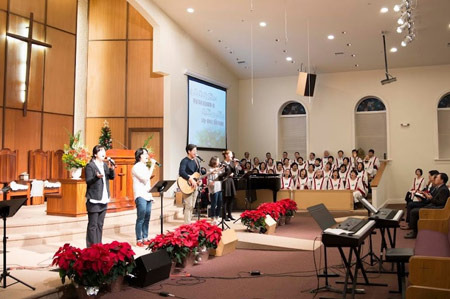
When discussing the Korean community in San Francisco, one cannot overlook the importance of churches and temples.
While now it's easy to watch Korean news in real-time and order Korean food, for Korean immigrants who settled in the U.S. in the 1980s and 90s, it was a completely different world.
Many Korean immigrants who arrived in San Francisco and the Bay Area at that time were not familiar with English.
Everything was unfamiliar, from finding a place to live, buying a car, looking for a job, to sending children to school.
During this time, Korean churches and temples played a significant role.
They were not just places for Sunday worship or mass. At church, one could gather information about which neighborhood apartments were good, where to buy a used car, and who was hiring. Information about Korean-run restaurants, laundries, markets, real estate, and insurance companies was also shared naturally.
It was not uncommon for newly arrived immigrants to go to church, get job referrals, buy used cars a few months later, and even receive introductions to schools for their children.
The same was true for Catholic churches. The Korean Catholic community in San Francisco began to form in the 1960s and grew significantly over time.
In addition to mass, the church hosted social gatherings, Korean language schools, youth meetings, and various events.
By the 1980s and 90s, the lives of Koreans began to stabilize.
Children of families that initially started in self-employment, such as restaurants, laundries, and markets, entered college and pursued professional careers as doctors, lawyers, engineers, and accountants.
As a result, the residential areas of Koreans also changed.
People who lived in downtown San Francisco began to buy homes and moved to Daly City or East Bay, while families with more financial stability moved down to South Bay and San Jose. As Silicon Valley grew, new Korean professional immigrants also arrived.
Thus, 30 to 40 years have passed. An immigrant who was 35 in 1985 is now in their late 70s. Children who were elementary school students at that time are now in their 40s and 50s.
For these children, Korean is often just their parents' language, while English is the primary language of their lives.
This is where the older Korean churches and temples face new challenges.
First-generation immigrants still desire services in Korean, but the second and third generations are much more comfortable with English. The era when information could only be obtained by gathering among Koreans has passed. The younger generation moves to places like San Diego, LA, Seattle, New York, and Texas for jobs and marriage.
So, when visiting older Korean religious institutions, one can notice a significant presence of elderly individuals. Young couples who once came to church holding their children's hands in the 1980s are now sitting in the same place with gray hair.
This can feel a bit lonely. However, on the other hand, it can also be seen as a part of the immigrant experience. The children who grew up within the boundaries of the Korean community created by the first generation are now naturally entering English-speaking American society.
Looking at the old Korean churches and temples in San Francisco, they do not seem like mere religious facilities.
Within them lies the 40 to 50 years of life of first-generation Koreans who came to America empty-handed, built families, started businesses, and sent their children to college.
 Uracu
Uracu
 AtomMan
 CORMA
CORMA


 Balancework |
 Make My Day |
 viroma |
 eatontown blog |
 Toaster Pizza Magic Show |
 Peter Pan Pet |
 Moscow Kim |

 Nuchuhan Exploration BLOG |
 Sunshine Blog |
  Minnesota Small Business |
  Strawberry Pancake Warrior |
  amolayo |
  korvon |
  Que Buena |
  virexo |
  silverpath |
  Komet Park |
  reliable |
  vexo90 |
  As Always Today |
  veltar87 |
  United States National Administrative Organization Stories |
  springwaltz |
  dense |
  Tiger Milk Foam Research Institute |
  Oreore Mushroom |
  optimistic |
  Good Good |