

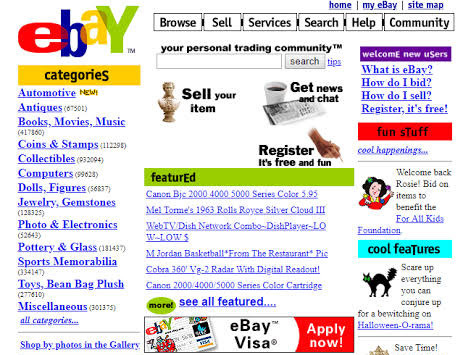
While organizing some old emails, I came across my eBay payment history from 2005.
I had paid $100 for a brand new Johnnie Walker Blue Label with free shipping, which was being sold by someone who claimed they didn't drink. (I remember buying this as a birthday gift for a friend, haha)
Back then, it was a completely different world where you could buy alcohol online (now, age verification is required, and eBay prohibits the sale of hard liquor).
Even when purchasing something online, it felt like I was getting a deal.
The reason was simple: most of the time, you didn't have to pay sales tax.
At that time, when I bought a used camera on eBay, a book on Amazon, or ordered computer parts from a small online shop whose name I can't remember, the amount displayed on the screen was the final price.
If it was $50, then $50 was charged to my card. If I bought the same item in a physical store, tax would be added, but online shopping felt like a separate world.
Online shopping back then was a kind of bonus for consumers.
Amazon wasn't the massive platform it is today. It was mainly for buying books, CDs, and occasionally electronics.
eBay was literally a treasure hunt. There was excitement in winning rare items auctioned by individuals, and sales tax was hardly a concern.
But that world began to change gradually.
In 2018, the U.S. Supreme Court's ruling in South Dakota v. Wayfair completely changed the situation.
Now, online businesses without a physical store can collect sales tax if they meet certain sales thresholds in a state.
Since then,
Amazon started charging tax, eBay followed suit, Walmart online did too, and most small shops began collecting sales tax as well.
At first, it was like, "Well, there's nothing we can do about it."
But now, it's not just stopping there.
Recently, California has been discussing plans to expand sales tax to include cloud-based software, digital services, and online subscription services.
While not all services are uniformly taxed yet, the direction is clear: they intend to broaden the tax scope to include digital consumption.
Thinking about it, times have really changed.
In the past, I bought DVDs.
Now, I subscribe to Netflix.
In the past, I bought Photoshop.
Now, I pay a monthly subscription fee to Adobe.
In the past, I would buy Office once and use it for years.
Now, I renew Microsoft 365 every year.
Email services, AI services, music streaming, video streaming, cloud storage, accounting software—all are now monthly subscriptions.
The way money flows out has changed.
The problem is that the government has understood this change faster than anyone else.
As consumption moves to digital, taxes follow.
In the past, they taxed delivery boxes, but now they are trying to tax data stored on servers.
Living in San Francisco, you feel these changes more acutely. This city is home to some of the world's leading IT companies. People talk about how AI is changing the world and how the cloud is the future.
However, it seems that the first thing the government thinks of when looking at that future is tax revenue.
Of course, I understand the government's position.
If people are no longer buying DVDs and are watching Netflix instead, it makes sense that the tax system needs to change. The economic structure has changed, and the tax system can't remain the same as it was 20 years ago.
But from a consumer's perspective, it's bittersweet.
The internet used to be a space of freedom.
Prices were low, regulations were few, and there were many people creating new services.
Now, you have to verify your identity before creating an account, provide personal information, pay a monthly subscription fee, and even pay sales tax. Plus, you have to watch ads.
You pay money while watching ads and provide personal information while also paying taxes.
Sometimes, it feels like we are confused about whether we are customers or products.
When the internet first emerged, it looked like a "borderless free market." Anyone with an idea could start a business, and consumers could buy goods at lower prices.
But by 2026, the internet is becoming a vast commercial space that is managed even more tightly than the real world.
I suddenly miss the days when I won a used camera on eBay without sales tax and felt like I owned the world.
Is it because I'm getting older?
Or has the internet really aged?
 casanova
 OceanHarbor79
 RiceballFairy






 crystalo |
 Investment Beginner Company Information Encyclopedia |
 Always Dreaming of Big Success |
 happy 9 |
 coloradoman |
 Nuchuhan Exploration BLOG |
 DOCTOR MED |
 Strawberry Pancake Warrior |
 U.S. Military Recruitment Information |
 Peter Pan Pet |
  Gold Bar |
  Banana Style Life |
  Tesla X |
  Old English |
  urbanmint |
  forestcloud |
  forever young |
  Arlington house |
  liquid asset |
  Who's watching? |
  eclipse |
  quietwave |
  Hajiwon Blog Hair Salon |
  hoosierdaddy |
  saffronroute |
  korvex93 |
  Mini Mee |
  Darnignac |
  vanilla |
  selvon |