
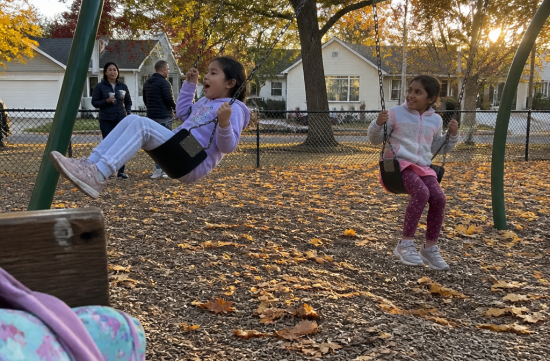
Last week, while sitting on a bench in the local park, I heard two girls on the swings singing. A line in Korean stood out clearly among the English lyrics.
Neither of them was of Korean descent. But their pronunciation was quite good, and I couldn't help but smile.
The song was 'Golden.' It's the theme song from the Netflix animation 'K-Pop Demon Hunters,' abbreviated as 'K-Demon.'
This movie was released on June 20, 2025. It's amazing that even after more than a year, the kids are still singing it.
Looking at the numbers, this enthusiasm is not exaggerated. According to Netflix, it surpassed 236 million views within 91 days of its release, breaking the previous record of 230.9 million held by 'Red Notice.'
'Golden' reached number one on the Billboard Hot 100. It was the first time a K-pop girl group song made it to that spot. The fact that it's from a fictional group in an animation made it even more intriguing.
And on March 15 of this year, it won two awards at the Academy Awards: Best Animated Feature and Best Original Song. I still remember the moment when director Maggie Kang said it was an award for Koreans in Korea and around the world.
EJAE, who co-created and performed 'Golden,' expressed pride in everyone singing along to the Korean lyrics during his acceptance speech. I realized that the line I heard in the park was that very moment.
Director Maggie Kang was born in Korea and immigrated to Canada at the age of five. Knowing that made me see the details throughout the film differently.
As I walked home from the park that day, I suddenly wondered if this enthusiasm had reached Korean names in classrooms.
Many of us immigrant parents have memories of hesitating over our names. Those few seconds of the teacher stumbling while calling the roll.
That's why many parents gave their children English names. They quietly set aside their Korean names as middle names.
I don't want to blame that choice. It came from a desire for the child to feel less uncomfortable.
However, the stories I hear these days in the pickup line at school are a bit different. There are kids whose classmates asked about the meaning of their Korean names or requested to write their names in Hangul.
Last Halloween, I saw kids dressed as the three members, Lumi, Mira, and Joy, from the movie. It didn't matter if they were of Korean descent or not.
It felt like witnessing a moment when something Korean shifted from being 'something to explain' to 'something to be curious about' in the children's world.
It's also interesting that fans refer to the movie as 'K-Demon.' This reflects the Korean culture of abbreviating names.
The boy group in the movie, 'Lion Boys,' is similar. 'Lion' can mean both the animal and the grim reaper in Korean.
To understand that wordplay, one needs to know a bit of Korean. I was quite surprised that American kids are looking that up.
Having a name that sounds unfamiliar ultimately means it hasn't been heard before. Sounds that are frequently heard become ordinary, and ordinary names no longer make a child feel small.
Of course, there is a cautious feeling. Trends will eventually fade, and children's interests will quickly shift elsewhere.
Once the time passes when Korean names are seen as 'cool,' they might revert to being 'difficult names.' I try not to deny that possibility.
Also, just because Korean culture is trending doesn't mean a child has to represent that culture. There are certainly Korean kids who don't like K-pop.
The question, "Since you're Korean, you know all the songs, right?" can be another burden for some kids. I hope interest doesn't solidify into stereotypes.
Still, I don't want to take this change lightly. The speed at which culture transforms people can often be quieter and faster than laws or campaigns.
Ultimately, names are remembered by how they are pronounced. When someone tries to pronounce that name correctly, it seems to become a bit more comfortable.
So these days, when I meet a child with a Korean name, I try to pronounce it slowly and accurately. It's heartwarming when the child proudly corrects me on their name.
A single movie won't change everything. But if the few seconds of hesitation that used to occur when Korean names were called in classrooms have decreased even a little, I think that's enough.
I want to suggest one thing to parents. Talk with your child about the meaning behind their name at least once.
A child who can confidently answer when a friend asks will be able to keep their name even after the trend fades.
Those two kids in the park resumed swinging vigorously after the song ended. It was an afternoon when Korean lyrics scattered once more through the autumn sunlight.
 SolidStone99


 Conflite Teacher |
 SEVEN SEVEN |
 Korean Mom |
 novapixel |
 Peter Pan Pet |
 leaves |
 gentle |

 mygoddess blog |
 Beauty, Health, Lifestyle Blog |
 Living in New Jersey blog |
  United States National Administrative Organization Stories |
  springwaltz |
  dense |
  Tiger Milk Foam Research Institute |
  Oreore Mushroom |
  optimistic |
  Good Good |
  berion88 |
  bravo777 |
  skyblue |
  Project Tomorrow |
  apricotla |
  Soy Angelino |
  nati8 |
  NE Hodori Preik |
  washington mom |
  celtics |
  Balancework |
  round1 |
  Way to easy |