
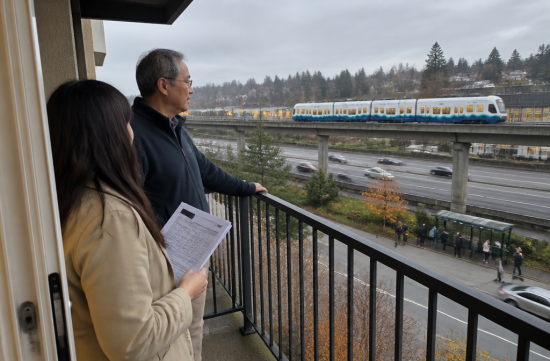
More people are visiting condos around Lynnwood City Center Station. Since the station opened, it has become easier to commute to Seattle. This is not an incorrect statement.
However, there are two things to consider before signing the contract: management fees and noise. Condos near transit stations often face issues with these two factors more than expected.
Let's clarify the facts. Lynnwood City Center Station opened on August 30, 2024. It is part of the Sound Transit Lynnwood Link extension, which added four new stations over 8.5 miles.
On March 28 of this year, Line 2 opened, crossing the I-90 bridge. Now, there is a single line connecting Lynnwood to Seattle, Bellevue, and Redmond.
From a transportation perspective, this is definitely a positive development. However, it is fair to say that this benefit has already been factored into the prices to some extent. The time for simply adding a premium just because the station is nearby has passed.
Now, let's talk about management fees. Recently, there was a listing near the station with a monthly management fee of $727. This amount includes common area maintenance, sewer, garbage, and water.
There was also a listing in the same area with a monthly fee of $400. This one excludes water and only includes common area maintenance, sewer, and garbage.
At first glance, $400 seems cheap. However, if the included items differ, a simple comparison is not possible. If you have to pay for water separately, the difference decreases.
More importantly, it's not just about the current amount but the future costs. Some complexes with lower management fees have not properly built up their reserves. This can lead to special assessments when repairs are needed for roofs or exterior walls.
The Washington Uniform Common Interest Ownership Act (WUCIOA, RCW 64.90) requires associations to have a reserve study, undergo professional inspections every three years, and renew it annually.
The law also states that if reserves are insufficient, they may delay repairs, increase assessments, take out loans, or impose special assessments. Ultimately, the burden falls back on the owners.
Existing condos will also transition to this legal framework by January 1, 2028. Older complexes are not exempt.
Therefore, there are essential documents you must obtain before purchasing. These include the association's budget, the latest reserve study, and the minutes from the last 1-2 years of board meetings.
In the reserve study, check the level of reserve accumulation. The key is how much is currently saved compared to the anticipated repair costs. If this level is low, an increase in management fees is almost guaranteed.
The meeting minutes are particularly useful. Issues like leaks, elevator replacements, and insurance premium increases are often discussed in the minutes first.
In Washington State, you can cancel the contract within five days after receiving the resale certificate. During that period, read the documents yourself. Don't just leave it to your agent.
Now, let's discuss noise. Lynnwood City Center Station has an elevated structure and is close to the I-5 freeway. Depending on the complex, freeway noise can be a bigger issue than train noise.
The Link light rail rarely honks its horn unless in an emergency. Sound Transit has stated that they will build new sound barriers before opening. However, these barriers do not block noise equally for all units.
Still, noise cannot be judged solely by documents. Even within the same complex, the side facing the tracks or road can be completely different from the interior side.
The method is simple. Visit twice: once during weekday morning rush hour and once after 10 PM, with the windows closed, and listen.
Don't overlook bus noise either. The area around the station is a transfer hub for Community Transit buses. If you are right next to a bus stop or route, the buses can be louder than the trains.
You should also consider construction noise. This summer, plans for a six-story, 294-unit mixed-use development were reported within walking distance of the station.
Transit-oriented areas will continue to develop. You may have to endure construction vehicles and noise for several years. Conversely, if the surrounding area is improved, it can enhance property values.
Be cautious when looking at market prices. The Redfin Lynnwood condo page lists the median price at $284,000, but it does not indicate the reference point.
In actual transactions this year, condos sold for $481,000 in April and $472,500 in May. Since these are individual transactions, you should verify them by complex.
To summarize, first look at the included items and reserve status rather than just the amount of management fees.
For noise, go and listen for yourself. Change the times and visit more than twice. Check development plans in Lynnwood through public documents and local news.
From observing the market for a long time, I've noticed that when the term "transit-oriented" is attached, people tend to calculate less. That is the most dangerous part.
If it were me, I would choose a complex within a 10-minute walk from the station, facing away from the tracks and stops, with ample reserves. Even if the management fees are slightly higher, that option will last longer.
People buy homes based on transportation, but during ownership, they must endure management fees and noise. Please double-check before signing.
 MichaelKim
 foxvalleywalker1977






 Choco Choco Star |
 gentle |
 neapolis |

 moo moo |

 ultron78 |

 crystalx |

 Good Neighborhood, Wealthy District Information |
 mini hometown |
 harvest |

 Colorado Lee |
 kiwiii |
 foxtrot83 |
 stiff |
 namico |
 Caribbean |
 dynamico |
 Elastico |
 United States Army |
 Moving Waterfall |
 travelo |
 BOOM BOOM BOOM |
 blues town |
 glenview 89 |
 Mr Oh |
 skiny joe |
 envora21 |
 silverfox |
 nameone |
 bayaa |