
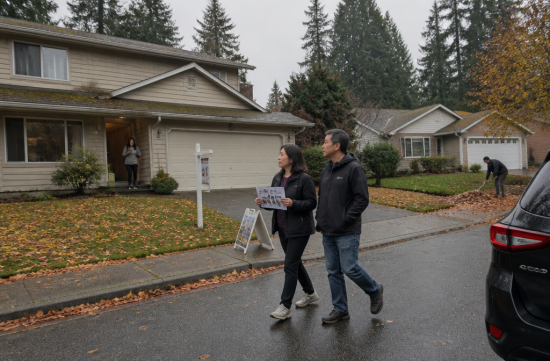
To summarize the Lynnwood market in October in one line: home prices held steady, rents decreased slightly, and interest rates shook things up.
First, let's clarify the reference point. The sales statistics for the month of October will be released by NWMLS in early November. Therefore, we will consider September's finalized sales figures, while rents and interest rates will be based on data from the end of October.
According to NWMLS data from September, the median sale price in Snohomish County was $720,000. This is a decrease of 0.35% compared to $722,525 a year ago.
Essentially, it's a standstill. From a price perspective, the market appears quiet.
However, looking at the number of listings tells a different story. At the end of September, there were 2,967 active listings in the county, which is an increase of 44.17% from 2,058 a year ago.
New listings also totaled 1,327, up from 1,203 a year ago. While the number of sellers has increased, buyers seem hesitant.
Conversely, contracts have decreased. Pending sales dropped to 819, a decrease of 17.02%, and closed transactions fell to 771, down 8.87%.
The months of inventory stands at 3.85 months. This is clearly a different number compared to the time last spring when sellers were more aggressive.
Let's narrow it down to the city of Lynnwood. Zillow reported the median home value in Lynnwood as of September 30 at $738,763. This is down 2.9% year-over-year and down 0.1% from the previous month.
While the county is steady, Lynnwood has seen a slight decline. This difference can be attributed to variations in calculation methods, so it's not a significant concern.
The real change in October was in interest rates. According to Freddie Mac's weekly survey, the average 30-year fixed rate was 6.71% on September 3.
By October 1, it rose to 7.28%, and on October 8 and 15, it reached 7.40%. It then slightly decreased to 7.32% on the 22nd and 7.24% on the 29th.
A year ago, the rate was 6.17%. This represents an increase of over 1 percentage point in just one year.
After checking the numbers, I paused for a moment. A 1% increase in interest rates has a much heavier impact than a percentage change in home prices.
Let's put this into perspective. If we consider a $720,000 home with a 20% down payment, borrowing $576,000 on a 30-year fixed mortgage,
at 6.17%, the monthly principal and interest would be about $3,517. At 7.24%, it rises to $3,925. That's a difference of $409 per month, excluding taxes and insurance.
While home prices remain unchanged, the burden on buyers has increased. This is why pending sales are down and inventory is piling up.
What about rent? According to the November report from ApartmentList, the median rent in Lynnwood is $1,728.
This is a decrease of 0.6% over the month of October and also down 0.6% compared to a year ago. The annual change for the entire state of Washington is also a decrease of 0.6%, indicating a similar trend.
In the same report, Lynnwood's rent is reported to be 13.7% lower than the overall Seattle metropolitan area. For a neighborhood that allows commuting to Seattle via light rail, it remains relatively affordable.
The light rail will reach Lynnwood City Center station by August 2024. The ongoing construction of large apartment complexes around the station is also contributing to the inability of rents to rise.
However, rent figures can vary significantly across different sites. Depending on whether houses and condos are included and the proportion of new apartments, the numbers can differ by hundreds of dollars. It's best to look at the overall direction.
As we enter winter, rents typically weaken due to a decrease in moving demand. The decline in October can also be attributed to seasonal factors.
So, who is in a favorable position right now? Based on the numbers alone, buyers have more room for negotiation.
With an abundance of listings and a decrease in contracts, sellers may need to consider price adjustments or closing cost assistance. Having observed this market for a long time, I find that in such conditions, those who set detailed conditions from the first offer tend to win.
Sellers should consider whether to hold out until spring. There's no guarantee that interest rates will decrease further. Holding onto listings with unrealistic prices can lead to losses.
That said, it cannot be definitively stated that prices will drop significantly. The fact that the median price in September is nearly the same as a year ago suggests that sellers are still reluctant to back down.
If tenants are facing a renewal in winter, it may be worth negotiating the extent of any increase. Bringing a few comparable listings from the neighborhood can facilitate the conversation.
If the goal is investment, the calculations need to be more precise. With rents decreasing and interest rates at 7%, it's challenging to secure rental income with a new mortgage.
If I were to buy now, I would choose to negotiate prices down during the winter when there are many listings rather than waiting for interest rates to drop, and I would address the rates later through refinancing. Of course, the answer may vary depending on income and holding period.
The finalized sales figures for October will be released by NWMLS in early November. Once they are out, we will check again to see if the decrease in pending sales has led to actual price adjustments.
Data sources include NWMLS September county statistics, Zillow September home values, ApartmentList November rent report, and Freddie Mac's weekly interest rate survey.
 Cricket
 HoleHeartShot








 Choco Choco Star |

 gentle |
 neapolis |

 moo moo |

 ultron78 |

 crystalx |

 mini hometown |

 Good Neighborhood, Wealthy District Information |
 harvest |

 ssome |
 skykong |
 Shining Our Own World |
 gardener 007 |
 golfmaster |
 Nanana Nanana Nanana |
 Who's watching? |
 endone |
 RockStar |
 Casa Mia |
 You Only Live Once |
 Hardworking CPA |
 Joyce 77 |
 Runner Kim |
 My Town My Way Blog |
 My Miami Stories |
 Entip |
 Tony Park |
 Jean Claude Bundang Blog |
 DJ DC BLOG |