
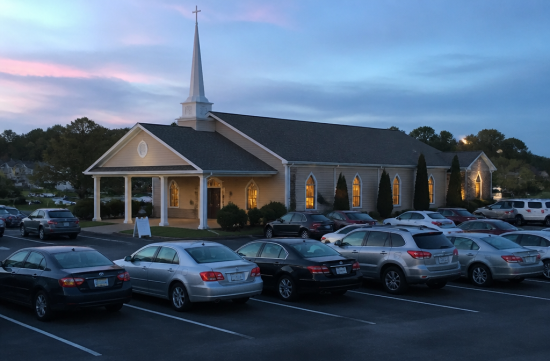
When passing by a neighborhood church parking lot on a weekday evening, you might see it filled with cars.
Looking inside, you might find not a worship service, but an alcoholics anonymous meeting, people carrying food pantry boxes, or even a polling station during election season.
So, what's the reason for this? The answer is simple: it's the most spacious and affordable place to rent in the neighborhood.
Libraries have set closing times, and city hall is completely locked on weekends, but churches are always lit up in the evenings and on weekends.
The fact that American churches serve as community centers is not coincidental; it has structural reasons.
According to a Pew Research survey, 80 percent of Americans agree that churches and religious organizations bring people together and strengthen local communities, and 78 percent say they play an important role in helping the poor and needy.
In numbers, this clearly shows support that goes beyond the realm of faith.
Whenever public budgets are cut and social welfare infrastructure thins out, it is often local churches that fill the gaps.
Personally, I find this somewhat bittersweet. I believe that the structure of churches taking on responsibilities that the government should handle is not a true solution, not because of a dislike for religion.
However, for those in immediate need, having a meal today or a place to sleep tonight takes precedence over such logic.
I believe that the safety net that should be filled by public budgets should be the government's responsibility, while churches should complement that role. If the order is reversed as it is now, it will be harder to revert later.
So, what about Korean churches?
Research on Korean immigrants categorizes the functions of Korean churches into four main areas: fellowship among compatriots, preservation of Korean culture and language, practical assistance for congregants and the local Korean community, and providing social status and roles that are hard to obtain in immigrant life.
In fact, if you look at the bulletin boards of Korean churches, you'll often find rental information, job listings, and school district information posted more frequently than worship schedules.
Picking up newly immigrated families at the airport and helping them obtain a driver's license or social security card is still a common sight at Korean churches.
Pew Research data shows that 59 percent of Korean Americans identify as Christians, which is a much higher percentage than in South Korea. This suggests that religious communities operate more tightly in immigrant societies.
However, there is a crucial difference from mainstream American churches. While American churches tend to open their doors to embrace the entire neighborhood, Korean churches still seem more accustomed to looking after their own.
There are language barriers and emotional differences between the first and second generations, which contribute to this situation.
English and Korean worship services are often scheduled at completely different times, and it is common for the younger generation to leave their parents' church as they grow up, moving to English-speaking churches or other communities. As generations change, the shape of the community within Korean churches is also gradually evolving.
Still, from a perspective that values diversity and openness, I hope that Korean churches can take a step beyond being a boundary for Koreans only and move towards sharing space with the entire local community.
Some Korean churches have already begun sharing their buildings with local non-profits or other immigrant communities. During the week, instead of Korean language schools, they might host after-school programs for local low-income children or offer their auditoriums to other language immigrant groups. If such initiatives increase, Korean churches could become true community centers, as their name suggests.
Whether one is religious or not, having even one more space that opens its doors to the neighborhood unconditionally benefits everyone in the end.


 lavender |
 logger |
 Conflite Teacher |
 Unknown Dog Walk blog |
 Khan Film Blog Production |
 DelphiaMo |
 Texas Migration Story |
 Good World Good Thoughts |
 Pennsylvania Information News |
 festive |
  You Turn Me On |
  Supplemental Security Income (SSI) Information |
  Sams Market |
  ansdal |
  VVV 80 |
  BIODOCTOR NEWS |
  Gold Bar |
  Tamfa Fan |
  Jenny's Mom blog |
  Karina's Blog |
  Best Frozen Yogurt |
  Victory 1988 |
  Coding Elf |
  Infinite Style |
  Mr Cleveland |
  Sugar Cream Door Bulletproof Noodles |
  novapixel |
  macan 08 |