
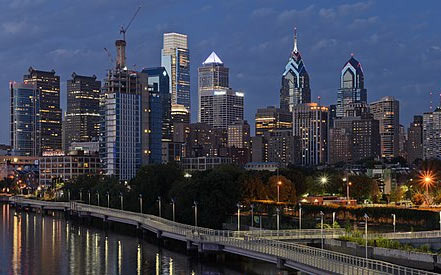
Philadelphia has a total area of about 142.7 square miles (369.6 km²), of which 134.28 square miles (347.6 km²) is land, and the remaining 8.42 square miles (21.79 km²) is water. The Delaware River and Schuylkill River flow through the city center, naturally dividing the city into east and west.
As of 2023, Philadelphia's estimated population is about 1.57 million, making it the 6th largest city in the United States. It has a larger population than New York, Los Angeles, Chicago, Houston, and Phoenix. However, due to its relatively small area, the population density is very high. The average population density is about 11,700 people per square mile (approximately 4,500 people/km²), making it one of the most densely populated metropolitan areas in the U.S. after New York City. This results in a vibrant atmosphere throughout the city, with a rich flow of people and culture on every street.
Geographically, Philadelphia is in a very strategic location. To the east, it borders New Jersey across the Delaware River, to the west is Montgomery County, to the north is Bucks County, and to the south is Delaware County. This provides excellent transportation, logistics, and business connectivity, serving as a central axis in the Eastern Megacity Belt located between New York and Washington D.C. In fact, the well-developed highway and rail networks make it easy to travel to New York, Baltimore, and D.C. within a day.
While Philadelphia is classified as a medium-sized city in terms of size, its influence is greater than its scale. As the birthplace of American independence and the city where the Constitution was established, it holds significant political symbolism, and is home to world-class educational institutions such as the University of Pennsylvania, Temple University, and Drexel University. This results in a young population and a vibrant ecosystem of innovative startups and research-driven industries.
Economically, Philadelphia has a balanced development of healthcare, finance, education, and technology industries. The industrial areas along the river are naturally connected to the downtown business district, and recently, the area known as University City, referred to as an 'innovation hub', has rapidly grown, emerging as a new economic center.
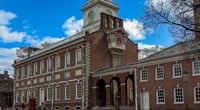
Culturally, Philadelphia offers a variety of sites from historical landmarks symbolizing the founding of the United States, such as Independence Hall and the Liberty Bell, to artistic spaces like the Philadelphia Museum of Art, the Rocky Steps, and the Kimmel Center. These elements combine to make Philadelphia feel like a vast history textbook and cultural museum.
In summary, Philadelphia may not be large in size, but its significance and vibrancy are densely packed within the city. Although the population density is high, it is a place full of energy and opportunities. The city perfectly embodies the phrase "compact yet powerful city." Philadelphia is not just a city in Pennsylvania; it is a 'heart' that carries the history of the United States and moves towards the future.





 Nationally Certified Lightning Charcoal Review |
 Northeastern |
 sparkling |
  Pennsylvania Information News |
 U.S. Weather Bureau News |
  Tonky |
  viroma |
  cookie |
  Live and that's it |
  Alright Twain |
  eatontown blog |
  HAWAII Korean Church News |
  Amore |
  linex |
  Balancework |
  laro90 |
  MEDBIO American Doctor Blog |
  SWAT TEAM BLK |
  DREAM BIG |
  frostbite |
  330 Forever My Love |
  El Dorado |
  dralix58 |
  Gorama Round |
  Skydiving |