


I paused while searching for my polling place on my phone, lying on the sofa. I found out that my polling place is in the basement hall of a local church.
Even though I've been going to the same place for years, I suddenly became curious today. Why a church, of all places?
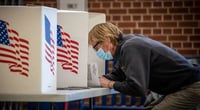
Today, November 1st, is the last day for early voting in New York. Tomorrow, Monday, the polling places will be closed, and the main voting will take place on Tuesday, November 3rd, from 6 AM to 9 PM.
This time, we are voting for the governor, the state comptroller, and the attorney general, along with five local propositions. It's quite an important lineup that gets your attention.
So, I decided to dig into the topic of polling places while still wrapped in my blanket. There turned out to be a surprisingly interesting history behind it.
First, let's look at the numbers. According to a report from the U.S. Election Assistance Commission (EAC), there were over 94,000 polling places used during the 2022 midterm elections.
Of those, less than 1% were in election office buildings. The rest were borrowed from other buildings like schools, churches, and community centers.
The reason is simple. Elections happen once or twice a year for just a day or two, so building a dedicated structure for that is considered wasteful.
I wouldn't want to have a room that I only use for one day a year either. My room is mostly a storage space aside from the bed, after all.
So, the question is which buildings to borrow. The priority is to find a place that local residents know, is spacious, and is easily accessible for wheelchairs.
Places that fit those criteria include school auditoriums, church fellowship halls, and fire station garages. There's usually at least one of these in every neighborhood.
New York's laws also provide a hint. Section 4-104 of the election law states that buildings exempt from taxes should be used as polling places whenever possible if they are in the same election district or adjacent districts.
Churches are typical tax-exempt buildings. So, it's no coincidence that churches frequently appear on polling place lists.
The same goes for public schools. When the election commission designates a school as a polling place, there are regulations requiring the school to provide space for voting.
Of course, parents have concerns too. There have been several proposals in the New York State Legislature suggesting that schools should be allowed to refuse to be polling places due to the anxiety of outsiders entering during class.
Looking at the list of early voting locations from past elections in Albany County, names like Lutheran church halls, Greek Orthodox churches, and local volunteer fire department buildings were mixed in. It felt like a miniature version of American polling places.
So, what about private homes? This was surprising, but there were actually neighborhoods where voting took place in someone's garage or living room.
According to a 2006 NPR report, there were several instances in the LA area where residents used their garages or game rooms as polling places in neighborhoods without public buildings. There were even ice rinks and beach lifeguard stations.
Then, LA County bundled polling places, including garages and living rooms, into large vote centers around the time of the 2020 primary elections. I haven't checked how many homes still serve as polling places these days.
Honestly, I felt a bit envious at the thought of lining up to vote in someone else's garage. It would be like casually walking next door in slippers. It gives the impression that the homeowner might offer cookies after voting.
If we go further back in history, it gets even more interesting. In 19th century America, it was common for saloons to serve as polling places.
Historian Richard Bensel wrote that voting took place in urban saloons and rural shacks, and the location itself influenced the results. There were even instances where parties would buy drinks in exchange for votes.
Secret ballots became established in the U.S. starting in the late 1880s. Before that, voting was done in a way where everyone could see who voted for whom.
This raises another question. Does voting in a church or school influence voter sentiment?
A study by Stanford researchers published in PNAS in 2008 addressed this. Analyzing the 2000 Arizona election, they found that people who voted in schools were more likely to support a sales tax increase for education funding.
Even accounting for political leanings and demographic characteristics, there were still differences. The researchers suggested that church polling places might have a similar effect, but this was more of a speculation from interviews than data from the study.
So, there are arguments that church polling places pose a separation of church and state issue, while others argue that there are no suitable alternatives for such spaces. Personally, I think both sides have valid points.
However, considering that there aren't many large buildings in the neighborhood, it would be practically difficult to exclude churches. Instead, I hope that within polling places, efforts are made to minimize religious influences.
Ultimately, American polling places operate on a structure where the community temporarily lends space. Schools provide auditoriums, churches offer fellowship halls, and some homes provide garages.
Thinking about it this way made the walk to the church basement hall feel a bit less bothersome. If you miss early voting, be sure to check the polling place location for Tuesday.
For now, I'll lie back down and set my alarm for Tuesday morning. I'll think about what to order for food after voting then.
 MoonBunnyRun
 MagicOcean


 hot chocolate |

 Chichiki Chicago Train |
 Noodle Noodle |
 Twist Kim |
 U.S. Weather Bureau News |
 Tan Zoo |
 seadoll |

 Tennis City |
 Gold Bar |
 Day by day |
 ssome |
 skykong |
 Shining Our Own World |
 gardener 007 |
 golfmaster |
 Nanana Nanana Nanana |
 Who's watching? |
 endone |
 RockStar |
 Casa Mia |
 You Only Live Once |
 Hardworking CPA |
 Joyce 77 |
 Runner Kim |
 My Town My Way Blog |
 My Miami Stories |
 Entip |
 Tony Park |
 DJ DC BLOG |