
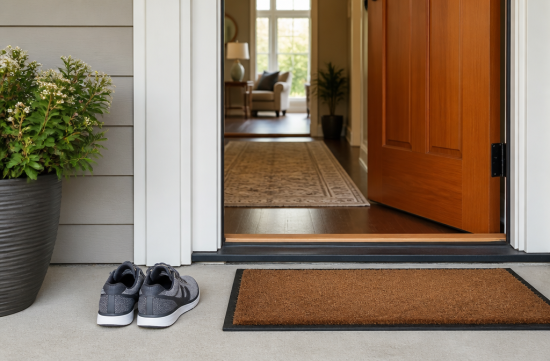
A friend who recently moved to the U.S. asked me with a curious expression after attending a housewarming party. Isn't it strange that everyone walks around the living room with their shoes on?
In fact, this question is something that any Korean who has lived in the U.S. might have pondered at least once. The scene of entering a carpeted living room with sneakers on makes everyone flinch at first. It can be confusing whether it's a matter of etiquette or just a cultural norm.
Upon researching, I found that it's not about being rude, but rather a difference in lifestyle that has developed historically.
In Korea, Japan, and China, sitting and lying on the floor has been the norm for a long time. Historical records indicate that in ancient China during the Zhou Dynasty, it was customary to take off shoes in front of elders, and this culture of eating and sleeping on the floor continued, making the floor an integral part of living space. It would have been hard to imagine walking in with shoes that had dirt from outside.
Interestingly, after the fall of the Han Dynasty in China, the introduction of high tables and chairs through northern tribes caused a temporary shift away from floor living. However, in Korea and Japan, the unique heating methods of ondol and tatami allowed floor-centered living to continue for much longer. Ultimately, the habit of taking off shoes was more about how the floor of the house was used rather than a matter of religion or etiquette.
In contrast, the situation in the West was different. Since the Roman era, a lifestyle using chairs and beds became established among the upper class, and the floor was not a place to sit or lie down, but merely a passageway. Since there was no need to live with one's body against the floor, the urgency to take off shoes was naturally less.
Additionally, the unique living environment in the U.S. played a role. As a country where traveling by car is the norm, it's not common to walk through muddy paths in front of homes. It's typical to get out of the garage and take just a few steps to the front door, and most roads are well-paved. There's an interpretation that the opportunity for shoes to get dirty is relatively low, so the rule of having to take them off didn't necessarily develop.
The way floors are maintained likely contributed as well. Western-style carpets have traditionally been managed by sweeping and beating them, and with the introduction of vacuum cleaners, an environment where wearing shoes doesn't leave noticeable marks naturally took hold. Since it's not a floor where one sits barefoot, the standards for cleaning were fundamentally different.
That said, not all Americans live with their shoes on. In a 2022 survey conducted by CBS and YouGov, 63 percent of Americans reported that they take off their shoes at home. However, only 24 percent requested guests to do the same. This means that while they may take them off in their own homes, they don't impose that on others. In a 2018 YouGov survey, 31 percent said they always take them off, but when combining those who said they take them off at least sometimes, the number reached 87 percent.
Looking at the numbers, there isn't a single conclusion. Contrary to the notion that America is a country where shoes are always worn, it seems more accurate to view it as a culture that leaves the decision up to personal preference indoors. Rather than imposing rules on guests, the attitude is to let everyone do what's comfortable for them, which aligns with a mindset that respects individual choices.
Ultimately, whether to take off shoes or not seems to be less about etiquette and more about how people have lived on the type of floor in their homes. The statistics alone reveal that there isn't a definitive answer.
In such matters, I believe it's important to consider both sides rather than taking one side. One side values hygiene, while the other values freedom, and neither choice is wrong.







 logger |
 Conflite Teacher |
 Unknown Dog Walk blog |
 Khan Film Blog Production |
 Yoyma |
  Dragon Lee |
 Blondee |
 Website Design Artisan |

 colo colo |
  U.S. Weather Bureau News |
  American Food Information & Calories |
  zephyrs |
  ness 6 |
  Montgomery Mom |
  SteelOrbit |
  Puddle Puddle |
  Arizona Cowboy |
  macaronpop |
  marydock |
  peachpanda |
  U.S. College Admission Information |
  Fruitop |
  Exploring American Life Information |
  sing sing |
  ORAVEZIN Oppa |
  Lego My Ego |