
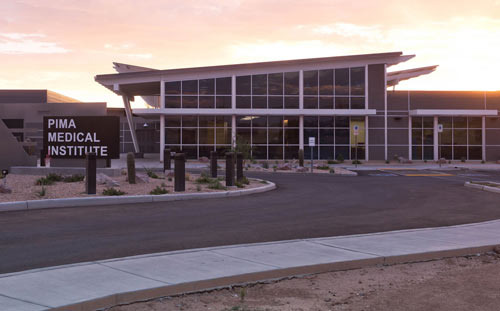
Tucson has well-established vocational training institutions where you can earn practical degrees and certifications in addition to four-year colleges.
These institutions serve as very realistic alternatives for those looking to quickly enter the job market or immigrants considering a career change.
The most notable of these is the Pima Medical Institute.
This institution is a healthcare vocational training provider with several campuses across the country, including Tucson. Rather than focusing on academic theory like a four-year college, it offers intensive practical training that can be applied directly in the field. Programs are available for high-demand healthcare professions in the U.S., such as radiologic technologist, respiratory therapist, veterinary technician, medical assistant, and dental assistant.
One of the biggest advantages of this institution is that its programs are typically structured as short-term courses lasting around two years, allowing for a quick entry into the job market. It provides a very practical and efficient pathway for those who want to start a career in healthcare in the U.S. but find the time and cost of a four-year degree burdensome.
Additionally, there are educational institutions that focus on adult learners and working professionals. Notably, the University of Phoenix Tucson campus offers online and hybrid education, and institutions like Western International University, which previously focused on adult education, have played a role in the adult education market in Arizona (for reference, Western International University officially closed in 2019, and its records and transcript services are now managed by the University of Phoenix).
These vocational training institutions are very useful within the immigrant community, alongside the public educational institution Pima Community College. For immigrants, they provide an excellent stepping stone, starting with ESL programs to improve English skills and allowing them to earn local certifications and degrees, which are essential for employment in the U.S.
When considering settling and working in the U.S., it is not necessary to insist on a diploma from a well-known large university.
Finding a practical educational path that allows for the quickest economic independence based on one's current situation is what matters most.
 ChickenNap
 NyaNyaNya







 Way to easy |
 Magic Cabbage School of Martial Arts |
 Vacation on Hawaii |
 morvex37 |
 Ari Songhan American Immigration Life |
  Arizona Cowboy |
 Project Tomorrow |
 Who's watching? |
  Sunshine Blog |
  Minnesota Small Business |
  Strawberry Pancake Warrior |
  amolayo |
  korvon |
  Que Buena |
  virexo |
  silverpath |
  Komet Park |
  reliable |
  vexo90 |
  As Always Today |
  veltar87 |
  United States National Administrative Organization Stories |
  springwaltz |
  dense |
  Tiger Milk Foam Research Institute |
  Oreore Mushroom |
  optimistic |
  Good Good |