

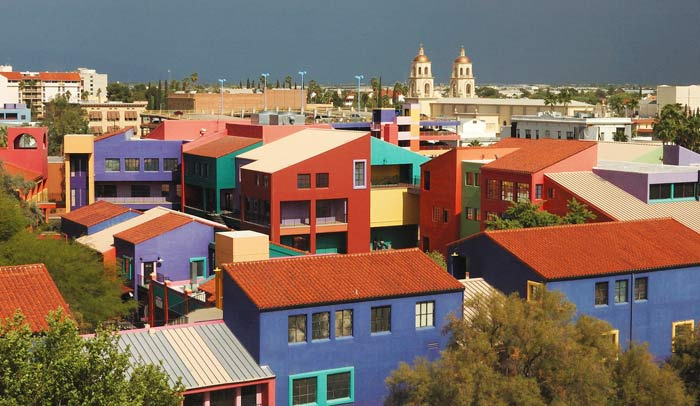
When you visit Tucson, Arizona, you can encounter a unique residential landscape that is hard to find in other American cities.
These are homes that boast colorful hues and exotic structures, and just looking at the scenery in this photo instantly conveys the uniqueness of Tucson. The sight of buildings painted in various primary colors like purple, red, yellow, and green gives the feeling of stepping into a village from a painting. It is definitely a landscape that stands out from the monotonous color schemes of homes commonly seen in American cities.
This sense of color comes from Tucson's history and geographical background.
Tucson is located just 98 km from the Mexican border, making it a city strongly influenced by Mexican and Latin cultures. Therefore, elements of Spanish colonial and Mexican styles are vividly reflected in its architecture and color schemes. The typical Spanish-Mexican architectural style is shown in the way buildings are painted in bright colors with red tiles on the roofs. This matches well with the climate of the desert city, where the brightly colored buildings shine more vividly under the hot sun, exuding a unique charm.
The reason Tucson's buildings are so colorful is not just for aesthetic effect but also as a way to express community identity.
When homes and shops in the city center are painted in bright colors, visitors to the city immediately get the impression that "this place is special." In fact, Tucson was designated as a 'Creative City of Gastronomy' by UNESCO in 2015, showcasing its unique urban identity, and the colors of these buildings can be seen as symbols of the city's cultural diversity.
This housing structure and color scheme not only make the urban landscape vibrant and warm but also impact the lives of the residents.
Living in a brightly colored home rather than a monotonous apartment can psychologically invigorate individuals and promote active interactions among neighbors. In fact, in Tucson's residential areas, residents actively participate in decorating their front yards and streets, hanging small artworks, transforming the city into a 'living cultural space' beyond just a simple residential area.
There are also distinctive features in the architectural style. While many homes have straight and simple shapes, elements like windows, doors, and balconies incorporate curves or unique colors, preventing them from being dull. The wisdom of having thick walls and small windows to keep the interior cool in the desert climate is also evident. This structure can be seen as a result of the blending of O'odham indigenous culture and the architectural heritage left by Spanish missionaries.
The colorful buildings of Tucson are also very popular among tourists. Since it is a landscape hard to find in other American cities, travelers take photos and share the "unique colors of Tucson" on social media. Especially at sunset, when the desert sky turns red, the scene created by the brightly colored buildings blending with the background is truly impressive.
The homes and buildings of Tucson serve as a canvas expressing the city's identity and culture, going beyond mere living spaces. Unlike the typical gray urban centers of America, Tucson reveals its personality through colors and forms influenced by Mexico and Spain, infusing vitality into people's lives.
Visitors to Tucson often express their amazement, saying, "It's surprising to find such a colorful village in the desert."






 moo moo |
 ultron78 |
 garlic bread |
 Sugar Cream Door Bulletproof Noodles |
 urbanmint |
 Who's watching? |

 AZ Road Master |

 US Embassy |
  Korean Mom |
  My NYC |
  Mr Oh |
  forevergee |
  festival |
  manchester |
  constant |
  Leapfrog Move |
  vibranto |
  Tora Tora |
  yellowbutter |
  Dolly |
  NYC saladbar |
  Finding Superfoods |
  lightyear |
  song bang |
  vexomo |
  Indiana Jones |