
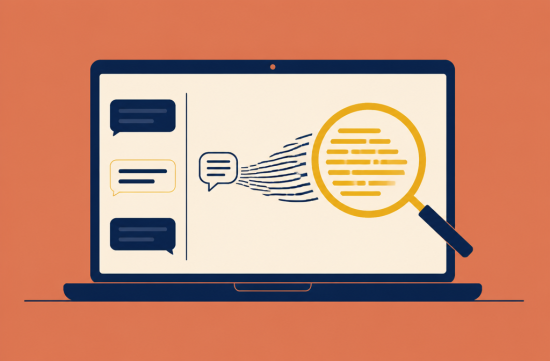
Have you been receiving emails like this after submitting your application? "Please click the link to schedule your interview at your convenience." When you open it, you find it's not a person but an AI interviewer.
I experienced this for the first time last year. The questions appear on the screen, you think for 30 seconds, and then you have to answer within 2 minutes. Honestly, I felt a bit empty afterward.
So this time, I organized my thoughts not just qualitatively but quantitatively. What exactly does AI look for in a first interview, and what should we prepare for?
First, let's talk about the scale. Resume.org surveyed 1,399 American workers in August 2025, and 57% reported that their companies use AI in hiring.
It's worth noting that this survey was answered by employees who are aware of their company's hiring practices, so it's not official company statistics. Still, it's enough to understand the trend.
Among them, 34% said they use AI even in the interview stage. While this is lower than the 79% for resume screening, it's still a significant number.
Companies that use AI in interviews also shared what they actually do. Language analysis of responses was at 66%, transcription at 65%, and evaluation of tone and body language at 59%.
About half of the companies allow AI to conduct the interview itself. Only 6% fully delegate the process to AI from start to finish.
Doesn't that 6% seem smaller than expected? It means that for the most part, AI filters candidates first, and humans make the final decision.
So where do the real scores come from beyond the screen? A hint can be found in the case of HireVue, a leading company in the industry.
In January 2021, HireVue announced that it would remove facial analysis from its evaluations. The reason is impressive. With advancements in natural language processing, the "content of speech" has become much more predictive, and facial expression analysis was deemed less meaningful.
Of course, there was significant criticism and pressure from the FTC. Nevertheless, the direction is clear. What AI focuses on the most is the text of the responses rather than facial expressions.
My own failure story reflects this. I focused on lighting, practiced smiling, and adjusted the camera angle. In reality, my answers were long-winded and disorganized, resulting in a quick rejection.
So for my second attempt, I changed my strategy. I directly addressed the question keywords in my first sentence.
I structured my answers in a brief sequence: situation, action taken, and result. This is commonly known as the STAR method. I made sure to include numbers like timeframes or percentages in my results.
I also naturally incorporated skill words from the job description into my experiences. If the transcript is left as text, the specific words that are highlighted become important.
And I didn't try to fill the full 2 minutes. I aimed to finish the key points in a minute and a half. Surprisingly, this was the most effective approach.
To be fair, I should mention the other side. Gartner surveyed 3,290 applicants in the fourth quarter of 2024, and 39% reported using AI in the application process.
In a second-quarter survey in 2025, 6% admitted to having someone else interview on their behalf or having done so for someone else. Gartner even projected that by 2028, one in four applicant profiles will be fake.
This is why companies are incorporating identity verification and fraud detection into AI interviews. Reading responses from ChatGPT off-screen is more noticeable than you might think. The gaze and tone suddenly shift to a more formal style.
Interestingly, there's the issue of trust. In a survey released by Gartner in July 2025, only 26% of applicants believed that AI would evaluate them fairly.
I can relate to this. Applicants have no way of knowing what data the algorithms were trained on.
For English speakers with accents, especially Korean immigrants, this can be even more anxiety-inducing.
So, there are rights to be aware of. Illinois has been implementing the AI Video Interview Law since January 2020. Companies must inform candidates about the use of AI and the evaluation methods in advance and obtain consent.
If requested by the applicant, companies must delete the video within 30 days. Not all states have such laws, so it's a good idea to check the regulations in your state.
If you have a disability, you can request reasonable accommodations during the hiring process under the ADA. You can ask for things like captions, extended time, or a human interviewer instead.
Lastly, just one point about the environment. Compared to the days of driving an hour round trip for an interview, carbon emissions are definitely lower. I see this as one of the few advantages of AI interviews.
One more thing. Among the respondents of the earlier Resume.org survey, 62% believed that by the end of 2026, AI would likely take over the entire hiring process. This means there's no harm in practicing now.
In summary, AI looks at the structure and words of your speech rather than your facial expressions, and the final decision is still made by humans.
If I were you, I would spend less time preparing my appearance in front of the camera and instead record myself saying five answers out loud. That would be the most effective practice.
How was your experience with AI interviews? I can't be the only one who was confused at first, right?
 SteveRespect






 Tonky |
 My NYC |
 coloradoman |
 Living Economy Information Blog |
 Tomato Health Club blog |
 TOTO Together |
 Arizona Cowboy |
 Who's watching? |

 skyblue |
  Project Tomorrow |
  apricotla |
  Soy Angelino |
  nati8 |
  NE Hodori Preik |
  washington mom |
  celtics |
  Balancework |
  round1 |
  Way to easy |
  musicque |
  road98 |
  Churros Train Conductor |
  gleeful |
  Burbank Lee |
  Olivia's Blog |
  Bushing Around Life |
  Active |
  Cherokee Rose |