
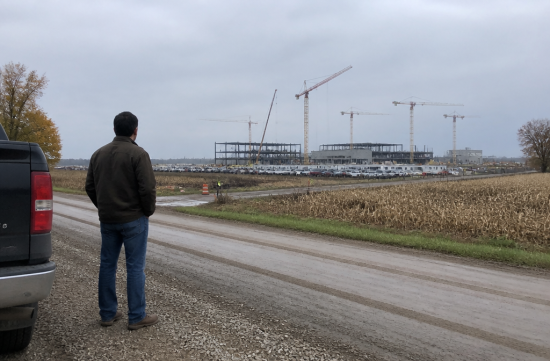
As you drive east toward New Albany in Columbus, you can still see the massive cranes. However, when talking to locals these days, the first question is almost always the same: "When is the Intel factory going to be operational?"
To get straight to the point, the factory's operations have been pushed back to the early 2030s. That said, the conversation about jobs in Columbus is far from over. Today, let's take a step-by-step look at the confirmed numbers.
First, let's start from the beginning. Intel announced the Ohio One project in January 2022, with an initial investment of $20 billion. At that time, the promise was to employ 3,000 Intel staff and 7,000 construction workers.
The first production target was set for 2025. However, that was pushed back to the end of 2026 in February 2024.
Then, in February 2025, it was delayed again. The first fab (Mod 1) is now expected to be completed in 2030, with operations starting in 2030-2031. The second fab (Mod 2) is targeted for completion in 2031, with operations in 2032.
This means it is over five years later than the original plan. Honestly, the numbers are quite surprising.
Intel cited the need to adjust production timelines based on market demand. The media has also mentioned the slowdown in semiconductor demand and delays in the execution of CHIPS Act subsidies.
In July 2025, Intel announced that it would further slow down construction in Ohio as part of a restructuring process. At the same time, Intel was undergoing a global workforce reduction of 15%.
So, how many people are currently on-site? According to the annual report submitted to the state government, there were 162 Intel employees at this site by the end of 2025. This is a far cry from the promised 3,000.
The construction site is similar. Earlier this year, a site manager reported that hundreds of skilled workers are still on the job. However, compared to the goal of 7,000 workers throughout the entire construction period, the perception is understandably different.
Still, the money hasn't stopped flowing. According to the same report, Intel spent over $1.5 billion in Ohio in 2025. However, this was a decrease compared to the previous year.
The number of suppliers has actually increased. Intel's suppliers in Ohio have steadily grown since the initial announcement, now exceeding 300.
Many are curious about state government subsidies. Ohio has signed an onshoring grant agreement with Intel worth at least $600 million.
This grant comes with conditions. By December 31, 2028, Intel must create 3,000 jobs, achieve a total annual payroll of $405 million, and invest over $20 billion in fixed assets.
Given the current timeline, it seems realistically difficult to fill 3,000 positions by 2028. However, the governor's office has stated that they would only claw back the funds if Intel completely abandons the project.
On the other hand, the job creation tax credit has a different structure. If the target is not met, the benefits will not be fully received.
This aspect is what I find most disappointing. The approach of requiring significant tax payments before results are achieved places the risk on taxpayers if the company changes its plans. This serves as a reminder that it is difficult for the government to accelerate the pace set by the market with money.
So, is the job outlook in Columbus bleak? Not necessarily. While it may seem frustrating to focus solely on Intel, other opportunities are emerging.
A prime example is Anduril's Arsenal-1. This defense manufacturing campus is being built on a 500-acre site near Rickenbacker Airport.
According to an agreement with the state government, Anduril has committed to creating 4,008 jobs by 2035. This is the largest employment promise for a single project in Ohio's history.
The pace is also in stark contrast to Intel's. The first Ohio-made Fury aircraft rolled off the production line in July 2026. The production of Fury itself began three months ahead of schedule in March.
Of course, the 4,008 jobs are still just a promise. Since this is a ten-year goal, we will need to monitor how many are actually hired year by year.
If you are job hunting, how should you approach it? I would recommend looking at the more than 300 suppliers and construction and equipment sectors rather than waiting solely for Intel's headquarters to hire.
Technical positions such as electrical, plumbing, HVAC, and cleanroom facilities will still require consistent staffing, even if construction slows down. Short-term courses related to semiconductors and manufacturing at places like Columbus State Community College are also worth checking out.
In the defense sector, it's important to pay attention to the requirements. Depending on the position, U.S. citizenship or security clearance may be necessary, so be sure to read the job postings carefully.
I'll briefly touch on real estate as well. Many remember the excitement surrounding real estate in Licking County right after the announcement in 2022. Now that the factory's operations have been pushed to the 2030s, I believe it is risky to make investment decisions based solely on the "Intel effect."
It is essential to verify the official timelines provided by the company against the actual employment numbers. Intel submits its annual report to the state government around February or March each year, so you can use those numbers as a basis for your judgment.
In summary, the Intel factory has been delayed but is not canceled, and other manufacturing jobs are coming to Columbus.
It's wise to lower expectations but start preparing now. Trust the actual job postings and report numbers rather than just the company's announcements.
 BusanYeocha







 loran |

 DeArizona Blog |

 Swift Falcon |
 Tonky |

 My NYC |
 Ohio Ohayoung Hello |

 constant |

 U.S. Weather Bureau News |

 rigid |

 lumbus |
 Real Estate |
 Forest Gump |
 Real Estate Investment Korean American |
 Dollydori, Lover of Movies |
 dmzline |
 travelo |
 American Food Information & Calories |
 Splendid Mission |
 sparklingo |
 Watch Walker |
 Soy Angelino |
 autumn |
 K-POP TV News |
 cortiva6 |
 Nevada Teppanyaki |
 aerion99 |
 Golado |
 Maximum Pro |
 Joyce blog |
 Atlanta Business Information |