
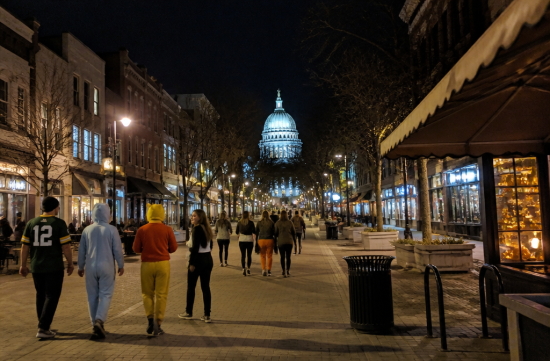
Walking down State Street at the end of October feels strangely quiet. You can still see students in costumes, but there are no fences blocking the road, no entrance gates, and no stage.
Just a few years ago, this street was a massive outdoor venue every Halloween weekend. It was called Freakfest.
However, this festival has quietly disappeared. I followed the records to find out why.
It all started in the late 1970s. On Halloween night in 1977, students are said to have spontaneously thrown a street party.
After that, the Wisconsin Student Association sponsored this party as a fundraising event from 1979 to 1988. Initially, it was a modest neighborhood celebration typical of a college town.
The problem was the scale. As the crowd grew, so did the alcohol and chaos, and by the early 2000s, it reached riot levels.
From 2002 to 2005, similar scenes repeated every year. Crowds would break shop windows and throw objects, prompting police to disperse them with pepper spray and tear gas.
The day after Halloween in 2004, then-Mayor Dave Cieslewicz held a press conference and stated that it was time to stop. The idea of completely eliminating the party was even put on the table.
Still, in 2005, an estimated 100,000 people showed up, and some even shouted for tear gas. Honestly, it was a bit absurd at that point.
The solution that emerged was the 2006 Freakfest. The city put up fences on State Street, booked bands, and started charging admission.
They transformed a chaotic street party into a managed paid event. Instead of eliminating the problems, they changed the structure, which I think was quite a clever idea.
The effects were immediate. That year, it was reported that there was no need to use pepper spray.
However, the costs were significant. In 2006, the total law enforcement costs amounted to $763,722, with the Madison Police Department's direct costs alone being $376,900.
It was reported that over 400 officers from five agencies were deployed that year. It's astonishing to think that this much manpower was dedicated to a single festival.
Starting in 2007, local event planning company Frank Productions partnered with the city to manage the music program. The structure was such that ticket sales and sponsorship revenue helped cover some of the city's costs.
Admission prices gradually increased. In 2007, advance tickets were $5, and by 2012, they were $8 if purchased by Friday and $12 on the day of the event.
Freakfest was held in 2019 as well. The city announced that hundreds of police officers and over 100 private security personnel would be deployed.
According to an AP report, by 1:30 AM that day, there had been two arrests. The fact that the street of riots had become this quiet is a clear achievement.
However, that was the last one. In 2020 and 2021, it was canceled due to COVID-19.
It was also canceled in 2022, but this time the reason was different. The organizers cited difficulties in gathering funds and support for the event, not COVID.
The city's Parks Department explained that Freakfest had already been on a decline before the pandemic. A decrease in attendance, high public costs, and a lack of interest from planners all contributed to this decline.
Michael Verveer, a city council member who has long represented the downtown area, stated that it is likely that the Freakfest event has come to an end. The event did not take place in 2023 either.
Deputy Mayor Reuben Shapiro also mentioned that the city has been trying to distance itself from this event for a long time. Essentially, the city has stepped back from it.
As far as I could find, there has been no official announcement of a revival since then. There has been no news of Freakfest from the city this year either.
In summary, Freakfest was a management mechanism created to prevent riots, and it achieved its purpose.
As the crisis faded, the justification for deploying hundreds of police officers and spending large budgets each year weakened. The pandemic gap was merely a catalyst that broke that trend.
There are voices of regret. A student newspaper suggested that eliminating the official festival won't eliminate drinking culture, and it could actually make management more difficult.
I see merit in both arguments. However, I believe that having hundreds of police officers on duty for one night funded by taxpayer money could not last forever.
It is natural for tools of one era to fade away once they have solved the problems of that time. I think Freakfest was just such a fate.
This Halloween, I plan to walk slowly down State Street without fences. I want to feel that quiet among the students in costumes. That quiet itself is the result of a problem that this city has grappled with for nearly 20 years.
 LatteMorning






 Twist Kim |
 U.S. Weather Bureau News |

 Community Cross |
 Conflite Teacher |

 SEVEN SEVEN |

 Superman Cat Blog |
 Wiscon Shin Blog |
 My Love Bambino Alaview |


 Where is a really nice neighborhood? |
 Real Estate |
 Forest Gump |
 Real Estate Investment Korean American |
 Dollydori, Lover of Movies |
 dmzline |
 travelo |
 American Food Information & Calories |
 Splendid Mission |
 sparklingo |
 Watch Walker |
 Soy Angelino |
 autumn |
 K-POP TV News |
 cortiva6 |
 Nevada Teppanyaki |
 aerion99 |
 Golado |
 Maximum Pro |
 Joyce blog |