

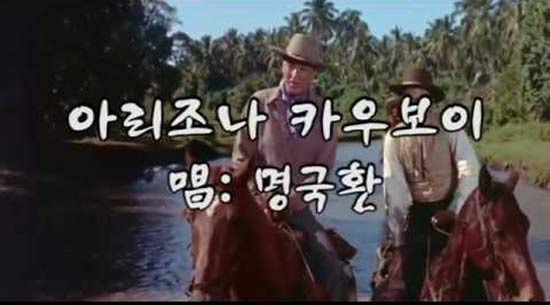
Cowboy Arizona CowboyRunning through the wilderness, Arizona CowboyWith a whip in hand, the stagecoach rushes onWhen the sound of the Indian drum echoes from afarLonging for the girl at the tavern over the hillRun, stagecoach, Arizona CowboyCowboy Arizona CowboyRunning through the wilderness, Arizona CowboyUnder the cracking whip, the stagecoach rushes onAs the twilight deepens over the blue horizonThe green fields are lonely like a crescent moonRun, stagecoach, Arizona Cowboy
This is a song that I remember because my father used to sing it whenever he was pleasantly drunk.
It was the song 'Arizona Cowboy' by Myung Guk-hwan.
Back then, in our living room or yard, when my father raised his glass and his voice grew stronger, this song would always come out. Looking back now, the name Arizona and the image of a cowboy might have represented something beyond a simple background for my father—perhaps freedom, romance, and an idealistic vision.
This song holds a rather unique position in the landscape of Korean pop music from the 1970s. The title itself is telling. It features the name 'Arizona,' which seems completely unrelated to Korean soil, and the cowboy, a symbolic figure of the Western frontier, takes the lead in the song.
At that time, Korean society was rapidly changing due to industrialization and urbanization, and for many, the cowboy from Western films was an icon that depicted freedom and adventure that could not be felt in reality.
This was likely why my father loved this song. While pouring drinks in the midst of a hard life, singing the lyrics "Arizona Cowboy" allowed him to momentarily set down the weight and fatigue of reality.
For my father's generation, the vast landscapes of the American West, which were both unfamiliar and an object of longing, and the image of cowboys riding freely must have felt like a sense of liberation.
When reflecting on the lyrics, the wilderness, desert, and the image of riding a horse can all be seen as metaphors for unbounded freedom. Moreover, the rugged charm of the cowboy, who perseveres through loneliness, likely resonated with the fathers of that time who were struggling to support their families. Perhaps my father enjoyed singing this song not just because of its lively melody, but because it allowed him to project his life and find solace.
For me, this song is not just a joyful scene associated with my father's drinking capacity. When my father sang 'Arizona Cowboy' at the top of his lungs, it seemed to carry a declaration he wanted to show his children: "I am still a dreamer." At the end of a hard and tiring day, becoming the cowboy in the song must have been his simple yet sincere joy.
As time has passed and I have grown older, approaching the age my father was when he sang, I now listen to the song from a different perspective. As a child, I found it fascinating simply because it had a fun and unfamiliar foreign name, but now I understand how special the freedom and romance in the lyrics were for my father's generation.
The late Myung Guk-hwan's 'Arizona Cowboy' is no longer just a pop song; it was a song that represented the freedom and liberation that my father's generation dreamed of, allowing them to momentarily forget reality.
The reason my father enjoyed singing that song was likely because the vast image of Arizona and the freedom of the cowboy comforted his life.







 Who's watching? |

 AZ Road Master |

 Anytime Journey |
  Mrs. Duluth |
  jaxter |
  Atlanta Mama |
  Baguette Blog |
  US Embassy |
  Korean Mom |
  My NYC |
  moo moo |
  Mr Oh |
  forevergee |
  festival |
  manchester |
  constant |
  Leapfrog Move |
  vibranto |
  Tora Tora |
  yellowbutter |
  Dolly |
  NYC saladbar |