
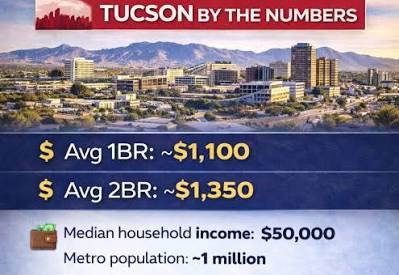
When living in Tucson, you often hear a lot about housing costs, especially regarding 'rent.'
While some find it reassuring that rent is definitely cheaper compared to major cities like Phoenix or the affluent Scottsdale, others who remember the prices from just a few years ago may feel frustrated by the recent increases. Both opinions are valid facts. Here, I will realistically summarize the current rent levels for 1-bedroom apartments in various areas of Tucson and the hidden costs that must be considered when signing a lease.
First, the average rent for a 1-bedroom apartment across Tucson is roughly between $900 and $1,300. On average, it is about $1,100.
This is significantly lower compared to the average price range of $1,300 to $1,600 for a 1-bedroom in the neighboring major city of Phoenix, making Tucson relatively less burdensome in terms of housing costs among major cities in the U.S. However, as you move deeper into the city, a clear polarization appears by area.
The most in-demand locations are near the University of Arizona (UA) campus and the Midtown area. Due to the influx of tens of thousands of students, graduate students, and researchers each year, there is often a shortage of supply, causing 1-bedroom prices in this area to typically soar to between $1,100 and $1,400.
Furthermore, in the traditional upscale residential area of Catalina Foothills, complexes with good security and excellent views often list 1-bedrooms for over $1,500 a month. In contrast, if you look towards some areas bordering downtown or South Tucson, you can find relatively affordable options in the $800 range, although they may be older, providing a wider selection overall.
One of the most commonly overlooked aspects by prospective tenants is the 'hidden maintenance costs.' Most apartment complexes in Tucson do not include utilities (water, electricity, trash collection, etc.) in the listed rental price. Especially during Arizona's notorious summer months (June to September), you must keep in mind the potential electric bill spike from running the air conditioning.
Depending on the insulation of the apartment, even a 1-bedroom can incur an additional electric bill of $100 to $200 in the summer months. Additionally, you should account for fixed expenses such as the fee for using assigned parking spaces and pet deposits and monthly pet rent if you have pets. Therefore, when looking for a place, it is wise to add at least $150 to $250 to the advertised rent to create a realistic monthly budget for total expenses.
On the other hand, if you look at the northern suburban areas like Oro Valley or Marana, the rent itself is similar to or slightly lower than Midtown, but the quality of living is much higher.
This is due to a higher proportion of newly built apartment complexes, which offer excellent interior designs and amenities like community pools and fitness centers. Even if you have to tolerate a slightly longer commute to downtown, comparing newly built complexes in the northern suburbs can be a great strategy to enhance your living satisfaction.
 PvtKim
 BlueHeart








 Balancework |
 Make My Day |
 viroma |
 eatontown blog |
 Toaster Pizza Magic Show |
  Arizona Cowboy |

 Project Tomorrow |
 Who's watching? |
  productionblog |
  What can make money? |
  Oklahoma Hoya OK |
  prixon74 |
  Roman Pan |
  USALATU BLOG |
  Sunshine Blog |
  Minnesota Small Business |
  Strawberry Pancake Warrior |
  amolayo |
  korvon |
  Que Buena |
  virexo |
  silverpath |
  Komet Park |
  reliable |
  vexo90 |
  As Always Today |
  veltar87 |
  United States National Administrative Organization Stories |