

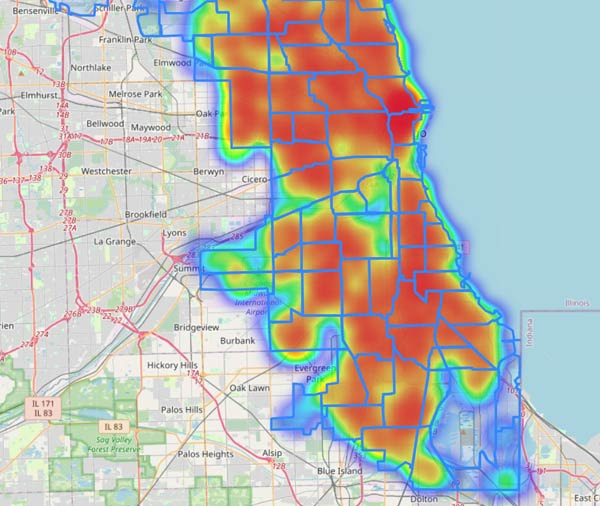
When talking about Chicago, there are always people who say, "Chicago has a lot of gun violence and the whole city is dangerous."
No, that logic suggests that there are no safe major cities in the U.S.
Chicago is certainly a city with a high rate of gun crime. This is an undeniable fact. However, the more important fact is that these crimes do not occur evenly throughout the city.
When national news reports a shooting, the word "Chicago" is often the only one that stands out.
But if you look at the actual addresses, they are mostly in specific areas.
Notably, parts of the South Side and West Side. Areas like Englewood, Austin, West Garfield Park, North Lawndale, and Roseland have recorded high crime rates for a long time. These places have been plagued by poverty, gangs, drugs, educational issues, and job shortages for decades.
Using incidents from these areas to describe the entirety of Chicago is not much different from judging all of New York based on just a part of the Bronx.
In contrast, northern areas like Lincoln Park, Lakeview, North Center, Lincoln Square, and Edison Park have a very different atmosphere.
These neighborhoods have many family residents, well-maintained parks and schools, and plenty of people out for walks.
Downtown Loop, Magnificent Mile, and Millennium Park also see a lot of tourists and workers, leading to frequent police patrols.
However, this does not mean that "it's safe, so you can go anywhere without care."
Nowadays, the crimes that require more attention in Chicago are vehicle-related crimes.
Car theft and carjacking have increased, and many of the criminals are minors, which has heightened citizens' anxiety.
Yet, there are still people who leave laptops in plain sight, shopping bags visible, and luxury bags thrown in the passenger seat.
Why do they do this? The thought of "surely no one would take it" is one of the most dangerous mindsets in America.
Your car is not a storage unit. It is not a showcase for valuables. The basic rule is to leave nothing visible when you leave your car.
Checking police crime maps before finding a home is also a good idea. Nowadays, you can easily check recent crime occurrences by just entering an address.
Additionally, looking at local communities like Nextdoor can give you insight into what actual residents are saying.
However, many people do not do this basic research. They only look at home prices and rent.
Then they say, "It's more dangerous than I thought."
No, you should have checked before signing a contract.
In the U.S., when buying a home, it's not just about the school district. Crime rates are also considered. The location of police stations is looked at as well.
Many people take a walk around the neighborhood at night. Doing this is essential to avoid regrets whether you are buying a house worth hundreds of thousands of dollars or renting for several years.
Chicago is indeed a city with safety issues.
Denying this fact is also a sign of a lack of reality.
However, saying that "the whole of Chicago is dangerous" is also far from the truth.
The city is much larger than you might think, and the atmosphere varies completely from neighborhood to neighborhood.
Today, millions of citizens go to work without incident, send their kids to school, take walks in the park, and end their day without making the news.
So when judging Chicago, look at the address, not the news headlines.
In America, a ZIP Code tells you much more than the city name. If you don't understand that difference, you will reach the simplistic conclusion that "Chicago is all dangerous," and if you understand that difference, you will find a much more realistic answer to "where should I live?"
Ultimately, in America, it's not about choosing a city; it's about choosing a neighborhood.
 iforever
 HappyHeart





 Tesla X |
 Another Eden Channel BLOG |
 Victory 1988 |
 Smile Face |
 Helpful Life Stories |
 Illinois Mom |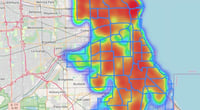
 Rice Shop Uncle BLOG |
 joyfull yang |
 Nanana Nanana Nanana |
 American General Knowledge Expert |
  Rhode Island Good People |
  Big North |
  Famous Attractions in the United States |
  Jin Soo V |
  Starbucks Reserve Roastery Closure |
  peppermint |
  Stable Co. |
  Purple Moons, |
  International Court |
  roma |
  horse |
  moodansa 77 |
  zymit |
  maplefox |
  Fun Flex Life |
  hopeful |
  Reeno |
  Coastal city |
  meonetoo |
  Winter bear |