

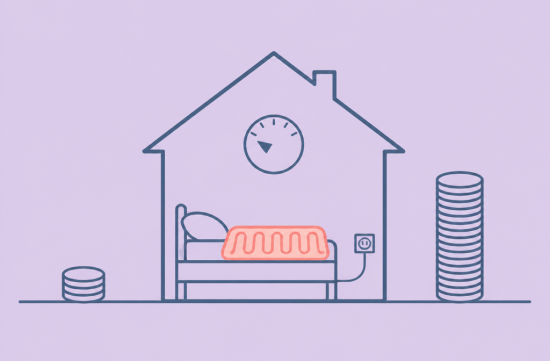
Last night, I took a stroll around the neighborhood park, and as the sun set, the air changed dramatically. I found myself thinking about this month's electricity bill as I walked with my coat collar turned up.
As soon as I got home, I had a strong urge to turn up the thermostat. However, I've been hearing a lot lately about people using an electric blanket while lowering their heating, so I decided to actually do the math this time.
My only question was whether the cost of running the electric blanket would outweigh the savings, or if it would still be a good deal.
First, I looked for some official data to use as a baseline. The U.S. Department of Energy states that lowering your thermostat by 7 to 10 degrees Fahrenheit for 8 hours a day can save you up to 10% on your heating and cooling costs annually.
The key word here is "up to." This means that the actual savings could be less depending on your home's insulation and heating method.
Also, the condition of 8 hours a day coincides perfectly with sleeping hours. That's why the method of lowering the temperature at night and relying on an electric blanket is often recommended.
Next, I looked into how much electricity an electric blanket consumes. Generally, electric blankets operate between 50 and 200 watts, while electric mattress pads use about 60 to 90 watts on a low setting.
I was surprised to find the numbers were much lower than I expected. When placed next to appliances like hair dryers or electric heaters, they seem almost negligible.
Now, I needed to factor in Maryland's electricity rates, and something interesting happened here. The U.S. Energy Information Administration initially announced that the average residential rate in Maryland for March 2026 would be 35 cents per kWh, but later corrected it to 22.2 cents.
The Maryland Public Service Commission staff caught the error and made the correction. If you've seen the 35-cent figure online, that's the outdated number.
So, let's calculate using the corrected rate of 22.2 cents. If you run a 100-watt electric blanket for 8 hours, it uses 0.8 kWh, costing 17.76 cents for one night.
If you keep it on for 30 days, that's $5.33. That's about the price of a latte, which honestly surprised me.
If you only use one side of a 60-watt pad, the cost goes down even further. It uses 0.48 kWh per night, costing 10.66 cents, which totals $3.20 for 30 days.
Of course, since each household has different rates, it's best to multiply the kWh rate on your bill for the most accurate calculation. The formula is watts divided by 1,000, multiplied by usage time, multiplied by the rate.
Now, let's look at the other side, the heating costs. For example, let's assume a household has a heating bill of $200 for one month in winter.
If we apply the maximum 10% savings mentioned by the Department of Energy, that would mean a $20 reduction. Subtracting the electric blanket cost of $5.33 leaves you with $14.67.
If the heating bill is $150, then 10% is $15, and after deducting the blanket cost, you would have $9.67 left. The larger the heating bill, the more money you save.
However, remember that this is based on maximum savings, and the actual reduction could be less.
Also, households using heat pumps need to be cautious. The Department of Energy's guide advises against doing this without a smart or programmable thermostat designed for heat pumps.
That's because if you lower the temperature significantly and then raise it all at once in the morning, it could trigger less efficient auxiliary heating, which might end up costing you more.
For renters like me, there are cases where you can't change the thermostat freely. In that case, just lowering the temperature a few degrees at night and raising it again in the morning can be sufficient.
We can't forget about safety either. Don't use an electric blanket while it's folded, and check for any frayed wires or damage before winter starts.
Following the manufacturer's instructions for use is essential. If you have an old product, consider replacing it with a new one.
If you want to save even more, you can preheat the blanket before bed and turn it off when you fall asleep. If you have a product with a timer function, this is much more convenient.
I also added some microfiber pajamas and thick sleep socks. When I throw on a cozy ivory knit cardigan, it feels like I'm in a castle bedroom even with the temperature lowered.
Curtains also play a surprisingly big role. As soon as the sun sets, just closing thick curtains can significantly reduce the chill from the windows.
In fact, the key to this method is to keep your body warm instead of heating the entire house. There's no need to heat an empty living room all night.
To summarize, the cost of using an electric blanket is just a few dollars a month, while the money saved by lowering the heat at night is usually greater than that. However, if you have a heat pump, checking the settings should be your first step.
If it were me, I would lower the temperature by about 7 degrees at night and keep the electric blanket on this winter. I'll definitely come back to share how much of a difference it made when I get my bill.
Let's enjoy a warm winter under a cozy blanket while keeping our wallets safe!
 NightSkyTV
 BeginnerGame


 There Are Such Things in the World |

 Bearded Strawberry Smoothie |

 honda civic |

 Giant Squid and Sweet Potato Soup |

 Hakuna Matata |
 Princess Park |

 mygoddess blog |

 kiwiii |

 dynamite |

 Samttugi Grasshopper Noodle |
 kansan55 |
 Skyline |
 Investment Information News Update |
 diamondo |
 Fairfax Fox |
 kuku 100 |
 US Embassy |
 Kims Spring |
 TOTO Together |
 Respect Rooftop Bro |
 Hani 1977 |
 Tilt Cicy |
 yorvik12 |
 lollipop |
 lioness |
 DREAM BIG |
 corner |
 Shintongbangtong Shin Naerin James Park |