
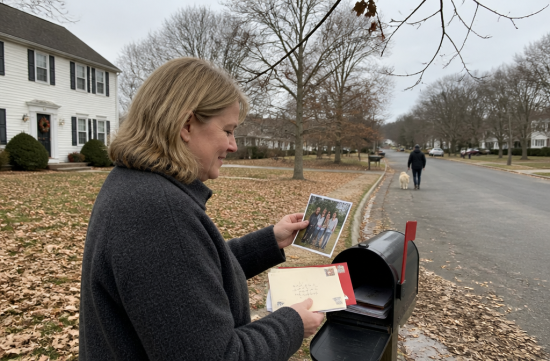
After the first week of November, the scenery at local pharmacies and supermarkets starts to change a bit. Even before Thanksgiving arrives, holiday card displays begin to quietly take their place near the entrance.
The first holiday card I received after coming to America honestly caught me off guard. The front was filled with children from someone else's home, all dressed in matching red sweaters and smiling.
To someone used to Korean-style New Year's cards, it seemed like a kind of bragging. It felt like an advertisement saying, "Look how well our family is doing!"
However, after spending a few winters, my perspective changed. I realized that one photo conveys much more than I initially thought.
The tradition of sending cards actually began in England, not America. The first commercial Christmas card is often credited to Henry Cole, a civil servant in London, who commissioned artist John Calcott Horsley to create a card in 1843.
In Cole's diary from December 17, 1843, there is a record of Horsley bringing the card design in the evening. It was a clever solution for someone who found it burdensome to write letters by hand, allowing them to simply sign a card instead.
It is said that 1,000 copies of that card were made, featuring a scene of a family gathered around a table raising their glasses. I found it quite interesting that the main subject of the card was family from the very beginning.
The tradition made its way to America a bit later. Louis Prang, a printer of German descent who settled in Boston, created cards for the British market in 1873 and began selling them in the U.S. the following year in 1874.
Prang even held design competitions starting in 1880, and it seems to have been quite a serious business, as names like Louis Comfort Tiffany appeared on the judging panel. This is why he is still referred to as the father of American Christmas cards.
The introduction of photographs to cards was made possible by technology. In 1902, Kodak released photo paper with a postcard format printed on the back, allowing people to send photos taken at home as postcards.
If you look at the postcards from that time, you'll find many pictures of children in front of the tree and families gathered in front of snow-covered houses. People a hundred years ago wanted to send the same kinds of messages.
By the late 20th century, improvements in printing technology allowed for family names, photos, and news from the year to be included on mass-produced cards. This is when the photo card we know today began to take shape.
I reevaluated this culture after encountering the concept of kinship work by anthropologist Michaela DeLeonardo. He referred to the act of maintaining connections with distant relatives and friends as kinship work.
In his 1987 study, he shared stories of people who felt guilty about losing touch with relatives after they stopped sending cards. This indicates that cards were not just simple greetings but tools for managing relationships.
From this perspective, American family photo cards are more like attendance checks than bragging rights. They signal that we are still here, that the kids have grown this much, and that we haven't forgotten you.
In a vast country, it's common for college friends to live in the West and former coworkers to be scattered in the South. A photo that arrives in the mailbox once a year can become almost the only window into that person's current situation.
Looking at the numbers, this culture is still very much alive. According to the Greeting Card Association, approximately 1.6 billion Christmas cards are sold each year, which makes the notion of the age of text and social media seem a bit hollow.
Of course, the costs are not insignificant. Since July 12 of this year, the price of a Forever stamp has increased from 78 cents to 82 cents.
Sending just 50 cards incurs a postage cost of $41. When you add in the printing costs for photo cards, it becomes a significant expense for a family during the holiday season.
Still, neighbors continue to send them. Even while grumbling about the expense, when you see them hand-addressing envelopes, it feels like that effort itself is part of the message.
For Korean families, there are also dilemmas. It can feel awkward to send American-style cards to family in Korea, while including children's photos can be a bit embarrassing.
From what I've seen, many families find a compromise. They send English photo cards to American neighbors and write New Year's greetings in Korean on the same photo for Korean adults.
If there are many neighbors of different religions, using "Happy Holidays" or "Season's Greetings" instead of "Merry Christmas" is now seen as a natural consideration. The answer lies in thinking about the recipient rather than which is correct.
There's no need to have the photos taken in a studio. In fact, a picture taken with a phone in a park during the fall, where one child is looking elsewhere, can be even more heartwarming for the recipient.
I also recommend including a handwritten note. A card with only printed text and one that includes a name will elicit very different expressions from the recipient.
You should also keep track of the schedule. The post office recommends that the deadline for domestic regular mail this year is December 17, so if you want it to arrive before Christmas, it's safest to send it by early that week.
This year, I plan to send cards again. Even if the photos aren't extravagant, I believe it's the quietest way to let people we haven't contacted in a year know that we are doing well.
Like that busy civil servant who tried to convey his feelings with just a signature 180 years ago, I think the true sentiment of a card lies in that simple message of remembering.
 NoPayBeauty





 Michigan Enthusiast |
 xylora |

 Tan Zoo |

 hot chocolate |

 Chichiki Chicago Train |

 secretmo |

 Anytime Journey |

 eatontown blog |
 Glow Yo |

 Amber H |
 ROLDU WAY |
 dreamming |
 greenloop |
 heartwarming |
 Jersey City |
 content |
 FROM Wyoming |
 My Love Bambino Alaview |
 Lord Island |
 fantastic |
 nero kim |
 Alaska Salmon Buyer |
 solvix18 |
 California Information News |
 HAWAII Korean Church News |
 Raomi News |
 My Love DS |
 Hardworking CPA |
 People Moon |