
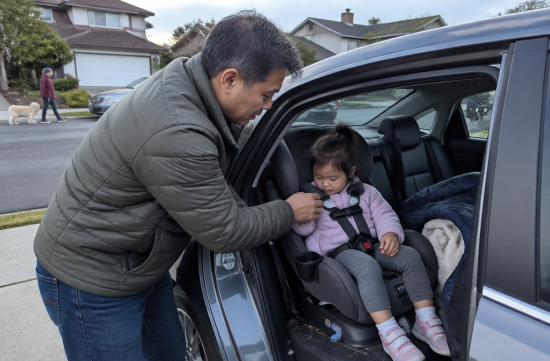
On a chilly morning, you often see a common scene in the parking lot in front of a daycare. A child dressed in a thick winter coat is being seated in a car seat, buckled in, and the door is closed.
At first glance, there seems to be no problem. The child is warm, and the belt appears to fit snugly.
Wait! This is a crucial point that shouldn't be overlooked. The American Academy of Pediatrics (AAP) clearly advises against dressing children in bulky clothing like winter coats and snow suits under the car seat harness.
The reason is surprisingly simple. In the event of a collision, the padding compresses quickly.
This creates a gap between the tightened straps and the child's body. The AAP explains that this gap could allow the child to slip out of the straps.
The key issue here is that the tightened straps are not securing the child's body but rather the air-filled padding.
I was a bit shocked when I first heard this. I always thought that dressing a child warmly on a cold day was part of being a good parent, but I never imagined that those clothes could loosen the safety restraints.
So how can we tell if our child's belt is properly tightened? The method recommended by the AAP is known as the pinch test.
After buckling the child in, pinch the shoulder straps between your thumb and forefinger. If the straps fold over when pinched, they are still too loose.
The straps should be tight enough that your fingers can barely slip off. Also, check that the chest clip is at armpit level and centered on the chest.
If you're wondering whether the clothing is too thick, you can easily check at home. While parked, buckle the child in with the padding on, tighten the straps, and then remove the child while leaving the straps as they are.
When you put the child back in and find space between the straps and the child, or if the shoulder straps are pinched, then that clothing is not suitable for car seat use. The difference can be surprising, and trying it once may change your perspective.
However, this doesn't mean you should let your child ride cold. The solution is to dress them in several layers of thinner clothing.
The AAP recommends starting with form-fitting clothes like leggings or long-sleeve bodysuits, then adding pants and a sweater on top. It's fine to add a thin fleece jacket as the outer layer.
Coats and blankets can be used after the belts are secured. You can drape a blanket over the straps or put the coat on backward with only the arms in.
For infants, the AAP suggests adding one more layer than adults. However, once the car warms up, you should be able to remove the top layer to prevent overheating.
Another common mistake is using fluffy car seat liners or sleeping bag-style products sold online.
The AAP points out that accessories not included with the product have not been crash-tested. They advise against using any thick items under the child or between the straps.
It's also not advisable to use stroller covers as they are. If you do use a cover, it should not have anything underneath the baby and should not cover the face.
Speaking of costs, I find this point the most appealing. There's no need to buy expensive new gear. A single fleece and a blanket you already have at home will suffice.
If mornings are busy in your household, you can simply change the order of preparation. The AAP recommends keeping the infant carrier inside to maintain room temperature and suggests heading out a bit earlier on winter mornings.
You might think this doesn't apply to you because snow is rare in California. However, early morning commutes can be quite chilly, and many families go to places like Big Bear on weekends to enjoy the snow.
Days when you go to see the snow are precisely when it's easy to buckle a child in while they're still wearing a snow suit. It's better to dress them in the snow suit once you arrive and keep blankets and extra clothes in the car.
It's also worth considering the law. According to the California Highway Patrol (CHP), children under 2 years old must be in a rear-facing car seat. Exceptions apply if they weigh over 40 pounds or are taller than 40 inches.
Children under 8 years old must be seated in a car seat or booster in the back seat. Once they turn 8 or reach 4 feet 9 inches, they may use a booster, but they must wear a seatbelt.
These numbers are not to be taken lightly. According to the CDC, in 2023, there were 1,019 children under 14 who died in traffic accidents in the U.S., and over 142,000 were injured.
Of the children who died that year, 43% were not wearing seatbelts. While this statistic does not specifically account for padding issues, it clearly shows how crucial it is to secure children properly.
If you're unsure, seeking the help of a professional can be a good option. Certified car seat technicians can be found at cert.safekids.org, and the CHP also advises contacting local offices for consultations with technicians.
Costs and appointment methods may vary by location, so it's best to inquire in advance. Getting this checked before the padding season arrives will give you peace of mind.
In conclusion, I would choose to remove the padding when getting in the car. Even if the child fusses for a moment and it delays us by 2 minutes, I believe it's better to ensure the belt is securing their body properly.
 CalorieGhost







 Well Done Sir |

 butter 90 |

 MacMorningBlog |

 Texas Migration Story |
 seadoll |

 Raccoon Ramen Night |

 Cap Com |

 American History This and That |

 Chino Min |

 Shoot Me |
 beerdreamer |
 ness 6 |
 Min's blog |
 American Politician Community |
 Sarah's Blog |
 james choi |
 solvix18 |
 Massachusetts |
 clouds 09 |
 Dr. Kelso |
 You Turn Me On |
 seouljung |
 Project Tomorrow |
 meadow |
 compass |
 Roman Pan |
 citrus pop |
 DO Main TODAY |
 korvex93 |