
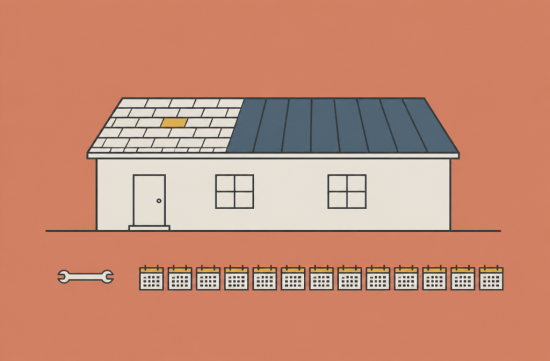
As the year-end approaches, those who own rental properties often pull out their receipt envelopes and face a common dilemma. They wonder which expenses, such as the new water heater, freshly painted walls, or newly installed flooring, can be deducted as costs for this year.
This distinction is crucial because it becomes clear when you look at the numbers. If recognized as repair costs, they can be fully deducted from rental income for that year, but if classified as improvement costs, they must be depreciated over 27.5 years for residential rental properties.
It's the difference between deducting the entire $5,000 in one year versus spreading it out over more than 27 years. From my experience observing this field for a long time, I find that many people unknowingly lose out because they don't understand this distinction.
The criteria are outlined in the IRS Tangible Property Regulations and the rental property guide, Publication 527. The key lies in three questions commonly referred to as the BAR test.
The first is Betterment. If the property has been noticeably improved beyond its original condition or if its size or capacity has increased, it is considered an improvement.
The second is Restoration. If major components or significant structural parts have been completely replaced, it is deemed a new creation rather than a repair.
The third is Adaptation. If the use of a space has changed, such as converting a garage into a room, it is also classified as an improvement cost.
It's important to remember that the unit of judgment is not the entire house. Each building system, such as the structural framework, HVAC, plumbing, and electrical systems, should be considered separately.
For example, if only a few broken shingles on a section of the roof were replaced, it is generally viewed as a repair cost. However, if the entire roof was replaced, it is likely to be classified as restoration and thus an improvement cost.
The same logic applies to replacing a single air conditioning compressor part versus replacing the entire HVAC system. What matters first is what was changed and to what extent, not just the amount spent.
That said, it is not necessary to scrutinize every single expense. The regulations provide three safe harbor rules for small landlords to simplify the process.
The first is the De Minimis Safe Harbor. Individual landlords without audited financial statements can treat expenses under $2,500 per item or invoice as repairs without determining if they are improvements.
For instance, a $1,800 dishwasher can be fully deducted this year under this rule. However, a statement indicating this choice must be attached to the original tax return submitted on time each year.
The second is the Routine Maintenance Safe Harbor. For building structures or systems, if a task is reasonably expected to occur more than once during the first 10 years of use, it is not considered an improvement.
Regular plumbing inspections, boiler cleanings, and repainting done each time a tenant changes are typical examples. However, this rule does not apply to improvement work that enhances performance.
The third is the Small Taxpayer Safe Harbor. If the adjusted acquisition cost of the building is $1 million or less and the average annual gross receipts are $10 million or less, this rule can be utilized.
In this case, if the total repair and improvement costs for one building in a year do not exceed the lesser of $10,000 or 2% of the building's acquisition cost, they can all be treated as expenses.
If the acquisition cost of the building is $200,000, then 2% is $4,000. This means that if the total repair and improvement costs for this house this year are $4,000 or less, they can all be deducted without the BAR test.
There is a common pitfall that many overlook. If the total exceeds that limit by even $1, not only the excess portion but the entire year cannot use this rule.
Therefore, it is important to double-check how much was spent on the property before year-end. For non-urgent repairs, it may be beneficial to carry them over into the next year.
Don't be too disappointed if some items must be classified as improvement costs. With the revised tax law effective January 19, 2025, assets with a recovery period of 20 years or less acquired and put into service after that date can again qualify for 100% bonus depreciation.
Appliances like refrigerators, washers, and dryers placed in rental properties typically fall under the 5-year asset category, so they may qualify. However, improvements attached to the building itself, which have a 27.5-year classification, do not qualify, so be sure to distinguish between them.
Practically, what you need to do now is simple. Organize this year's receipts by property and make a note of what was changed and to what extent for each item.
It's also a good idea to keep before-and-after photos. There's no better documentation when explaining whether it was a partial repair or a complete replacement later on.
Receiving invoices itemized is generally more favorable for applying the De Minimis rule. If you receive a lump sum invoice from a contractor, it becomes difficult to meet the $2,500 threshold.
In my view, most individual landlords can manage to categorize a significant portion of their expenses for this year by properly utilizing the De Minimis and Routine Maintenance rules. Personally, I would separate larger projects like roofing or HVAC and consult with a professional.
Choosing safe harbor options and depreciation methods can yield different results depending on the property's situation and income structure, so I recommend confirming with a tax professional before filing. This article is based on IRS Publication 527 (2025 edition) and the Tangible Property Regulations guide.
Organizing receipts can be tedious, but spending a few hours at year-end can make tax reporting much easier in the spring. This year, I encourage you to open that envelope early.
 PeelStealth





 B.I.G. Victor |

 Amber H |
 uplifted |
 Dr. Kelso |
 silents |

 US Home Buying Information Home Insurance |

 Samttugi Grasshopper Noodle |

 The Day the Sun Rises |

 honey honey |

 U.S. Weather Bureau News |
 Epoca News |
 kansan55 |
 Skyline |
 Investment Information News Update |
 diamondo |
 Fairfax Fox |
 kuku 100 |
 US Embassy |
 Kims Spring |
 TOTO Together |
 Princess Park |
 Respect Rooftop Bro |
 Hani 1977 |
 Tilt Cicy |
 yorvik12 |
 lollipop |
 lioness |
 DREAM BIG |
 corner |