

After midnight, if you walk along the Charles River, you can see a row of pale arches standing across the river. At first glance, I thought it was some kind of ruin.
It wasn't until much later that I learned it was Harvard Stadium. Harvard's main campus is in Cambridge, but this stadium is located across the river in Allston.
When viewed under the streetlights, the concrete surface is uneven. Old stains and repair marks are mixed throughout, resembling a quilt made of pieces of fabric in slightly different colors.
However, there is a story that this old wall played a part in changing the rules of the sport of football. When I first heard it, I thought it might be an exaggeration.
Upon researching, I found that the core of the story was quite solid. The stadium opened in 1903, and the first game was on November 14 of that year against Dartmouth.
Interestingly, Harvard lost that opening game to Dartmouth with a score of 11 to 0. It was the first time Dartmouth had beaten Harvard, so it was like the guest stole the spotlight on the host's big day.
Moreover, one side of the stands was still under construction that day. It seems everyone was in such a hurry that they held the opening game in an unfinished stadium.
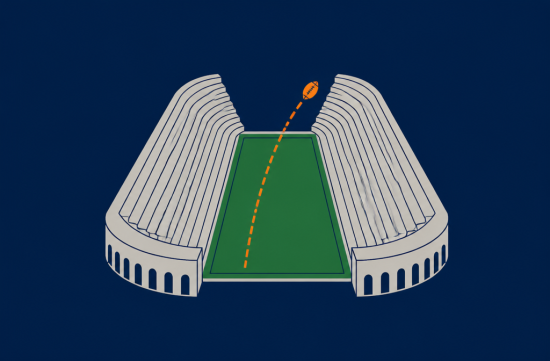
The person who led the design was Ira Hollis, a professor at Harvard's engineering school. He chose a U-shape that was open on one side, similar to ancient Greek stadiums.
The material used was reinforced concrete. Civil engineering professor Louis Jerome Johnson served as a consultant, and at that time, constructing an entire grandstand out of concrete was a novel endeavor.
There is almost no disagreement that this stadium is one of the early examples of using reinforced concrete in large structures. However, whether it was the first in the world or the first in the U.S. varies slightly depending on the sources.
The problem was its sturdiness. If it were a wooden grandstand, you could just tear it down and rebuild it, but once concrete sets, that's it.
At that time, football was quite different from what it is today. Most plays involved players forming a mass and pushing forward, leading to injuries and even fatalities, which drew significant social criticism.
In 1905, President Theodore Roosevelt summoned officials from Harvard, Yale, and Princeton to the White House and pressured them to make the game less dangerous. Given that the president himself got involved, you can imagine the atmosphere.
One of the reform ideas proposed was to widen the field. The thinking was that if the space increased, players would spread out, reducing the chances of collisions.
However, this was impossible at the newly built Harvard Stadium. Since the concrete stands surrounded the field, widening it would require major renovations to the stadium.
At that time, Harvard was a prominent voice in college football. Ultimately, the rules committee chose a different path instead of widening the field.
In January 1906, the forward pass was legalized. With the ability to throw the ball forward, the game began to open up vertically and forward rather than just laterally.
The exact proposal for how much to widen the field varies between sources, with some saying 40 feet and others 40 yards, making it difficult to pinpoint. I decided to remember this part without the numbers.
To be fair, it's hard to definitively say that one stadium created the forward pass. There is certainly a perspective that it would have been introduced regardless of the atmosphere at the time.
Moreover, the early forward pass had many restrictions and was not widely used in actual games. The dominance of the quarterback as we see today came much later.
Still, I find this story appealing. It suggests that an unchangeable wall led people to seek entirely different solutions.
When creating something from pieces of fabric, a similar moment often arises. When you don't have the desired size of fabric, changing the shape itself rather than forcing it can lead to better results.
Harvard Stadium was designated a National Historic Landmark in 1987. Its early use of reinforced concrete, simple U-shape, and impact on football were cited as reasons.
Only a handful of college stadiums have received such a designation. The Rose Bowl, LA Memorial Coliseum, and Yale Bowl are among those on the same list.
Even now, over a hundred years later, games are still held at this stadium. During the day, you can often see students running up and down the tiered stands.
When you go back to the riverbank at night and look at the arches, the layers of time seem to overlap within them. The construction noise of 1903, the unfamiliar pass of 1906, and the tranquility of tonight.
You don't need to know much about football. If you happen to pass by this area, take a moment to look across the river at dusk or late at night.
If it were me, I would choose a quiet weekday night over game day. The story of how hardened concrete opened up a new path is clearest during that time.
 GlowHeadAnne
 NDakotaButler


 Rice Shop Uncle BLOG |
 Noodle Noodle |

 Chino Min |

 Glow Yo |

 Michigan Enthusiast |

 Lime berry |
 Art patch |

 umbrellafruit |


 strawberry |
 US Regional Information Local News |
 USA Business News |
 Blondee |
 E whisper |
 Potato House |
 freshmint |
 Ansaso |
 Golado |
 babybay |
 honeycom |
 French Macarons |
 Exploring American Life Information |
 Sunshine Blog |
 Community Cross |
 Sayonara H |
 What can make money? |
 Information Search LifeMAN |
 morvex37 |
 neontrail |