
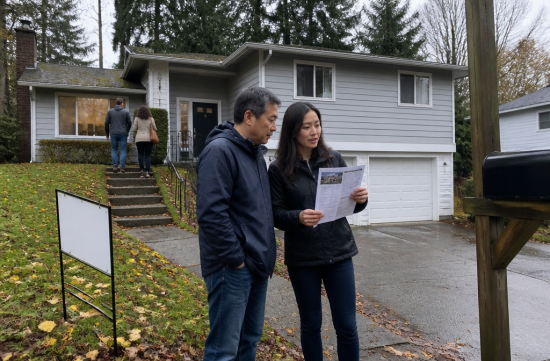
To summarize the Federal Way housing market in October in one line: home prices have decreased compared to a year ago, while rent has remained relatively unchanged.
Let's go through some key numbers that both potential buyers and tenants facing lease renewals might be curious about. The reference point is October 2026, and the rent figures are based on the most recent available data.
First, regarding home prices. According to the Beyond WA report, which compiles NWMLS data, the median sale price in Federal Way for October was $580,000.
In the same month last year, it was $599,975, indicating a decrease of 6.0%. Compared to the September median of $588,000, it has dropped slightly over the month.
The extent of the decline varies depending on the method of calculation. According to Redfin, the median sale price for October shows a 3.1% decrease year-over-year.
While the drop varies by source, the trend is consistent: homes are being sold for less than last year, as confirmed by multiple reports.
It's also important to look at the inventory situation. As of November 11, there were 265 active listings in Federal Way, with a supply of 3.7 months.
Typically, a market is considered favorable to sellers when inventory is below four months. Based on the numbers, it still appears to favor sellers, but the reality feels a bit different.
The average time homes are staying on the market is 39 days, and the sale price to listing price ratio was 98.1%. This suggests that it's common for buyers to negotiate slightly below the listing price.
This is certainly different from a couple of years ago when multiple offers would drive prices up. Buyers now have the opportunity to request inspections or closing cost assistance.
The overall trend in King County is similar. The NWMLS October snapshot shows the median sale price in King County at $851,250, down 4.1% from last year.
When looking specifically at single-family homes, the median price was $925,000, reflecting a 7.2% decrease. Condos saw a significant drop to $465,000, down 15.5%, with inventory increasing to 7.0 months.
Expanding to the entire NWMLS service area, there were 5,332 transactions in October, a 14.3% decrease from last year. In contrast, active listings rose to 23,519, an increase of 25.2%.
This is a typical adjustment phase where transactions are declining while inventory is building up. Federal Way tends to have lower prices compared to Seattle, resulting in a relatively smaller decline.
The primary reason for this situation is interest rates. According to Freddie Mac, the average 30-year fixed mortgage rate was 7.24% as of October 29.
At the beginning of October, rates peaked at 7.4%, the highest in nearly three years. Compared to the same time last year when it was 6.17%, this is over a percentage point higher.
In late February, rates had dropped to 5.98%, which disrupted many plans for those looking to buy this year. This aspect is particularly disappointing for those monitoring the market.
Let's translate this burden into numbers. If you buy a $580,000 home with a 20% down payment and a 30-year loan at 7.24%, your monthly principal and interest payment would be $3,162.
If you had secured the same loan at the February rate of 5.98%, your payment would have been $2,776. Even excluding property taxes and insurance, there's still a $386 difference each month.
Now, regarding rent. According to the November report from Apartment List, the overall median rent in Federal Way is $1,781, which is nearly the same as the previous month.
Compared to last year, it has only increased by 0.7%. There hasn't been much change compared to the June figure of $1,749.
No official figures for just October have been confirmed, so the most recent data has been used. Keep in mind that different sites may have varying sample sizes, leading to discrepancies in amounts.
In summary, home prices are decreasing while rent is holding steady. However, the monthly costs still favor renting significantly.
The difference between the median rent of $1,781 and the mortgage payment of $3,162 is $1,381. When you add taxes, insurance, and HOA fees, the gap widens even further.
Therefore, the current question is less about whether to buy a home and more about when and under what conditions to buy. With prices dropping, buyers have gained more negotiating power.
If you're a tenant, there's little reason to accept a steep increase when renewing your lease. It's advisable to check the market rates of similar complexes and negotiate accordingly.
If you're considering buying, I recommend looking into seller credits to lower your interest rate as part of your negotiation. If rates decrease, refinancing later could also reduce your burden.
In my opinion, if you plan to live in the home for five years or more, now is a good time to negotiate rather than waiting unnecessarily. Conversely, if your goal is investment, there's no rush since rental income isn't keeping pace with mortgage payments.
In next month's report, I will summarize how interest rates and inventory levels change as we approach year-end.
 BingsuLab








 B.I.G. Victor |

 Amber H |
 uplifted |
 Dr. Kelso |

 silents |

 timemachine |

 corner kick |

 Seattle - Emerald City |

 legalway |

 central |
 bluebird |
 Epoca News |
 Samttugi Grasshopper Noodle |
 kansan55 |
 Skyline |
 Investment Information News Update |
 diamondo |
 Fairfax Fox |
 kuku 100 |
 US Embassy |
 Kims Spring |
 TOTO Together |
 Princess Park |
 Respect Rooftop Bro |
 Hani 1977 |
 Tilt Cicy |
 yorvik12 |
 lollipop |
 lioness |
 DREAM BIG |