
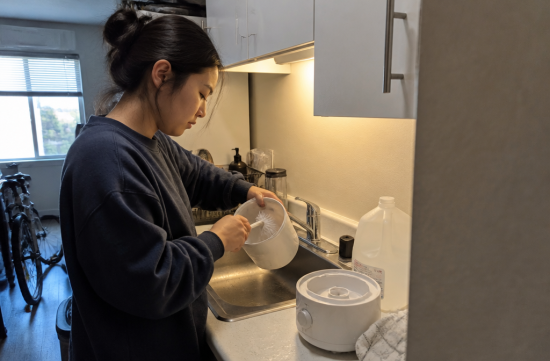
When the Santa Ana winds blow through, I often wake up with a scratchy throat and chapped lips. That's why my room's humidifier has been running almost 24 hours a day lately.
However, when I opened the tank lid last week, I was a bit shocked. There was a slippery film at the bottom, and a white residue was lining the edges.
I received a comment on my last post that said, "I fill the water every day, but honestly, I only clean it maybe once a month." I think many people might feel the same way.
So this time, I looked up official information. Upon closer inspection, the issue isn't the humidifier itself, but rather the stagnant water and maintenance habits.
According to the Environmental Protection Agency (EPA) fact sheet on humidifier maintenance, so-called cool mist humidifiers, like ultrasonic or impeller types, can release microorganisms and minerals from the tank directly into the indoor air.
In simple terms, if the water in the tank is dirty, that water can turn into very fine particles that enter the air I breathe. Considering that it's running next to my bed all night, it's quite unsettling.
On the other hand, steam humidifiers, which boil water to produce vapor, or evaporative types that moisten a filter to evaporate, are said by the EPA to have a lower likelihood of spreading minerals. However, these methods also require the same level of maintenance since stagnant water can still promote bacterial growth.
So, what can actually happen to your lungs? The American Lung Association explains that, although rare, a condition known as humidifier lung, or hypersensitivity pneumonitis, can occur.
This happens when the body reacts to microorganisms released from a contaminated humidifier, causing inflammation in lung tissue, which can lead to scarring in severe cases. While it's not common, just hearing the term is quite frightening.
Many medical sources also commonly advise those with asthma or allergies to be particularly cautious. If you experience persistent coughing or shortness of breath, don't make assumptions—consult a doctor or pharmacist.
Another common issue is the white dust that settles on furniture. This is caused by minerals in tap water being dispersed into the air by ultrasonic humidifiers and then settling down.
The Consumer Product Safety Commission (CPSC) has stated that this dust may contain particles small enough to enter the lungs. However, they also noted that the health effects are still not clearly understood.
The EPA has candidly stated that the health impacts of microorganisms and minerals spread by humidifiers are not fully understood. So, while there's no need to panic excessively, it's also not something to overlook, which is my conclusion.
Now, let's get practical. The basics recommended by the EPA are simpler than you might think.
First, for portable humidifiers, empty the water daily, wipe down the surfaces, and refill with fresh water. You need to break the habit of just adding new water to what was left over from yesterday.
Second, clean portable humidifiers every three days. The key is to empty the tank and scrub the inside with a brush to remove any residue and film.
Third, if you've used any detergents or disinfectants, make sure to rinse the tank thoroughly. This is to prevent any chemicals from being released into the air.
Fourth, both the EPA and CPSC recommend using distilled water with low mineral content. A bottle of distilled water from the store can last quite a while.
The EPA explains that while distilled water isn't completely free of minerals, it generally contains less than most tap water. Depending on the product, the performance of mineral removal cartridges can vary greatly, so don't rely on them too much.
There's something I really want to say to the Korean community. Many of you might remember the issue with humidifier disinfectants that emerged in 2011, leading to unexplained lung diseases in Korea.
So, it's best to set aside the thought that adding disinfectants or bleach to the water will make it safe to run continuously. The principle is to clean properly and only use clean water after rinsing.
I also received a DM asking, "Isn't it better to keep the humidifier running?" The conclusion is no.
The EPA recommends keeping indoor relative humidity below 50%. If the humidity is too high, it creates an environment conducive to mold, bacteria, and dust mites.
That's why I bought an inexpensive digital hygrometer. Seeing the numbers visually helped me change my habit of running it at maximum all night.
If you have a product with a filter, check the replacement schedule in the manufacturer's instructions. Cleaning methods and allowable cleaning agents can vary by brand, so ultimately, it's best to follow the manufacturer's instructions.
Honestly, cleaning every three days is a hassle. Still, if it were up to me, I would definitely stick to daily water changes, cleaning every three days, and using distilled water.
In dry seasons, humidifiers are undoubtedly helpful machines. However, just as you wouldn't drink stagnant water, I hope you won't breathe in stagnant water either.
I'm curious about your opinions. How often do you clean your humidifier—every day, once a week, or only when you remember? Please vote in the comments!
 HappyCookie








 fruitflash |

 Anjollinya Blog |

 United States Army |

 premium |

 The Emperor Must Grow |

 Chino Min |

 Information on All Regions of the United States |
 DREAM BIG |

 Shoot Me |

 Cap Com |
 yorvik12 |
 lollipop |
 lioness |
 corner |
 Shintongbangtong Shin Naerin James Park |
 primeleaf |
 forward |
 action blog 101 |
 athome blog |
 calvor |
 Haha and Bomi Blog |
 Lee Ton |
 viba viba |
 Olivia's Blog |
 208 Master |
 crumb |
 blanke |
 Burbank Lee |
 tervox95 |