
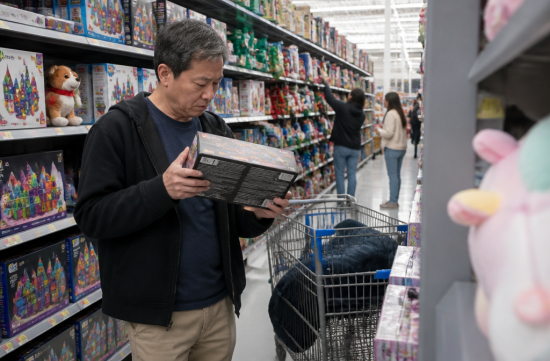
Thanksgiving turkey hasn't even been roasted yet, but the toy aisle at the store is already all about Christmas. There are twinkling lights, singing dolls, and blocks that stick together with magnets, all beckoning to be bought.
However, starting this year, I first flip over the toy boxes. The battery compartment and magnets catch my eye before the price tag does.
It's not because I'm being stingy; it's because the numbers I've looked up are scarier than I expected.
First, let's talk about the coin-shaped flat button batteries. Those little guys that are commonly found in remote controls, car keys, glowing toys, and greeting cards.
The U.S. Consumer Product Safety Commission (CPSC) estimates that there were 54,300 emergency room visits related to button batteries from 2011 to 2021. There have also been several reported fatalities.
The problem starts the moment they are swallowed. If a battery gets stuck in the esophagus, it can react with saliva and cause severe damage within just two hours.
This led to the passage of Reese's Law in 2022, named after a baby named Reese who died after swallowing a button battery.
According to this law, consumer products must have battery compartments that require a tool to open or must be designed to require two actions to open simultaneously. Warning labels on packaging are also mandatory.
Here's the twist: children's toys are exempt from this law.
Toys are subject to separate federal toy safety standards (ASTM F963). The CPSC has also reported that these standards are insufficient and proposed stricter measures for toys intended for children under 14 in 2024.
However, I couldn't find any news confirming that the proposed measures have been finalized. The law is still under discussion, and children's hands are quick even at this moment.
Consumer Reports also warned that in their end-of-year survey in 2024, they found products in toys and household items that allowed batteries to be easily removed.
So, in stores, I check if there are small screws in the battery compartments. If the lid can be opened with just a push from my fingernail, I put it back down.
The second concern is magnets. If a child swallows just one, it might pass through, but if they swallow two or more, it's a different story.
They can attract each other inside the intestines, sticking together across a barrier, leading to perforations or twisted intestines. Who would have thought small magnets could be so persistent?
According to CPSC data, there were an estimated 23,700 emergency room visits due to magnet ingestion from 2010 to 2020.
As a result, new safety standards for magnets were established in 2022. Small magnets that can fit into a small parts tester must have a magnetic force index of less than 50.
Yet, products that violate these standards continue to appear online. In 2025 alone, the CPSC issued warnings to stop using magnetic balls, magnetic fishing games, and magnetic doll sets sold in online markets.
In December 2025, a recall was issued for a Crayola brand magnetic cube set because the magnets inside could come loose. Just because it's a well-known brand doesn't mean it's safe.
My criteria are simple. I check if the magnets in toys are securely embedded in plastic and whether they rattle when shaken.
I don't even put powerful magnet sets that look like beads in my cart. Even if it's a gift for an older sibling, if there's a younger sibling in the house, they will eventually end up rolling around on the floor.
It's not just about toys. Singing greeting cards, light-up clothing and decorations, car keys, and remote controls should all have their battery compartments taped shut at home for peace of mind. Don't leave used batteries rolling around in a drawer; dispose of them immediately.
I also recommend searching for the product name on the CPSC recall page before making a purchase. It only takes a minute.
But what if an accident happens? If you suspect a battery has been swallowed, do not induce vomiting; go straight to the emergency room.
According to the National Capital Poison Center guidelines, if a child over 12 months is in a state where they could swallow something, they should be given 2 teaspoons of honey every 10 minutes, up to a maximum of 6 times while on the way to the emergency room. It's important to emphasize that honey is just a way to buy time, not a treatment.
The hotline for battery ingestion is 800-498-8666. If breathing becomes difficult, don't hesitate to call 911. Ultimately, accurate judgment should be made in consultation with a pediatrician.
Writing this makes me feel like Santa Claus has become a safety inspector. Still, considering that the months following the unwrapping of gifts are much longer than the five minutes of tearing open the wrapping, I think this kind of nagging is worth it.
If it were up to me, I would choose something sturdy over something shiny this year. Even if the child is a little less excited, parents can sleep much more comfortably.
 SodaSleepLab
 OmuriceCopter







 rissa |

 Gomo Nim |

 lattepop |

 Well Done Sir |

 butter 90 |


 Taco Bell Candy Note Blog |

 Good Riddle |

 Epoca News |
 Samttugi Grasshopper Noodle |
 kansan55 |
 Skyline |
 Investment Information News Update |
 diamondo |
 Fairfax Fox |
 kuku 100 |
 US Embassy |
 Kims Spring |
 TOTO Together |
 Princess Park |
 Respect Rooftop Bro |
 Hani 1977 |
 Tilt Cicy |
 yorvik12 |
 lollipop |
 lioness |
 DREAM BIG |
 corner |