

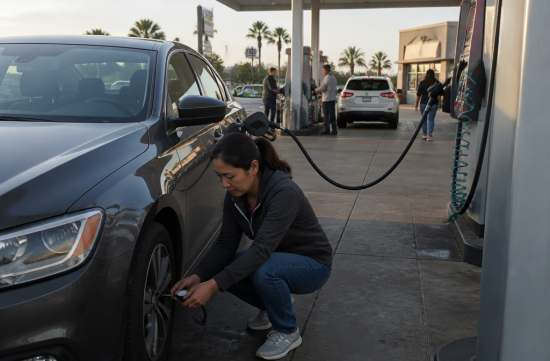
Last week, I paused for a moment after receiving my receipt at the gas station. The number was much larger than I expected, even though I didn't fill the tank completely.
These days, discussions about gas prices are everywhere. According to AAA, as of October 14, the national average for regular gas was $4.33 per gallon.
Before the conflict with Iran began in February, it was around $2.98, so the difference is noticeable. This year, there have been 158 days where the national average exceeded $4, surpassing last year's record.
California, as usual, is significantly above the national average. Honestly, at this point, commuting distances have become a fixed expense in household budgets.
Gas prices are a variable I can't control. However, even with the same car on the same road, fuel efficiency can vary greatly depending on driving style.
So this time, based on data from fueleconomy.gov, operated by the U.S. Department of Energy and the EPA, I've selected tips that actually have numbers associated with them.
The first is rapid starts, hard acceleration, and sudden braking. Officially, this is referred to as aggressive driving.
According to fueleconomy.gov, this type of driving can reduce fuel efficiency by 15-30% on the highway and by 10-40% in congested city driving.
Similar ranges were found in experiments by the Oak Ridge National Laboratory. I was a bit surprised when I first saw the figure of up to 40%.
When the light turns green and you take off, you end up stopping at the next red light anyway. You're burning fuel just to gain a few seconds.
The second factor is speed. Each car has an optimal speed, but generally, fuel efficiency declines rapidly after exceeding 50 miles per hour.
Fueleconomy.gov explains that for every 5 miles per hour over 50, fuel efficiency drops by about 7%. By adhering to speed limits and reducing your speed by 5-10 miles per hour, you could save 7-14%.
If you reduce your speed from 80 miles per hour to just 70 on the freeway, you'll notice a difference. Your arrival time won't be significantly delayed.
On flat highways, using cruise control can also help. Maintaining a steady speed is beneficial for fuel efficiency.
When you control the speed manually, it tends to fluctuate. Letting the machine handle it is definitely better in this case.
The third factor is idling. Depending on engine size and whether the air conditioning is on, it can consume between a quarter to half a gallon per hour.
The time spent waiting with the engine running in school pickup lines or drive-thrus can be surprisingly long. If you're going to be stopped for a while, it's better to turn off the engine.
The fourth factor is trunk organization. Carrying an extra 100 pounds in your car can reduce fuel efficiency by about 1%.
When you combine golf bags, cases of bottled water from Costco that you haven't unloaded, and kids' sports equipment, that weight adds up quickly. I felt a bit embarrassed when I cleaned out my trunk last weekend and saw items that had been there for months.
A cargo box on the roof has an even greater impact. Due to air resistance, fuel efficiency can decrease by 2% to as much as 17%, so it's best to remove it right after your trip.
The fifth factor is tire pressure. For every 1 psi drop in all four tires, fuel efficiency decreases by 0.2%.
While the numbers may seem small, tire pressure tends to gradually decrease over a few weeks. The recommended pressure is listed on the sticker inside the driver's door, so check it about once a month, ideally when you fill up. It's a good habit for tire longevity and safety.
There's one more thing. Making several short trips with a cold engine can use up to twice as much fuel compared to making the same distance in one trip with a warmed-up engine.
If you have a habit of running errands at the grocery store, laundromat, and post office separately, try to combine them into one trip. This is another way to save without spending anything.
One thing I want to emphasize is that you shouldn't just add up these percentages. The effects can overlap or diminish depending on the type of vehicle and road conditions.
Still, the direction is clear. As gas prices rise, the same percentage translates into a larger dollar amount.
For example, if a household spends $300 a month on gas, improving fuel efficiency by just 10% could save about $30 each month. Over a year, that adds up to a significant amount.
Personally, I hope that during times like these, options like public transportation or carpooling become more widely available. In areas where there are no alternatives to driving, the shock of rising gas prices ultimately falls on households.
Until then, what I can control is my driving habits. I'm planning to start with reducing rapid starts and lowering my freeway speed.
It doesn't cost anything, and I can start right away on my commute home today. What will you change first?
 MockAllDoll






 SKy Face |

 gleeful |

 forevergee |

 mortrix |

 cherrydino |

 Conflite Teacher |


 OC Real Estate Business Information |

 Soy Angelino |

 Choco Choco Star |
 sparklingo |
 Watch Walker |
 autumn |
 K-POP TV News |
 cortiva6 |
 Nevada Teppanyaki |
 aerion99 |
 Golado |
 Maximum Pro |
 Joyce blog |
 Atlanta Business Information |
 Ansaso |
 Soft Feeling That Feeling |
 assa man |
 Yugo Girl I'm So Hot |
 nexaro |
 Experiences Living in America |
 arsnack |
 Nebraska Center Director TOP |