

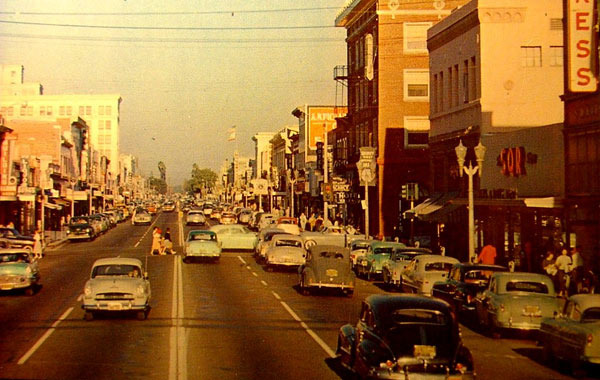
Looking at a postcard from the early 1960s of downtown Anaheim, one can feel a completely different atmosphere compared to today. Low buildings, shops with signs neither too big nor too small, cars lined up along the street, and people strolling leisurely. The time this photo was taken marked the transition period when Anaheim, once an agricultural town, was rapidly transforming into a city.
Originally known for its fruit farming, Anaheim changed dramatically when Disneyland opened in 1955. Tourists flocked in, jobs were created, and new residents moved in, causing the city to expand explosively. Just a few years after this change began, in the late 1950s and early 1960s, downtown Anaheim still mixed the old with the new.
The street in the photo captures that moment of 'two eras coexisting.' Shop owners knew their customers by name, and it was a time when, upon opening the store door, they would warmly ask what you were looking for.
Children rode their bikes around, people stopped to greet each other on the street, and everyone knew each other well enough to wonder, "Whose car is that parked on the street?" The warmth of a small town was alive.
However, change was already seeping in. The city needed wider and larger roads, and motels and restaurants for tourists began to appear one by one. As car-centered development spread, roads widened, parking lots grew, and neon signs began to multiply. This change seemed to progress slowly, but in fact, it was the beginning of a fundamental shift in the city's identity.
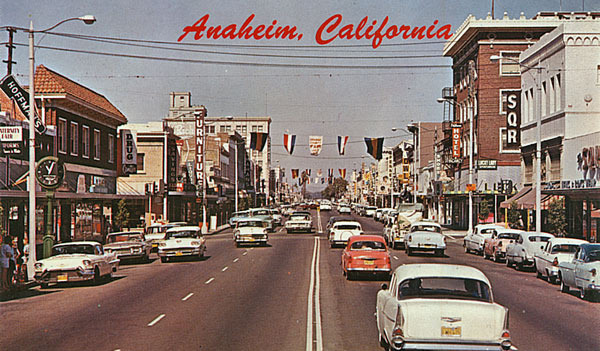
Especially with the emergence of large shopping centers, cracks began to form in the traditional street commerce that had been the heart of downtown. The shopping mall, with its wide parking lots and multiple stores gathered in one place, offered a new consumer culture to the people of that time, and gradually more residents began to drive there, causing downtown to become quieter.
The Anaheim depicted in the postcard is therefore symbolic in itself. It captures a special moment where two eras mixed, on the cusp of transforming from a rural village to a city of tourism, commerce, and residence. Within a single photo, the scent of the already vanished orange groves and the leisurely daily life centered around neighbors coexist with the bustling energy of a future city.
Today, Koreans living in Anaheim experience a city environment that is completely different from the rural atmosphere of the past, blending tourism and residential areas. Near Disneyland, there are many hotel, restaurant, and service industry workers due to the variety of jobs, and in the slightly distant residential areas, there are Korean families who moved here for the educational environment.
Since Anaheim has relatively lower housing prices within Orange County, it becomes a realistic option for those who find Fullerton and Irvine burdensome. There is a mix of single-family homes, older townhouses, and relatively spacious apartments, making it common for families to reside here, often sharing living space with the densely populated Korean area of Fullerton due to school issues for children.
Public transportation is lacking, but if you have a car, shopping, commuting, and weekend outings are convenient, and above all, living in a unique city atmosphere where the park fireworks sound like a daily occurrence due to the proximity to Disneyland.





 moo moo |
 ultron78 |
 garlic bread |
 Sugar Cream Door Bulletproof Noodles |
 urbanmint |
 Round and Round Children's Song Kingdom |

 Anna Life |
 Lifestyle Information Search USA |
 U.S. Weather Bureau News |
  Tonky |
  viroma |
  cookie |
  Live and that's it |
  Alright Twain |
  eatontown blog |
  HAWAII Korean Church News |
  Amore |
  linex |
  Balancework |
  laro90 |
  MEDBIO American Doctor Blog |
  SWAT TEAM BLK |
  DREAM BIG |
  frostbite |
  330 Forever My Love |
  El Dorado |
  dralix58 |
  Gorama Round |
  Skydiving |