

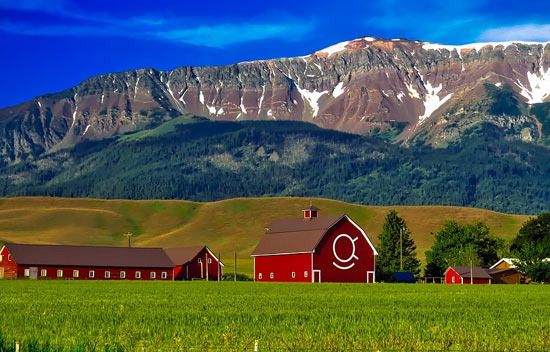
Sometimes in Korea, we use the term "remote village." Honestly, I chuckle a bit every time I hear that word.
That's because after living in America for a long time, the remote villages in Korea and those in America are on a completely different level.
This is something only those who have experienced it truly understand. When I explain it, people often say, "Oh, come on," but once you visit rural America, you realize it's true.
When I first came to America, I had the impression that "everything in America is big, nice, and spacious." But as I traveled around, I gradually started to realize more.
The difference between cities and rural areas in America is extremely pronounced. It's like a different country altogether.
Once, I visited a rural area in the Midwest. Just looking at the map, I thought there would be cities and people living there.
But when I got there... the road seemed endless. It really felt like it had no end.
Even after driving for 2 or 3 hours, the scenery remained the same. Roads, fields, sky. That's it.
When a gas station finally appears, I think, "Okay, this must be a place where people live."
That's when I first heard the phrase, "We don't have escalators in our state."
At first, I thought it was a joke. But it's true. Since there are no shopping malls, escalators are almost unnecessary.
Most buildings are one story, at most two stories high. There's no need for anything more. In fact, the state with the fewest escalators is Wyoming. This state has the smallest population in America, and the cities here are small. There are hardly any shopping malls, and the buildings aren't tall. So, there's no structural reason to install escalators.
Next is Montana. Here, the land is vast, but there are few people. Except for a few cities, it's mostly rural. Since there aren't many large commercial facilities, there's really no need for escalators. Stairs or elevators are sufficient.
Lastly, North Dakota is similar. Here, especially in winter, the weather is harsh, and life is very practical. Buildings aren't constructed tall or complicated. So, naturally, escalators are hardly seen.
In Korea, when we say "remote village," there are still buses, convenience stores, and at least one café, right?
But in America, these remote villages are not like that. Convenience store? You have to drive for 30 minutes to find one.
Hospital? You have to drive for over an hour. There are hardly any traffic lights. At intersections, there's just a single STOP sign.
There aren't many people either. Even if you add up all the residents, it might only be a few hundred.
So everyone knows each other. If someone moves in, the news spreads immediately. There's no "I don't know who lives next door." They know each other so well that it becomes a problem.
Interestingly, the people in these rural areas don't find that inconvenient. They actually feel suffocated in the city.
There are too many people, traffic jams, and noise. From their perspective, that's the strange part. I didn't understand it at first, but after visiting a few times, I think I get it. The air is different, the sky is different, and at night, it's really quiet. The stars are so visible that it's surprising.
But that doesn't mean I think, "I could live here too." Honestly, I don't feel that way.
It's nice for a day or two, but if I had to live there, it wouldn't be easy, especially for someone coming from Korea, where you have to drive a long way for anything.
So sometimes when I hear people in Korea say, "It's a remote village," I think to myself.
"That's not a remote village... come to America..." That's the feeling. The real remote villages have a completely different way of life.
Still, experiencing this at least once is worthwhile. You understand why America is called a vast country and why people's temperaments are different.
It's easy to think you know America just by looking at the cities, but once you visit the countryside, it feels like you're seeing a completely different country.
In the end, the conclusion is that Korean remote villages are at the level of "a bit inconvenient," while American remote villages feel like a completely different game map.Visiting at least once will definitely change your perspective on the world. But driving at night, you really have to be prepared. There are no streetlights, no cars, and no people... you suddenly think, "Am I on the right road?" You have to rely solely on the GPS, which can sometimes be unsettling.
So it's fun, but honestly, it's a bit scary, right? Haha. That's part of its charm.






 Montgomery Mom |
 Anjollinya Blog |
 Taco Seattle |
 Mr Song Song |
 Living Economy Information Blog |
 Healthy Local Fresh Information |
 Round and Round Children's Song Kingdom |
 Anna Life |

 Famous Attractions in the United States |
  beerdreamer |
  Kims Spring |
  White bunny |
  Kansas City Representative Singer |
  shadow 007 |
  sun walker |
  Choco Choco Star |
  midnight blue |
  honeypot |
  summer |
  adventure77 |
  flexible |
  Shintongbangtong Shin Naerin James Park |
  truepixel |
  Kathy's Blog |
  Hae Naem |
  quatspace |
  Marisol |
  Glassroom |
  Granola |