
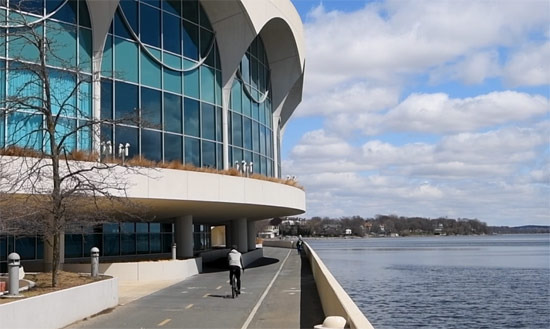
On the day I first set foot in Madison, what caught my eye was not the tall buildings or the Wisconsin State Capitol.
It was the lakes.
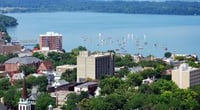
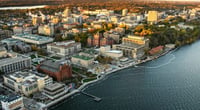
On one side of the city, Lake Mendota stretches wide, and on the opposite side is Lake Monona. And between those two lakes, the city is long and narrow.
At first, I thought it was a rather strange city. But as time passed, I realized that this geography is indeed the face of Madison.
Lake, City, Lake.
These three words can describe Madison quite accurately.
Madison is the capital of Wisconsin and, according to the 2020 census, has a population of about 270,000.
It is located about 80 miles west of Milwaukee and about 120 miles northwest of Chicago. It is neither a very small rural town nor a huge city like Chicago. It has a peculiar size that feels urban, yet nature is just a short distance away.
Here, the lakes are not just tourist attractions; they are part of everyday life.
The lakes, including Wingra, Waubesa, and Kegonsa, centered around Mendota and Monona, shape the landscape of the Madison area. Just a few blocks from downtown, you can see the water, and in the summer, people appear to kayak and boat. Many people also ride their bikes along the lakeshore.
Then, when the long winter arrives, the vast lakes freeze over. In the spots where boats floated in the summer, people drill holes in the ice to fish. The same place transforms into a completely different landscape with the changing seasons.
At the heart of the city is UW-Madison. Founded in 1848, this university has helped Madison maintain a youthful atmosphere as a college town for a long time. Walking through the campus, you encounter students and researchers from around the world, and cafes, restaurants, and bookstores naturally line the area around the university.
However, it is not a city that survives solely on the university.
There is the Wisconsin state government, a healthcare industry centered around UW Health, and a large headquarters of the healthcare information technology company Epic Systems located a bit southwest in Verona. With the state government, university, healthcare, and tech companies all in one area, the economic structure is somewhat different from similar-sized cities in the Midwest.
What I particularly like about Madison is that there is not much of a boundary between the city and nature.
There are parks everywhere, and bike paths connect the neighborhoods. On nice days, you see workers commuting by bike and students heading to campus in a line. On weekends, you don't have to drive far to walk by the lakes and spend the day in the parks.
Of course, when winter comes, romance and all that must be set aside to clear the snow. It is a city cold enough for the lakes to freeze.
Yet strangely, as time goes on, some people come to accept even the winter as part of Madison. When spring arrives, the ice on the lakes melts, and people start sitting again at the Memorial Union Terrace, they feel rewarded for enduring the long winter.
Madison is not a city that overwhelms you at first sight. It doesn't have a glamorous skyline like New York or a massive downtown like Chicago.
Instead, you can walk by the lakes in the morning, work in the city during the day, and watch the sun set over the water in the evening.
So, it seems that people who leave this city sometimes say things like this.
When they go somewhere else, they find it strange that there is no lake near their home.
If you've started to understand that sentiment, you might already be quite familiar with the city of Madison.
 HeroLife
 RainbowCitrus






 Victory 1988 |
 Smile Face |
 Helpful Life Stories |
 Casa Mia |
 Study Abroad Life Know-How Tips |
 Wiscon Shin Blog |
 Superman Cat Blog |
 planeto |
 dorange |
  valtri |
  August Snowman |
  Way to easy |
  Pirate Ship Popcorn Maker |
  USA Business News |
  Samsung My My |
  bubblo |
  tartbear |
  Washington Monument |
  Forever Young |
  crystalx |
  Spaghetti Flying Religion |
  lunarpath |
  Another Eden Channel BLOG |
  sprinkletop |
  bongo |
  savannah choi |
  Successful Manager Kim's Team |
  crystalo |
  Canvas Pro Blog |