
A few days ago, I overheard an elderly man in front of me at the grocery store checkout talking on the phone. He said, "They say pensions will be cut in 2032?" I found myself gripping my wallet a little tighter.
When I got home, I immediately looked it up. The news headlines made it seem like pensions would be halved as soon as next year.
To get straight to the point, the numbers are accurate. The report from the Social Security Board of Trustees released in June this year confirms it.
The OASI fund, which handles retirement and survivor benefits, is projected to run out in the fourth quarter of 2032. Last year's report indicated it would be in the first quarter of 2033, so it has been pushed up by one quarter.
At the point when the fund runs out, the tax revenue coming in will only cover 78% of the scheduled benefits. This means there will be a shortfall of 22%, which is where the talk of a 22% cut comes from.
One common misunderstanding is that the depletion of the fund means pensions will drop to $0.
Tax revenue from working individuals will continue to come in. It means that the accumulated reserves will be gone, and only the money that comes in that year will be distributed.
So, how much is 22% in real terms? Let's say someone receives $2,000 a month.
A 22% cut means $440 will be deducted, leaving $1,560. It's a significant amount that disappears after paying rent or insurance, and seeing it in numbers really hits home.
Moreover, this cut won't only affect new recipients. According to current law, even those already receiving benefits will see their amounts reduced by the same percentage.
The Committee for a Responsible Federal Budget (CRFB) pointed out that 2032 is the year when the youngest generation currently retiring will turn 68. This isn't just a distant future issue.
Of course, this is a simple calculation based on current amounts. Adjustments for inflation will occur each year, so the actual dollar amounts will change.
Interestingly, last October, the cost-of-living adjustment (COLA) for 2027 was announced at 3.6%. Nearly 72 million beneficiaries will receive the increased amount starting in January.
While it's nice that it's higher than this year's 2.8%, it feels strange that one side is increasing while the other is decreasing.
Additionally, the number 2034 comes up, which can be confusing. This date assumes the disability insurance fund is included.
If the two funds are combined, they can last until 2034, with a payout ratio of 83% at that time. However, combining the funds would require Congress to change the law.
Looking at the disability insurance fund separately, the situation appears better. It is projected to have reserves throughout the 75-year forecast period.
The Congressional Budget Office (CBO) has a more pessimistic outlook. They predict that the same fund will run out in 2032, with cuts of around 26%.
Different agencies have varying economic assumptions, leading to slightly different numbers. However, the direction of the trend is the same, which is concerning.
So, will there really be cuts? According to the law, if Congress does nothing, the payouts will automatically decrease.
But there is precedent. In 1983, the fund was on the brink of depletion, and Congress passed reform measures.
That reform gradually raised the retirement age to 67 and introduced a system to tax pensions. Ultimately, some people paid more, while others received less or had to wait longer.
This time, similar measures are being discussed, such as increasing the payroll tax rate, raising the taxable maximum, and adjusting the retirement age.
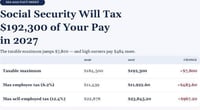
For reference, the taxable maximum will rise to $192,300 next year, up from $184,500 this year, an increase of $7,800.
As a freelancer, this aspect makes me sigh. Self-employed individuals pay 12.4% on their own, including the employer's share.
While I consistently pay my share, it feels like a letdown to see cuts when it's time to receive benefits, like paying a gym membership only to find the gym has closed.
According to the report, the shortfall over 75 years is 4.42% of taxable payroll. Experts agree that the longer we wait to address this, the greater the burden will be to manage all at once.
So, I decided to start with what I can do. By creating a My Social Security account at ssa.gov, I can see my estimated benefits.
Once logged in, I can view my reported income records by year. If there are any missing or incorrect years, I can request corrections, so it's worth checking out.
Try subtracting 22% from the amount shown there and see if you can still make ends meet. I did this and decided to increase my retirement account contributions a bit.
The timing of benefits and spousal benefits varies for each person. It's essential to check with a professional based on individual circumstances.
I believe a compromise will emerge somewhere in the middle. I just hope it doesn't come down to an all-nighter right before the deadline. One freelancer pulling an all-nighter is enough.
 skyroadmaker1967



 puddingcat |

 American Politician Community |

 memorabilia |
 orvian89 |

 looksee 78 |

 nero kim |

 korvon |




 tarve7 |
 Something is popping in the situation |
 chiobase |
 homan |
 The Yellow |
 love ya |
 virex |
 U.S. Weather Bureau News |
 korvex93 |
 nougatpop |
 milkyotter |
 sun walker |
 Hawaii Tourist Information |
 savannah choi |
 glimmer |
 Hot Seat Driver |
 Thou Thou |
 Supplemental Security Income (SSI) Information |
 Breaking Bad Drama |
 San Jose Pop |