
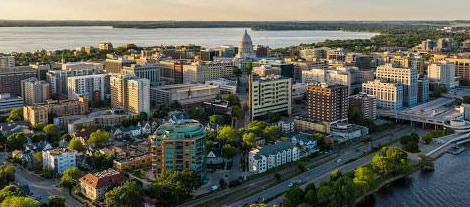
Wisconsin has a balanced economic structure with agriculture, manufacturing, and services, boasting a stable economy and population in the Midwest. Below is a summary of Wisconsin's economic status, median income, racial composition, and population.
Economic Status
The economy of Wisconsin has grown based on agriculture and manufacturing, and recently, the service and technology industries are also rapidly developing.
- Main Industries:
- Agriculture: Wisconsin is known as "America's Dairyland" and ranks high nationally in dairy production, including cheese and milk.
- Manufacturing: The state is primarily focused on paper, appliances, medical devices, and beer production, with Milwaukee and Madison as major manufacturing hubs.
- Services: The education, healthcare, and tourism industries are growing rapidly. Tourist attractions like Wisconsin Dells significantly contribute to economic revitalization.
- Renewable Energy: Eco-friendly energy industries such as wind and bioenergy are expanding.
- Unemployment Rate: Approximately 3.2% (as of 2025), which is similar to or slightly lower than the national average.
Median Income
- Household Median Income: Approximately $66,000 (as of 2025).
- This is slightly lower than the national average (around $70,000).
- Regional Income Disparities:
- Urban areas (Milwaukee, Madison, etc.) tend to record higher incomes, while rural areas show relatively lower incomes.
Racial Composition
Wisconsin primarily has a majority white population, but various racial groups reside together.
- White (Non-Hispanic): Approximately 82%
- Black or African American: Approximately 7%
- Concentrated mainly in urban areas like Milwaukee.
- Hispanic/Latino: Approximately 7%
- Communities are increasing mainly in the southwest and agricultural areas.
- Asian: Approximately 3%
- Notably, the Hmong community is large, residing in Madison and Milwaukee.
- Other and Mixed: Approximately 1-2%
Population
- Total Population: Approximately 5.9 million (as of 2025).
- Population Density: About 44 people per square mile, which is lower than the national average.
- Major Cities:
- Milwaukee: The largest city and economic center.
- Madison: The capital and a college town, with a young and highly educated population.
- Green Bay: Historically a center for agriculture and manufacturing, home to the NFL team Green Bay Packers.
- Population Growth Rate: Showing slight increases, particularly among Hispanic and Asian immigrant populations.
Summary
- Economy: Centered on agriculture and manufacturing, with growth in services and renewable energy.
- Median Income: $66,000, slightly lower than the national average.
- Racial Composition: Predominantly white, but notable communities of Hispanic, Black or African American, and Hmong populations.
- Population: Approximately 5.9 million, with significant differences in population density between urban and rural areas.
Wisconsin is a stable state with increasing diversity, seeking a transition from an agriculture and manufacturing base to advanced technology and service industries.






 middlekick |
 Forever Coco is Bangga |

 Wiscon Shin Blog |
 Superman Cat Blog |
  Tonky |
  viroma |
  cookie |
  Live and that's it |
  Alright Twain |
  eatontown blog |
  HAWAII Korean Church News |
  Amore |
  linex |
  Balancework |
  laro90 |
  MEDBIO American Doctor Blog |
  SWAT TEAM BLK |
  DREAM BIG |
  frostbite |
  330 Forever My Love |
  El Dorado |
  dralix58 |
  Gorama Round |
  Skydiving |