
Last weekend, I walked along the southern coast for quite a while at Plymouth Beach. The wind was pretty strong, and as I walked, a strange question kept swirling in my mind.
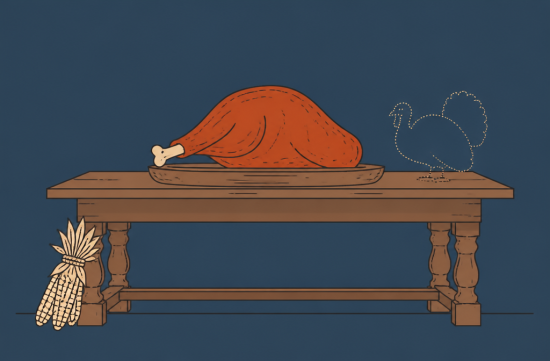
At that famous first Thanksgiving in 1621, held right around here, was there really a turkey in the center of the table?
When I got home and dug through the records, I found the answer to be more interesting than I expected. There are essentially only two eyewitness accounts written at the time.
The first is a letter written by settler Edward Winslow on December 11, 1621. This letter was published the following year in London in a book called Mourt's Relation.
According to Winslow, after the harvest, the governor sent four men to hunt for fowl. It is noted that the birds they caught in one day were enough to feed them for almost a week.
During this time, the leader of the Wampanoag tribe, Massasoit, came to visit with the men, and the settlers hosted them for three days. Winslow noted that there were about ninety people in attendance.
Given that many settlers had perished during the harsh first winter, historians generally explain that there were actually more guests than hosts. It seems this gathering was more about the two groups confirming each other's presence than a feast.
Here comes the key moment. The Wampanoag people went out and brought back five deer, which they presented to the governor and Captain Miles Standish.
So, the meat recorded by name was venison, not turkey, along with a general mention of fowl. Honestly, I found this a bit amusing. The turkey we roast every year doesn't even appear once in the original documents.
The second record is from Governor William Bradford, who later wrote about the Plymouth settlement. In it, he mentions that they caught a lot of wild turkeys in addition to venison and waterfowl that fall.
However, Bradford was describing the food available that entire autumn, not specifically the feast menu. So while it's possible turkey was present, it's hard to conclude it was the main dish.
Researchers at the museum that recreates life in Plymouth at that time, now known as the Plymouth Patuxet Museum, share a similar view. Venison and wild birds are certain, and they believe the fowl were more likely geese or ducks than turkeys.
Of course, within the same museum, there are opinions suggesting that turkey could have been present, as wild turkeys were common in nearby forests.
Ultimately, what's certain is venison, what's plausible is goose and duck, and turkey is a possibility. This seems to be the most honest summary.
What about dessert? If you were expecting pumpkin pie, you might be a bit disappointed. Given that it was the first year of settlement, they likely didn't have an oven, and butter and flour were probably scarce.
It's generally interpreted that they probably just boiled the pumpkin. Being by the sea, they likely also had clams, fish, and corn-based dishes.
Interestingly, in Winslow's lengthy letter, this feast is mentioned in only a few sentences. He probably had no idea that those few lines would remain as the roots of a national holiday over 400 years later.
The date is also more ambiguous than expected. Winslow didn't specify the exact day, and the museum estimates it was sometime between late September and mid-November of 1621.
Even more surprising is that it wasn't even called Thanksgiving at that time. For the Puritans, a day of thanks was a religious day of fasting and prayer, not a three-day feast.
The label of the first Thanksgiving was attached much later, in 1841. It began when a man named Alexander Young republished Winslow's letter in a book and noted that in the footnotes.
The next key figure was magazine editor Sarah Josepha Hale. She persistently wrote letters to various presidents and Congress to establish it as a national holiday.
Hale sent a letter to Lincoln on September 28, 1863, and Lincoln issued a proclamation five days later on October 3, declaring the last Thursday in November as Thanksgiving Day.
Then in 1939, Franklin Roosevelt moved the date up by a week to extend the holiday shopping season, which caused quite a backlash. Ultimately, Congress stepped in, and on December 26, 1941, a law was signed making the fourth Thursday in November the official holiday.
So this year, Thanksgiving falls on November 26. As of the day this is posted, that's exactly one week away.
One more thing worth noting is that since 1970, Indigenous groups have held a National Day of Mourning event every Thanksgiving at Cole's Hill in Plymouth.
For some, 1621 is remembered as a feast of thanks, while for others, it marks the beginning of a history of loss. Rather than choosing which perspective is correct, it's important to recognize that both are valid viewpoints.
After my walk along the beach, I stopped by a nearby shop where someone bought a caramel to chew on. Just like that chewy texture sticking to my teeth, the story of 1621 also sticks with you once you know it.
This year, I won't be leaving turkey off my table. Instead, I might put a pot of venison stew next to it, as that's the meat that actually has a name in the 1621 records.
If you have time during the holiday, I encourage you to take a walk along Plymouth Beach. If you think of the five deer instead of turkey, the familiar holiday might look a little different.
 TakoBalloon


 San Jose Pop |
 Princess Park |
 Art patch |

 Rice Shop Uncle BLOG |
 Noodle Noodle |
 bagel90 |


 juicylol |
 Investment Information News Update |

 tiramisu |

 The Gelaton |
 nougatpop |
 milkyotter |
 sun walker |
 Hawaii Tourist Information |
 savannah choi |
 glimmer |
 Hot Seat Driver |
 Thou Thou |
 Supplemental Security Income (SSI) Information |
 Breaking Bad Drama |
 Gook Rule |
 UCLA Captain |
 Asparagus Blog |
 US Regional Information Local News |
 Joseon Dynasty Seal Enthusiasts |
 zestorbit |
 Lemon Kim |
 blueman |