
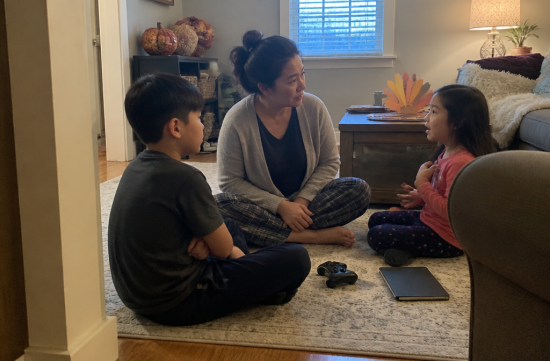
Mom, he did it first! Hearing this a few times a day really makes you feel like Thanksgiving break has begun.
The schools in this area will be closed from Monday the 23rd to Friday the 27th next week. If you include the weekend, that means the kids will be home for a full 9 days.
Honestly, the most exhausting part of those 9 days isn't the cooking or entertaining guests. It's having to step in every time my kids fight and play the role of judge.
I used to be a complete judge myself. I would ask who hit first, listen to the evidence, and even determine the punishment. But strangely, the more judgments I made, the more cases seemed to come to my courtroom.
It turns out I wasn't the only one experiencing this. A paper by Professor Lori Kramer, well-known for her research on sibling relationships, revealed some pretty surprising numbers in 2010.
Observations showed that siblings aged 2 to 4 argue an average of 7.65 times per hour. This figure is cited from research by Perlman and Ross published in 2005.
Siblings aged 3 to 9 also clash with similar frequency, and each fight lasts about 45 seconds, according to observations from Kramer's research team in 1999.
Seeing these numbers actually made me feel relieved. It means my kids aren't unusual; that's just how kids that age are.
Another notable point from Professor Kramer's research is that if siblings get along well when they're young, they tend to maintain that good relationship as they grow older, and if they don't, it often solidifies into a bad relationship. So how we teach them to fight now can have a longer-lasting impact than we might think.
The problem is that if parents always step in as judges during all those fights, the kids never learn how to resolve conflicts on their own. But that doesn't mean we should just leave them to it.
What really helped me was research from Professor Hildy Ross's team at the University of Waterloo in Canada. They published their findings in the journal Child Development in 2007, along with Julie Smith.
The research team gathered 48 families with siblings aged 5 to 10 and taught half of the parents how to mediate. The other half continued to intervene as usual.
The results were quite clear. In families where mediation was taught, fights ended more fairly, and the kids were more actively involved in the resolution process.
Even more interesting was the change in the kids themselves. The children in the mediation group were better at understanding what their sibling wanted and how they felt.
In contrast, the kids in the control group were more likely to blame their sibling and demand explanations. It's like they were growing up under judge parents, becoming prosecutors and defense attorneys.
So what does a mediator do instead of a judge? If I were to explain Professor Ross's method in my own words, it goes like this.
First, we set some rules. No interrupting, no swearing, no yelling. We also make it clear that it's not mom who will decide the outcome, but the kids themselves.
Next, we take turns speaking. Each child explains what happened in their own words, while the parents help clarify what the real issues are.
The third step is the most important. Each child shares how they felt and repeats what the other said in their own words. At this stage, surprisingly, the fight often starts to resolve itself.
The fourth step is for the kids to come up with their own solutions. Parents just need to confirm whether those solutions are realistic.
If they still can't agree, we use a backup plan like rock-paper-scissors or flipping a coin as a fair method. No matter who wins, we agree to accept the outcome cleanly.
At first, honestly, it took more time. What could be resolved in a minute with a judgment took 10 minutes, which was frustrating.
But after a few rounds, the kids started bringing up the rules themselves. They would say things like, "That's interrupting!" Research also showed that kids in the mediation group took the initiative in setting rules and identifying issues.
Of course, there are exceptions. If there's hitting or throwing objects involved, the first step is to separate them, regardless of mediation. It's okay to start the conversation once safety is ensured.
During the holiday, setting things up in advance was also effective. If we set a timer for items that usually cause fights, like tablets or game consoles, it reduces the number of incidents.
On days when guests come over, giving each child a specific task also helps. When they have something to do, they definitely have less time to bother each other.
I think of this as a small market economy within the family. When the parties involved negotiate within the rules rather than having everything dictated from above, they are more likely to accept the outcomes.
That said, parents shouldn't completely step back. It's still the parents' role to enforce the rules and maintain fairness in the process.
This holiday, I would start by setting the rules together on the first morning. I'd put down the judge's gavel and pick up the mediator's microphone. I hope that after 9 days, our home courtroom will be a little less busy.
 CloudMedia
 HotDogMove






 rissa |

 Gomo Nim |

 lattepop |

 Well Done Sir |

 butter 90 |

 Macon Boy |

 vivavida |



 Missouri Kings News Information |
 Going Once |
 monica hong |
 Tainami American Travel Story |
 tarve7 |
 Something is popping in the situation |
 chiobase |
 homan |
 The Yellow |
 love ya |
 virex |
 U.S. Weather Bureau News |
 korvex93 |
 nougatpop |
 milkyotter |
 sun walker |
 Hawaii Tourist Information |
 savannah choi |
 glimmer |
 Hot Seat Driver |