
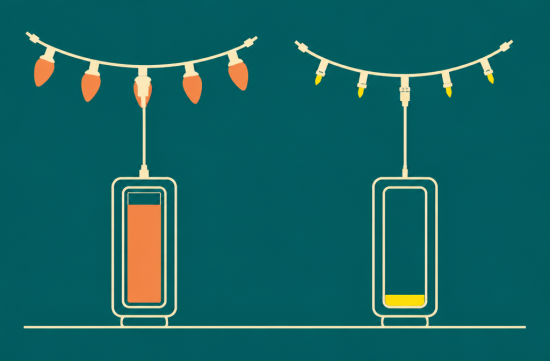
As Thanksgiving approaches, it's an annual tradition to pull out the Christmas lights box from storage. This year, when I opened the box, I found several strands of old mini bulbs tangled among the wires.
The side of the packaging said 40W. At that moment, I became curious. If I leave these on every day for over a month, how much will my electric bill be?
In Hawaii, you can't just brush off discussions about electric bills. So this time, instead of guessing, I decided to calculate using the actual rate schedule.
First, I checked the rates. The residential Schedule R rate from Hawaii Electric Light, which serves Hawaii Island, is $0.442048 per kWh for the first 300 kWh as of November 1, 2026.
The next 700 kWh is $0.480342 per kWh, and anything over 1,000 kWh is $0.492901. Additionally, there is a monthly base fee of $13.14.
For reference, in the August rate schedule, the second tier was $0.499135. Since rates fluctuate monthly due to fuel adjustments, it's best to check the rate schedule for the specific month when calculating.
Lighting typically adds to the base usage, so I calculated using the second tier rate of $0.480342. Most households fall within this usage range.
Now, regarding the bulbs. A set of 100 incandescent mini bulbs is often labeled as 40W on the packaging. Keep in mind that this 40W refers to the entire set, not just one bulb.
A similar set of 100 LED mini bulbs varies by product but generally ranges from 4 to 8W. To simplify the calculation, I used 5W.
I assumed usage for 6 hours each evening, from around Thanksgiving to the first week of the New Year, totaling 40 days. This should be similar to the actual duration most homes keep their lights on.
For one strand of incandescent lights, that's 40W multiplied by 240 hours, resulting in 9.6 kWh. In terms of cost, that's $4.61 for the season.
For one strand of LED lights under the same conditions, that's 1.2 kWh, costing $0.58. The difference per strand is $4.03.
Oh, that's smaller than I expected! I thought the same at first. But most homes don't just stop at one strand; they wrap railings, palm trees, and windows.
If we recalculate based on ten strands, the numbers change significantly. Incandescent would be 96 kWh at $46.11, while LED would be 12 kWh at $5.76. That means a difference of $40.35 for the season.
In terms of energy usage, that's a reduction of 87.5 percent. It's the same sparkle, but using only one-eighth of the electricity, which honestly surprised me.
The U.S. Department of Energy says similar things. They explain that LED lighting uses about 70 percent less energy than traditional incandescent lighting.
LED decorative lights that are ENERGY STAR certified are reported to use about 92 percent less energy than incandescent products. They also last up to ten times longer.
According to the Department of Energy, if you keep a 6-foot tree lit for 12 hours a day for 40 days, the LED would cost $0.27, while the incandescent would cost $10. However, this example is from a 2015 article, so keep in mind it reflects rates from that time on the mainland.
When recalculating with Hawaii rates, the difference can only get larger. Even with the same percentage, if the unit price is higher, the dollar savings increase.
So, is switching a no-brainer? It's important to consider the other side as well. LED sets tend to be more expensive upfront than incandescent ones.
If you're only using one or two strands, the savings for a season might only be a few dollars. It may not be worth it to immediately discard perfectly functioning incandescent sets to buy new ones.
On the other hand, for homes that go all out with decorations, and where incandescent sets are already failing, the calculations change. The cost of replacement can often be recouped within a few seasons.
There's also a safety aspect. ENERGY STAR explains that certified LED lights don't get hot to the touch, reducing fire risk. This difference can be significant when wrapping them near dry decorations.
Whether you switch or not, there's an immediate way to see results: adding a timer. If you forget to turn them off while falling asleep, 6 hours can quickly turn into 12 hours.
If the lights are on for double the time, the electric bill will also double. For ten strands of incandescent, that means a seasonal cost of $46 could jump to $92.
When purchasing new products, be sure to check the wattage on the packaging. Even among LEDs, power consumption can vary by product, and if it has the ENERGY STAR label, it makes choosing easier.
If you're curious about the rate per kWh, you can check the Effective Rate Summary on the Hawaiian Electric website. They provide a monthly breakdown of rates for Hawaii Island.
I ultimately decided to switch the broken sets to LED this year. I'll keep the ones that still work for one more season, but I plan to install a timer today. How many strands do you wrap at your house?
 WhiteHorseP






 West Kong |

 havero70 |

 Grow Your Gut Bacteria Well |
 choi family |
 content |
 figtop |
 raviont |

 Hilo Cat |


 Hawaii Tourist Information |
 savannah choi |
 glimmer |
 Hot Seat Driver |
 Thou Thou |
 Supplemental Security Income (SSI) Information |
 Breaking Bad Drama |
 San Jose Pop |
 Gook Rule |
 UCLA Captain |
 Asparagus Blog |
 US Regional Information Local News |
 Joseon Dynasty Seal Enthusiasts |
 zestorbit |
 Lemon Kim |
 Noodle Noodle |
 blueman |
 Alabama Bang |
 Soy Angelino |
 puddingcat |