

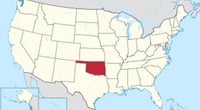
Next Tuesday, November 3rd, there will be a question related to property taxes on the Oklahoma ballot. It's State Question 847, abbreviated as SQ 847.
I've received several questions from local Korean seniors asking if this will reduce their taxes if it passes. So, I looked into the bill summary and county data myself.
First, it's important to note that this is not yet finalized; it's a proposed constitutional amendment that will take effect starting in the 2027 tax year if passed.
This bill addresses the assessment cap, which is the limit on how much the assessed value for tax purposes can increase each year, not the tax rate itself. No matter how much home values rise, the amount used for tax calculations cannot exceed this cap.
Currently, the cap for homesteads, meaning the home you live in and agricultural land, is 3% per year, while other properties have a cap of 5% per year.
If SQ 847 passes, the cap for homesteads and agricultural land will drop to 1.75%, and for commercial and other properties, it will decrease to 4%. This change does not depend on age.
The real point of interest is the provision for those over 65. Oklahoma already has a program called the Senior Valuation Freeze.
Eligible homeowners aged 65 and older can have their assessed value fixed at the time of application. The income limit is set at 100% of the county median household income, based on figures released by HUD.
For Oklahoma County, the income limit for 2026 is a total household income of $99,000. This is a significant increase from $89,500 in 2025.
However, since OKC spans Canadian and Cleveland counties, the limits may vary depending on where you live. Be sure to check the numbers on your county assessor's website.
The problem with the current structure is that if your income exceeds the limit by just $1, you lose the freeze benefit and revert to the standard 3% cap. This creates a sort of cliff effect, which can be quite frustrating for those just above the limit.
SQ 847 aims to turn this cliff into a staircase. It keeps the existing freeze in place and introduces new income brackets for seniors who exceed the limit.
For those with incomes between 100% and 120% of the median, the cap can increase by 0.35% per year; for those between 120% and 140%, it can increase by 0.7%.
For incomes between 140% and 160%, the cap can rise by 1.05%, and for those over 160% but under 180%, it can increase by 1.4%. If your income exceeds 180%, the standard homestead rate of 1.75% applies.
The income used as a basis is the previous year's gross household income. Since retirement income and IRA withdrawals can add up, it's wise to calculate this in advance.
From the data alone, I see a fairly clean design. It's much more reasonable than having benefits disappear entirely just because income is slightly higher.
However, there's one point that shouldn't be misunderstood. Many people seem to confuse this. The assessment cap is being lowered, but that doesn't mean the amount on your current tax bill will immediately decrease.
Taxes are calculated by multiplying the assessed value by the millage rate. The freeze only fixes the assessed value; it doesn't fix the tax amount itself.
The opposing side, OK Policy, warns that local governments may raise the millage rate to meet already approved school and local bond repayments. This means that even those benefiting from the freeze could see their tax bills increase.
There are also concerns that the gap between new homebuyers and long-term residents will widen since selling a home will reset the assessed value to market rates.
The proponents argue that this doesn't cut current income but slows the rate of future increases, giving local governments time to adjust their budgets.
The fiscal note from the state legislature states that the financial impact is unknown. Personally, I find it disappointing that there isn't a concrete estimate. For analysts, these blanks can be quite frustrating.
I personally like the design for the senior bracket, but I think we need to further examine the part about lowering the cap for commercial properties and the financial impact on rural schools.
No matter the voting outcome, there's something you can do now. If you're over 65 and haven't applied for the freeze yet, check the income limits first.
In Oklahoma County, you must apply by March 15 each year for it to take effect that year. Applications can be submitted online, by mail, or in person, and those already receiving the benefit do not need to reapply.
When applying, you typically need to prepare a copy of your most recent federal tax return and other proof of household income and ownership.
If it were me, I would check my home's assessed value records before voting. If it has increased by the full 3% each year for the past few years, I would get a sense of how significant this bill is for me.
Income brackets and tax effects can vary based on individual circumstances, so be sure to confirm with your county assessor's office or a tax professional. Voting is on November 3rd.
 GoldenRain
 StarlitTalk



 orvian89 |

 looksee 78 |

 vivavida |
 MEDBIO American Doctor Blog |

 Burbank Lee |

 Trustworthy Faces |
 Chimhanbang Korea ACU |

 US Regional Information Blog |

 hazelnut |

 ssome |
 skykong |
 Shining Our Own World |
 gardener 007 |
 golfmaster |
 Nanana Nanana Nanana |
 Who's watching? |
 endone |
 RockStar |
 Casa Mia |
 You Only Live Once |
 Hardworking CPA |
 Joyce 77 |
 Runner Kim |
 My Town My Way Blog |
 My Miami Stories |
 Entip |
 Tony Park |
 Jean Claude Bundang Blog |
 DJ DC BLOG |