

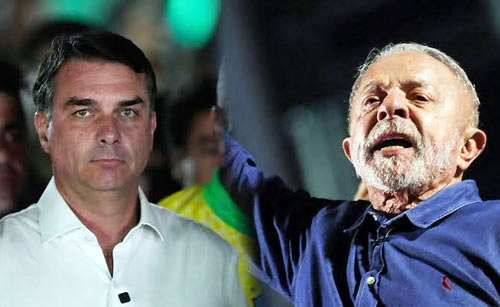
However, this Brazilian presidential election is truly astonishing. There is someone who, despite not being elected, acted as if they had already won and ultimately lost the election.
That person is Flávio Bolsonaro. He is the son of former president Jair Bolsonaro and was seen as the next leader of Brazil's right-wing.
On October 4, in the first round of Brazil's presidential election, Flávio received 47.03%. The incumbent president, Lula, received 45.16%. He won by about 2.23 million votes.
This was quite a favorable start.
Moreover, since 1989, there has been no case of a candidate trailing in the first round of Brazil's presidential elections coming back to win in the runoff.
So, it was understandable that the right-wing was excited.
The problem is that excitement and losing one's grip on reality are entirely different things.
As soon as Flávio won the first round, he began to act as if he had received a certificate of election.
Even before the election was over, he started discussing appointments for the next government. Political experts in Brazil pointed out that this excessive confidence came off as arrogance to voters.
What remarkable confidence! It's as if he was already contemplating where to display the championship trophy before the final match.
The second issue is that he relied too heavily on his father's political legacy.
Throughout his campaign, Flávio emphasized his image as his father Bolsonaro's political successor. He even promised to pardon his father and his associates if he became president.
This would have been an appealing narrative for his fervent right-wing supporters.
However, a presidential election is not a family event to restore a father's honor.
What the Brazilian people are concerned about right now are prices, jobs, security, and living costs.
Wouldn't it have been more important to explain how he would improve the citizens' wallets rather than talking about saving his father?
The third issue is that he underestimated his opponent.
Lula is 80 years old this year. There have been corruption controversies, and there is significant fatigue regarding his long tenure.
However, this seasoned politician regained his focus after losing the first round.
He strengthened his street campaigning and social media activities and actively engaged voters who did not participate in the first round.
About 33.4 million people abstained from the first round. Voter turnout in the runoff increased from 78.92% to 80.8%.
In the end, Lula received 51.79%, while Flávio got 48.21%.
The person who led by 2.23 million votes in the first round lost by about 4.43 million votes in the runoff. Hahaha, this happened in just three weeks.
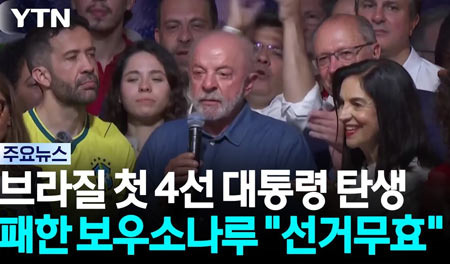
Of course, this defeat cannot be solely attributed to Flávio's arrogance. Lula's organizational strength, support for welfare policies, and increased voter turnout were also significant factors.
However, if he acted as if he had already won until the very end of the election, it's hard to avoid criticism of his political judgment.
Even more absurd is his behavior after the defeat.
Flávio questioned the extension of voting hours and refused to acknowledge the election results, demanding their annulment.
Yet, his own camp had requested an extension of voting hours in areas affected by heavy rain.
This situation makes it easy to perceive that it's acceptable when it benefits him but a fraudulent election when it doesn't.
Ultimately, his party, the Liberal Party, officially recognized the election results.
From the perspective of a Korean living here in Washington, I have a few thoughts while observing this election.
First, political enthusiasm and actual public sentiment are different.
In the Korean community in the U.S., it's easy to fall into the illusion that everyone thinks the same way just by looking at YouTube or political communities.
However, those who are loud online are different from those who show up at the polls.
Another point is that a politician's abilities should not be evaluated solely based on party logic.
I fundamentally support small government and free-market economics. However, that doesn't mean I believe that right-wing candidates are necessarily competent.
What matters to us living in America is not who can shout louder against the left but how taxes, prices, business environments, security, healthcare costs, and immigration policies are actually managed.
Especially for Koreans living in America who run businesses and pay taxes, a politician's practical abilities are not a trivial matter.
Finally, politics is ultimately about persuading people.
It's easy to gather supporters and assure victory among them. The challenge lies in winning over those who have yet to make up their minds.
Flávio had already secured sufficient support in the first round. However, he failed to gain the additional support needed in the runoff.
A politician who acted like a president before even becoming one.
Yet, after the election, he found himself in a position where he had to acknowledge his defeat, let alone become president.
This serves as a good example of what happens when one jumps the gun in politics.
If the right truly wants to seize power, they need to listen to the voices of the citizens who do not yet support them rather than just the applause of their enthusiastic supporters.
Because elections are not a game where the loudest cheers from one's own side guarantee victory.
 Biscuit






 postcard |

 Breaking Bad Drama |

 Coastal city |

 novapixel |

 Victory 1988 |

 Another Eden Channel BLOG |
 El Dorado |

 Everything Students Can Do |

 Holey Moley |

 heartbreaker |
 silents |
 Team Korea Psychoanalysis Research |
 North Dakota Ragdoll Cat Owner |
 Cap Com |
 Trot King News |
 Blondee |
 some fame |
 rapidfire |
 walnutbo |
 Shinbaram Dr. Blog |
 breaddough |
 Michigan Enthusiast |
 Only Dentalbay |
 Buckwheat Muktudari Notebook |
 Kitchen Ideas |
 Jellia Angel |
 Rice Shop Uncle BLOG |