
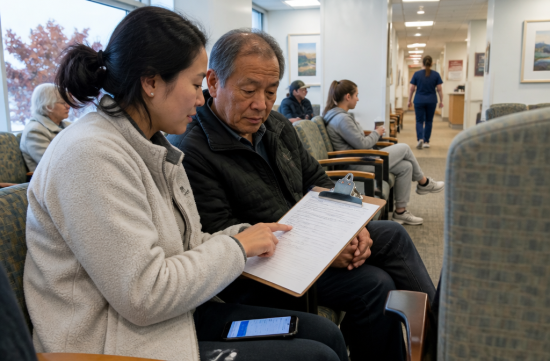
These days, one of the most common concerns I hear from people is about their parents' hospital schedules. They have surgery dates set, but they feel lost about what to tell their employer, how many weeks they need to take off, and what will happen to their salary during that time.
Having gone through a similar situation myself, I took a close look at the Connecticut programs. To put it simply, if you are a child working in this state, there are more options available than you might think.
However, there are three programs with similar names that can be confusing: CT Paid Leave, CT FMLA, and paid sick leave.
First, let's look at CT Paid Leave. This program provides income replacement. It is managed by the CT Paid Leave Authority under the state government, and it is this agency—not your employer—that determines eligibility.
The funding comes from a 0.5% contribution deducted from employee salaries. This rate remains the same in 2026, and the salary cap for contributions is $184,500, meaning the maximum contribution per year is $922.50.
In simple terms, this means you are already paying a monthly premium. You should use it when you need it, honestly.
You can receive benefits for up to 12 weeks within a 12-month period for family caregiving. Family includes not only parents but also in-laws, grandparents, and siblings.
It's quite broad in that it includes people who are not blood relatives but are recognized as family-like relationships. The care recipient must have a serious health condition.
The eligibility criteria are based on income. You must have earned more than $2,325 in the highest-earning quarter of the four quarters in the most recently completed five-quarter base period.
Most full-time employees will meet this threshold. Since it looks at income rather than tenure, even if you recently changed jobs, you may still qualify.
Now, you might be wondering how much you will receive. The minimum wage in Connecticut in 2026 is $16.94 per hour, and the calculation is tied to this figure.
You will receive 95% of your pay up to $677.60, which is 40 times the minimum wage. Any amount above that is only recognized at 60%.
The overall cap is $1,016.40 per week, which is 60 times the minimum wage. This is an increase from $981 in 2025.
For example, if your average weekly wage is $1,200, you would receive $643.72, which is 95% of $677.60, plus $313.44, which is 60% of the remaining $522.40, totaling about $957.16 per week.
The average weekly wage is calculated based on the two highest-earning quarters in the base period, so the actual amount will be confirmed in the notification after applying. Be prepared for the fact that the higher your income, the lower the replacement rate will be.
One trap that many people fall into is that CT Paid Leave is a program that provides money, not job protection.
Job protection, or the guarantee of returning to your position, comes from a separate law called CT FMLA. Therefore, it's crucial to apply for both simultaneously.
CT FMLA applies to almost all private employers with at least one employee. If you have worked for the same company for three consecutive months, you are eligible, and there are no hour requirements.
In contrast, the federal FMLA requires you to have worked 1,250 hours over 12 months at a company with 50 or more employees, making Connecticut's threshold much lower. Often, both laws are applied simultaneously.
The third option is paid sick leave. Connecticut is gradually expanding this law, so by 2026, it will apply to businesses with 11 or more employees, and starting January 2027, it will apply to any business with just one employee.
Sick leave can also be used for family caregiving. For short appointments like check-ups, you can use this, while longer recovery periods after surgery can be covered by Paid Leave, making it efficient to split the two.
Paid Leave can be taken not just in a continuous block but also in separate days. This approach is much more practical for situations like chemotherapy, where you need to go to the hospital regularly.
Now, let's outline the steps to take. First, notify HR as soon as the schedule is set and request the CT FMLA paperwork.
Second, apply for Paid Leave through the online portal at ctpaidleave.org or by calling 877-499-8606. Third, ask your parents' healthcare provider for a certification.
Since it can be difficult for your parents to gather the English documents themselves, it's a good idea for you to bring the forms when making the medical appointment to save time. I've seen many cases where this part gets delayed by a week.
Also, your company might operate a private plan for Paid Leave instead of using the state program, so be sure to check with HR about where to apply. Since the application can vary based on personal circumstances, it's safest to confirm with HR or a labor law expert if you're unsure.
Personally, I think this program is quite well-designed. It operates on the contributions made by employees rather than being fully funded by the government, and it provides more robust protection for those with lower incomes, creating a balance.
Of course, high earners may find the cap disappointing, and the burden on small business employers cannot be overlooked. Still, I believe it's a much more reasonable option than giving up your career to stay by your parents' side.
If I were in your shoes, I would start preparing the name of the HR contact and setting up a portal account as soon as my parents' health check results were uncertain. When the urgency hits, those small preparations feel the most significant.
Have you ever considered taking leave to care for your parents? I'm curious about how you approached the conversation with your company the first time you brought it up.
 Fruity Pebble




 memorabilia |
 orvian89 |

 looksee 78 |

 vivavida |
 MEDBIO American Doctor Blog |

 Buckwheat Muktudari Notebook |

 Lee Sang Don |

 Dream Mong |

 Hagen |

 Purple Moons, |
 Ted 600 |
 jaxter |
 garlic bread |
 Cheese Hill Restaurant Exploration |
 gentle |
 tamarindbay |
 Yes Dorian |
 Hedgehog Baggu Story |
 Good Riddle |
 Well Done Sir |
 struct |
 Vision XT |
 Way to easy |
 Joyce 77 |
 dreamer20 |
 business lim |
 lorixa |
 Que Buena |
 Street Smart Blog |