
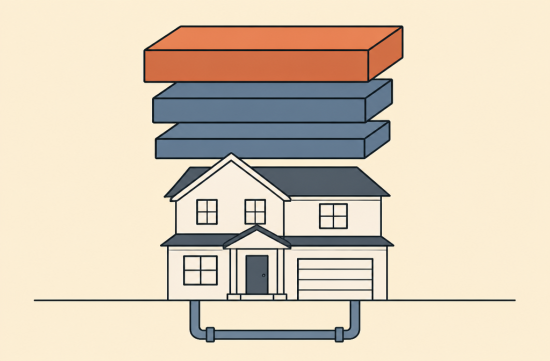
People visiting new developments on the outskirts of Fort Worth often ask a common question: if home prices are similar to existing neighborhoods, why are the property tax bills so much heavier?
The answer can usually be summed up in two words: MUD and PID.
Both of these add a line for taxes that didn't exist in the previous neighborhoods. Today, we will go through what these two are and what you should check before buying a home.
First, let's look at the basics. Texas has no state income tax.
Therefore, local governments like cities, counties, and school districts heavily rely on property taxes. This applies equally to both new and existing neighborhoods.
The problem arises when creating a new neighborhood on undeveloped land. Someone has to lay down water pipes, sewer lines, drainage systems, and roads before homes can be built.
In the past, cities often covered these costs. Now, it's common for developers to create special districts, issue bonds, and have the residents pay off that debt through taxes later.
MUD stands for Municipal Utility District, which can be thought of as a small local government set up to repay the debt incurred from building neighborhood water and sewer facilities.
MUDs are operated by a board elected by residents, which sets its own tax rate each year. Therefore, even within the same Fort Worth area, tax rates can vary from development to development.
According to the Parker County Appraisal District, the tax rate for Morningstar MUD in 2020 was $1.00 per $100 of assessed value, which was higher than the Fort Worth city rate of $0.7475 listed in the same data.
MUD tax rates are usually highest at the beginning. This is because there is a lot of debt but still a small number of homes to share the tax burden.
As occupancy increases and the bonds are paid off, tax rates often decrease. However, if additional bonds are issued, the rates may not drop as expected, so it's important to consider the remaining debt size as well.
PID stands for Public Improvement District. If the term is unfamiliar, think of it this way: it's a special assessment for improvements like roads, parks, and landscaping that the city charges separately to homes within an approved district.
While a MUD is an independent local government, a PID is a district designated and managed by the city. Both appear as separate items on the tax bill.
The city of Fort Worth has made the calculation method for PID assessments public. It involves dividing the appraised value by 100 and multiplying it by the rate for that district.
Let's look at a real example. Walsh, a large development on the west side of Fort Worth, states that it is within the city limits of Fort Worth.
According to Walsh, the combined tax rate as of December 31, 2025, is 2.689427%. This includes a PID assessment of 0.35%, and some areas have additional fixed assessments.
To make the calculation easier, for a home appraised at $400,000 with a 0.35% rate, the PID assessment alone would be $1,400 per year.
Additionally, the city tax has become a variable. The Fort Worth City Council set the tax rate for the 2027 fiscal year at $0.70565 per $100 during a meeting on September 15, 2026.
This is an increase from the previous year's rate of $0.67. If it's a new development within the city limits, residents will have to bear this increase along with the PID assessment.
However, this doesn't mean that new developments are always at a disadvantage. When compared side by side with existing neighborhoods, the picture looks a bit different.
Existing neighborhoods may have lower tax rates, but the homes are older and may require repairs for roofs, plumbing, and air conditioning. New developments have a higher tax burden but often have lower initial repair costs and new schools and shopping centers coming in.
Ultimately, the comparison should be made based on total monthly costs rather than just home prices. You need to consider the principal and interest, taxes, insurance, and HOA fees to get an accurate picture.
There are also established methods for checking this. In Texas, when selling a home in a special tax district, the seller must provide written notice to the buyer.
The form provided by the Texas Real Estate Commission (TREC) is titled Special Tax or Assessment District Buyer Notice. If a contract is signed without this notice, the law allows the buyer to terminate the contract.
In addition to the notice, it's advisable to verify directly. You can search by address on the Tarrant County or Parker County Appraisal District websites to see the tax units attached to that home.
If it's a PID, you can find the district's assessment plan published by the city. It will indicate how long the assessments will continue and whether they can be paid off in one lump sum.
Don't forget to check the school district taxes separately. In November 2025, a resident vote raised the school district homestead exemption to $140,000, so be sure to apply for the exemption after moving in.
From my experience observing the market in this area for a long time, I believe that the duration of the tax rate is more important than the rate itself. I would choose a development with a transparent debt repayment plan, even if the tax rate is slightly higher.
Don't just rely on the monthly payment estimates you receive from model homes; make sure to check each line of the tax bill before making a decision.
 MintCandy






 silents |
 Choco Choco Star |

 gentle |
 neapolis |

 moo moo |

 chilli chilli |

 mariashin |

 Dala Dala |

 jaxter |
 Ted 600 |
 garlic bread |
 Cheese Hill Restaurant Exploration |
 tamarindbay |
 Yes Dorian |
 Hedgehog Baggu Story |
 Good Riddle |
 Well Done Sir |
 struct |
 Vision XT |
 Way to easy |
 Joyce 77 |
 dreamer20 |
 business lim |
 lorixa |
 Que Buena |
 Street Smart Blog |
 butter 90 |