

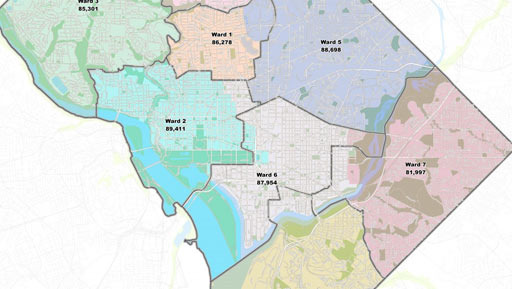
When you start to learn about Washington DC, you often come across the term "Ward."
Is it an electoral district? An administrative division? This unit, which feels both familiar and foreign, is a significant concept in DC.
DC is divided into 8 wards, and each ward has distinctly different population compositions, income levels, and atmospheres.
DC is broadly divided into four sections based on direction: NW (Northwest), NE (Northeast), SW (Southwest), and SE (Southeast).
This division is centered around the U.S. Capitol. The 8 wards overlap within this framework. Ward 1 includes areas like Columbia Heights, Adams Morgan, and Mount Pleasant, which have a diverse population with a high percentage of Hispanic and African American residents, as well as a vibrant arts community.
Ward 2 encompasses Georgetown, Dupont Circle, Logan Circle, and U Street, which are among the busiest commercial areas and historic districts in DC. It has a high percentage of affluent white residents and is densely populated with restaurants, bars, and galleries.
Ward 3 covers upscale residential areas in Northwest DC, such as Cleveland Park, Chevy Chase DC, and Tenleytown. Traditionally, this area boasts the highest income and education levels in DC, with many white professional families.
Ward 4 includes middle-class residential areas in North DC, such as Petworth, Brightwood, and Takoma, with a significant number of middle-class African American families, and some areas currently undergoing gentrification.
Ward 5 includes neighborhoods in the Northeast, such as Brookland, Woodridge, and Brentwood, and is home to Catholic University and Gallaudet University.
Ward 6 covers the eastern part of Capitol Hill, Navy Yard, and NoMa (North of Massachusetts Avenue), where rapid development has recently attracted many young professionals. Nationals Park and one of the largest entertainment clusters in the metropolitan area, the Navy Yard, are located here. Ward 7 includes areas east of the Potomac River, such as Deanwood, Benning Heights, and River Terrace, which have lower income levels and relatively high crime rates. Public investment and development are urgently needed in this area. Ward 8 includes neighborhoods in Southeast DC, such as Anacostia, Congress Heights, and Bellevue, which have historically been among the most marginalized areas. However, recent development along the Anacostia Riverfront is bringing about change.
Another important geographical concept to understand DC is the nicknames of each area.
Upper NW is known for its affluent image, Capitol Hill for being a residence for politicians, Shaw and U Street for their historical significance in Black culture, and Adams Morgan for its Latinx and multicultural image. Areas with significant Korean populations are concentrated in the suburbs of Virginia (Annandale, Centreville, Fairfax) and Maryland (Rockville, Gaithersburg) rather than within DC itself. Within DC, areas with some Korean residents include Tenleytown and near Friendship Heights.
Understanding DC's administrative divisions allows for a more comprehensive grasp of real estate, school districts, safety, and living conveniences.
Even within DC, Ward 3 and Ward 8 can feel like completely different cities due to the significant disparities.
This inequality has long been a challenge for DC. For those considering a move, developing a habit of examining areas by ward can be helpful.
 SunSparkle
 HappyOcean
 CocoDreams


 neapolis |
 moo moo |
 ultron78 |
 garlic bread |
 Sugar Cream Door Bulletproof Noodles |
 Another Eden Channel BLOG |
 Everything Students Can Do |
 El Dorado |
 washington mom |
 lavender |
  Bridgo |
  Tamfa Fan |
  Sunny Sunday |
  mini hometown |
  torvia |
  Chichiki Chicago Train |
  Univ Student |
  See It |
  Con Cheese |
  softmoony |
  Breaking Bad Drama |
  New York Queens Native Blog |
  Shinbaram Dr. Blog |
  vivavida |
  Way to easy |
  limestone |
  oster |
  daddyyo |