
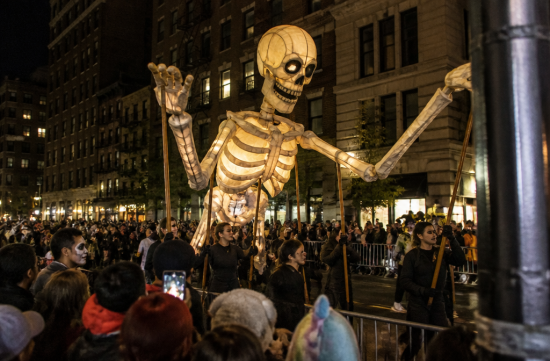
You've probably heard the story of skeleton puppets marching down 6th Avenue in New York on Halloween night, right? I used to think this parade was originally a corporate event or a city government function.
But it turns out it all started with one puppet playwright. His name is Ralph Lee, an artist who created masks and puppets.
The story goes back to the spring of 1974. While teaching at Bennington College in Vermont, he was tasked with an outdoor performance on campus.
It wasn't a performance that ended on one stage; instead, the audience walked along a path, encountering scenes one by one. This idea later became the backbone of the parade.
That Halloween, he brought that format to the West Village. The starting point was the courtyard of Westbeth, an artist housing community.
Initially, it was more like a moving puppet show for his kids and their friends. People with large puppets and masks walked through the neighborhood alleys toward Washington Square.
Honestly, I felt a bit emotional at this point. It all started with the simple intention of bringing joy to neighborhood kids, without any grand plans or sponsors.
The following year, in 1975, it grew significantly. They even added a structure that concluded with a vaudeville performance in the park.
That year, Ralph Lee received an Obie Award for the parade, which shows the true identity of this event—street marching receiving a theater award.
Afterward, the parade established itself as a nonprofit organization, and now Jeanne Fleming serves as the artistic director and producer. The year she took over varies slightly across different sources.
The current parade is on a scale that can't be compared to that initial alley march. However, the tradition of a giant puppet leading the way remains intact.
These puppets are created by a team called the Processional Arts Workshop. The sight of puppets made of paper, fabric, and light floating above the streets at night is overwhelming, even just in photos.
This year, 2026, marks the 53rd parade. It starts at 7 PM on Saturday, October 31, and will proceed even if it rains.
The route begins at Canal Street and goes up 6th Avenue to 15th Street. In previous years, the endpoint has varied, so be sure to check the official guide before you go.
This year's theme, according to various media reports, is Body & Soul. They are preparing glowing spirits and dancing skeleton puppets inspired by the Mexican Day of the Dead.
I really love this theme. As someone whose eyes light up at the mention of food, the Day of the Dead is a holiday rich in culinary culture.
People place their deceased loved ones' favorite foods on altars and share sugar skulls and pan de muerto. It has a strangely similar aspect to our own ancestral rites.
The idea of inviting the dead to the table instead of scaring them away resonates deeply. This sentiment is not unfamiliar to Koreans, which makes it even more appealing.
The most wonderful aspect of this parade is how anyone can participate. As long as you come in costume, you can join the march without any prior registration.
Watching is also free. There are no tickets or VIP seats; standing by the roadside is your front-row seat.
It's quite surprising that such an event has survived for over 50 years in today's world. While everything else is turning into paid experiences, this event keeps an entire street open for everyone.
From an immigrant's perspective, this holds significant meaning. Even if your English isn't great or you have no ties to the neighborhood, wearing just a mask makes you a participant for that night.
It's also worth noting that this event is particularly beloved by the LGBTQ+ community. It's a night when people can step out onto the street as their true selves without worrying about judgment.
Here are a few practical tips. To participate in the march, head to the gathering spot near Canal Street and 6th Avenue, and check the official site for entry times.
Parking that night is nearly impossible. The organizers also recommend using the subway.
If you're just there to watch, it's best to claim your spot early. The area near the starting point gets really crowded, so aim for a block a bit further up.
And don't go hungry, seriously. The march is long, and it's not easy to pop into a restaurant along the way.
If it were me, I'd have a hearty meal in the Village during the day, grab a warm drink, and walk to 6th Avenue. A simple face painting would be enough for a skeleton costume.
A neighborhood march started by one puppet playwright for children has now become a symbol of New York. It shows that sincerity can go further than a huge budget, which is why I truly love this parade.
 GalaxyLink





 Community Cross |

 Conflite Teacher |

 SEVEN SEVEN |

 Korean Mom |
 novapixel |
 newyorker 101 |

 PPAP Pineapple Pen |

 NYC saladbar |

 Eating Gukbap and Working Hard Deer |

 Encyclopedia of New York and Surrounding Areas |
 Moon Su San |
 vanilla |
 norvexi |
 Lunch and Dinner Mexican Taco |
 skykong |
 My Circle |
 urban legend |
 coolriver |
 Good Neighborhood, Wealthy District Information |
 Ro Ro Car |
 Amber H |
 new sugar |
 Palm 1000 |
 loran |
 donutfield |
 Tennis City |
 sunny7 |
 Questions about firearms while living in America |
 Shoot Me |