
There is a song that is often heard at American school events or baseball games, either instead of or following the national anthem. That song is America the Beautiful.
At first, I thought it was just a patriotic hymn. However, I was surprised to learn that the lyrics originated from the summit of Pikes Peak, located just behind Colorado Springs.
The story dates back to the summer of 1893. Katherine Lee Bates, an English professor at Wellesley College in Massachusetts, took a vacation and headed west.
Her destination was Colorado Springs, where she was set to teach English at a summer school at Colorado College.
On her way, she stopped in Chicago. That year, the World's Columbian Exposition was taking place in Chicago, and she saw the so-called White City with its rows of white buildings.
It is widely believed that the image of the shining white city mentioned in the lyrics came from that fair. I thought the song only celebrated the plains and mountains, but it also included dreams of the city.
Then, on a day in July, Bates decided to climb Pikes Peak with her fellow teachers. It is a mountain that rises over 14,000 feet above sea level.
Nowadays, you can drive to the summit, but it was different back then. Bates recalled that the group rented a prairie wagon to ascend, and near the summit, they abandoned the wagon and switched to mules.
Honestly, I found this part amusing. A college professor switching from a wagon to a mule seems quite tough.
I can imagine what the view from the summit must have been like. To the east, there were endless plains, and to the west, the layered Rocky Mountains stretched out.
It is said that the first line of the poem came to her while she was taking in that sight. However, the records differ slightly on where she finished writing it.
Some say she wrote the first stanza in her room at the Antlers Hotel after descending the mountain, while others say she jotted it down in her notebook on the way down. What is certain is that the starting point was Pikes Peak.
Interestingly, this poem did not immediately see the light of day. It remained hidden in her notebook for two years.
There are records that the original working title was Pikes Peak, indicating how strong an impression that day left on her.
The first publication was on July 4, 1895, Independence Day. It appeared in the church weekly The Congregationalist under the title America.
Bates continued to revise the lyrics. She released a second version in 1904, and the final version we sing today was completed in 1913.
The story of the music is another tale. The melody we know today was created by Samuel A. Ward, an organist from New Jersey, in 1882 for another hymn called Materna.
The poem and the music were later paired together, and they were published under the title America the Beautiful in 1910. Some sources suggest that the pairing occurred as early as 1904.
However, there is a bittersweet fact here. Ward passed away in 1903.
This means that the lyricist and the composer never met. Ward never got to see his melody become one of the most beloved songs in America.
I believe this aspect is the true charm of the song. It became a national song through the separate creations of two individuals who never knew each other, which feels very American, doesn't it?
This is not a song planned and directed by someone above. It was created from the emotions felt by a professor on a journey, a melody from an organist, and the people who chose to sing it.
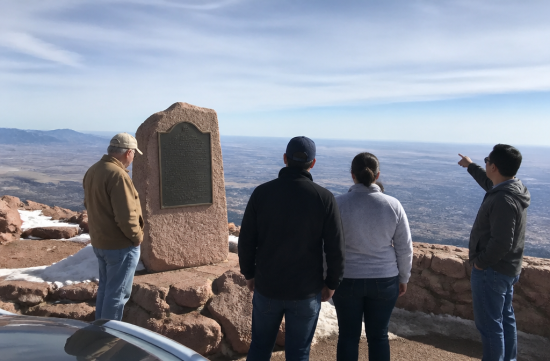
The people of Colorado Springs have not forgotten this connection either. In 1993, the 100th anniversary of Bates's ascent, local businessman Costas Lombochos donated a monument, which was erected at the summit of Pikes Peak.
So, the next time you go up Pikes Peak, don't just buy donuts and head back down; make sure to find that monument as well. The air at the summit is thin, so you might find it a bit hard to breathe.
If I were there, I would hum a line or two of the song. After all, I would be seeing the same plains and mountains that Bates saw from that very spot.
As an immigrant, there are times when I feel like I'm wearing someone else's clothes when I sing this country's song. I felt that way too.
However, this song resonates differently. It sings not of war like the national anthem but of the land and sky, and the hope that people care for one another.
That's why I prefer this song over the national anthem, The Star-Spangled Banner. Knowing that the admiration of one person looking down from a mountaintop is the starting point of this song makes it even more special.
 TigerMilkFoam








 Community Cross |

 Conflite Teacher |

 SEVEN SEVEN |

 Korean Mom |

 novapixel |

 Skydiving |

 Questions about firearms while living in America |

 Famous Attractions in the United States |
 Jellia Angel |
 sunny7 |
 Shoot Me |
 mochifox |
 zucchini |
 Anna Life |
 Exciting FM Radio |
 pet dog |
 toodin |
 rosed |
 DeArizona Blog |
 river9 |
 ollege Mom |
 Pronunciation Yo |
 nuvex11 |
 Living in Florida |
 axelon47 |
 lumbus |
 Texas Migration Story |
 Scade Studio |