
Last weekend, I loaded a large pack of ground beef, a bag of chicken breasts, and a two-loaf bundle of bread into my cart at Costco. I felt proud at the checkout, but as soon as I opened the fridge door at home, I sighed.
I wondered if this amount made sense for a household of two. In fact, I used to throw away half of it. Buying in bulk and then throwing it away ultimately means I paid a lot for it.
So, after years of trial and error, I want to share the storage tips I've settled on. It's not a big secret; it's just a method that takes an hour on the day you shop.
The first thing to remember is time. According to the USDA, perishable foods should not be left at room temperature for more than 2 hours. If the outside temperature exceeds 90 degrees Fahrenheit, that time is reduced to 1 hour.
I realized how dangerous my habit of loading meat into the trunk of my car after shopping and running errands was during the summer. Nowadays, I don't schedule other appointments on days I go to Costco.
When I get home, I first check the temperatures of my fridge and freezer. The guidelines are to keep the fridge below 40 degrees Fahrenheit and the freezer at 0 degrees Fahrenheit. Having a thermometer attached gives me peace of mind.
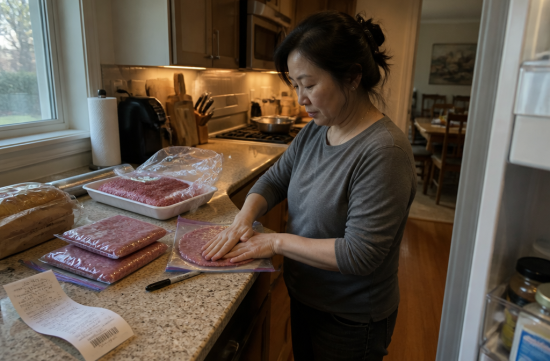
Now, let's look at the meat. If you freeze ground beef in one large chunk, it can be really inconvenient later. I portion it into zip-top bags, flattening them with my palm before freezing.
This way, it thaws quickly and can be stored upright in the freezer like a book. I always write the date on the zip-top bag with a marker.
There's a reason for writing the date. Food frozen at 0 degrees Fahrenheit is safe indefinitely, but there is a time limit for taste and quality. Ground beef is recommended to be consumed within 3 to 4 months.
Chicken has a bit more leeway. Cut chicken pieces are good for about 9 months, while whole chickens can last about a year in terms of quality. Still, I try to eat it within a few months.
If you plan to freeze something in its original packaging for more than 2 months, it's advised to wrap it again in cooking foil or freezer bags. The store wrap is thinner than you might think, and freezer odors can seep in, causing freezer burn on the surface.
I send one loaf of bread straight to the freezer as soon as I get it. It's said that if you put it in a thick freezer bag, the quality will be maintained for about 3 months.
In the morning, I take out two slices and pop them straight into the toaster, and they come out crispy like freshly bought bread. When I first tried this, I laughed at myself for not knowing it sooner.
Cheese is a bit tricky. Hard cheeses like cheddar freeze fairly well, but soft cheeses can lose their texture when frozen.
So, I grate hard cheeses and freeze them in portions, while I buy small sizes of soft cheeses like brie or cream cheese. Bulk buying isn't always the answer.
Vegetables and fruits are the items I used to throw away the most. I wash spinach or berries and dry them completely before placing them in airtight containers lined with paper towels.
If I think I won't eat them within a few days, I peel and slice bananas, and spread berries out to freeze. No one can tell they were frozen when added to smoothies or oatmeal.
Preparing meals in advance is also a good strategy. I make a large batch of bulgogi or curry in a big pot and divide it into shallow containers to cool quickly and be safer.
For sauces or broths, I pour them into ice cube trays or muffin tins to freeze, then transfer the cubes into zip-top bags. It's really convenient to toss in a couple of cubes when making stew.
Leftover food made this way should be eaten within 3 to 4 days in the fridge, and if I think I won't finish it, I freeze it right away. When reheating, it's recommended to heat it to 165 degrees Fahrenheit.
If you open my freezer now, you'll see flat bags of meat organized by date on the left side, and bags of bread and cheese on the right. The top shelf is for items that need to be eaten within the week.
Having this designated shelf makes it easy to see what's getting old. It also helps to keep a small note on the fridge door listing what's inside.
Still, there are days when I have too much. On those days, I share with neighbors or friends. There are quite a few households around me that shop together from the start to split items.
In fact, this is something that weighs on my mind a bit. The bulk discount structure favors those who pay a membership fee, have a car, and own a large freezer.
So, I believe that sharing is more than just simple savings. Just bringing a container of side dishes to an elderly neighbor can turn wasted food into someone's meal.
If you don't have a good place to share, donating unopened canned goods or dry foods to a local food bank is another option. Since the items accepted can vary by location, it's best to ask in advance.
To summarize, I share right after shopping, freeze things flat, write dates, and share when I have too much. Just following these four steps has significantly reduced the amount I throw away.
Buying in bulk isn't always a benefit. It's only advantageous when you can consume it all. If I were to advise, I'd suggest starting with easy-to-freeze items like meat and bread in bulk.
What items do you find yourself throwing away the most after shopping at Costco? Is it vegetables, bread, or sauces? Let me know by picking one in the comments, and I'll compile storage tips for that item in the next post.
 AutoOkay








 choi family |

 What can make money? |

 road98 |

 Baguette Blog |

 Khan Film Blog Production |

 DREAM BIG |

 Information on All Regions of the United States |

 American History This and That |

 Famous Attractions in the United States |

 Cap Com |
 sunny7 |
 Questions about firearms while living in America |
 Shoot Me |
 mochifox |
 zucchini |
 Anna Life |
 Exciting FM Radio |
 pet dog |
 toodin |
 rosed |
 DeArizona Blog |
 river9 |
 ollege Mom |
 Pronunciation Yo |
 nuvex11 |
 Living in Florida |
 axelon47 |
 lumbus |
 Texas Migration Story |
 Scade Studio |