
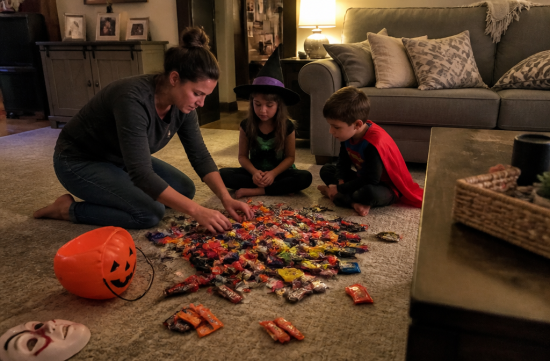
On Halloween night, similar scenes unfold in neighborhoods everywhere. When children come home with bags of candy, parents first dump them on the living room floor and inspect each piece.
They discard any that are torn, as well as homemade cookies or candy wrapped in plastic. If you've raised a child in the U.S., you've likely participated in this candy check at least once.
But it made me wonder: when and why did this habit start? Were there really that many incidents of strangers poisoning candy?
Upon researching, I found the answer quite surprising. To put it simply, there have been no confirmed cases of strangers poisoning Halloween candy that resulted in a child's death.
There is a sociologist from the University of Delaware, Joel Best, who has delved into this topic for decades.
Since 1958, he has collected reports of Halloween candy incidents published in major newspapers and verified them with police and hospitals. Most were pranks or completely fabricated stories.
In fact, there were quite a few cases where children themselves reported finding pins in their candy. They likely wanted attention.
Reports of sharp objects like razor blades or needles found in candy were mostly unfounded. In reality, very few injuries occurred, with the worst being a few stitches.
So where did this fear come from? Rumors about razor blades in apples began circulating in the late 1960s.
In 1968, New Jersey even passed a law to punish anyone who put harmful substances in apples right before Halloween. The practice of handing out apples, which was common before, nearly disappeared by the 1970s.
The tipping point came in 1974 in Texas, when 8-year-old Timothy O'Brien died after consuming a Pixy Stix laced with cyanide.
The perpetrator was not a stranger but the child's own father, Ronald O'Brien. He committed the crime to collect life insurance on his children and was executed in 1984.
A case in 1970 where a 5-year-old in Detroit died was initially blamed on candy. However, upon investigation, it was revealed that the child had ingested heroin hidden by an uncle, and the family had tried to cover it up by placing it in candy.
In both cases, the perpetrators were family members. Yet, what stuck in people's memories was the image of a stranger handing out candy. It's ironic.
The nationwide fear was amplified by the 1982 Tylenol incident in the Chicago area. Someone had laced painkiller capsules with cyanide, resulting in the deaths of seven people, and the perpetrator was never caught.
That fall, reports of pins found in candy surged, and some communities even canceled Halloween events. Reports indicated that Halloween candy sales dropped by 20% to 50%.
After this incident, tamper-proof packaging for bottles and food became standard. It seems natural to conclude that the habit of parents sorting through opened candy began around this time.
Professor Best refers to this as a modern urban legend. While people may not believe in ghosts or goblins, they do believe in criminals.
It's also interesting to note that such reports tend to increase during times of societal anxiety. Ultimately, the candy check seems more like a ritual to soothe parents' worries rather than a genuine search for poison.
So what is the real danger? The numbers provide a clear answer.
A study published in JAMA Pediatrics in 2018 analyzed traffic accident data in the U.S. from 1975 to 2016. The risk of pedestrian fatalities on Halloween night was 43% higher than during the same time frame a week before or after.
Especially for children aged 4 to 8, the risk increased tenfold. The most dangerous time was between 5 PM and 8 PM.
This means that crossing the street is far scarier than the candy bag. Honestly, I was a bit shocked by these numbers.
That said, I'm not suggesting parents stop inspecting candy. It makes sense to discard opened items, homemade treats, or anything of unknown origin.
It's also important to check for choking hazards in hard candies and to verify allergy ingredients. This is a practical check unrelated to poison.
However, it's worth considering where to direct your energy. If it were me, I would finish the candy check in five minutes and focus the rest of my attention on the road.
Attaching reflective stickers to costumes, carrying flashlights, and ensuring young children are accompanied by an adult are essential. If you're driving, slowing down in residential areas is a must.
Rather than being chased by unfounded fears, preparing for the risks that numbers indicate is what I believe is the judgment of an independent parent.
This Halloween, many living room floors will once again be covered in candy. It might be a good idea to share this story with the kids at least once. The real danger is not the candy, but the cars.
 ChillVibeRider







 Conflite Teacher |

 SEVEN SEVEN |

 Korean Mom |

 novapixel |

 Peter Pan Pet |

 Famous Attractions in the United States |


 Finding Superfoods |


 U.S. Military Recruitment Information |
 Diana Blues |
 Helpful Life Stories |
 Community Cross |
 journey |
 heeve |
 leman |
 corner kick |
 treasure |
 strawberry |
 Augusta Univ |
 B.I.G. Victor |
 Victory 1988 |
 Swift Falcon |
 venture |
 SPAM 101 |
 choi family |
 zoryan |
 cloud0 |
 SKy Face |
 wonder |