
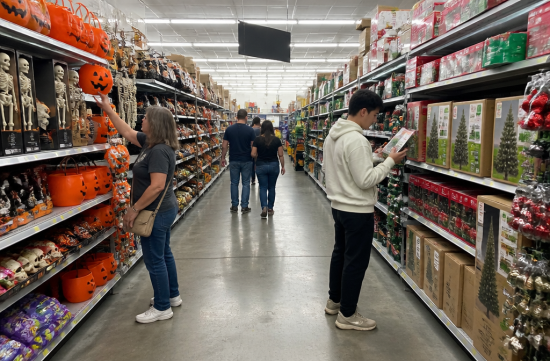
Last weekend, my friend and I went to the store and both of us stopped in our tracks. On one aisle, there were piles of skeletons and pumpkin baskets, while right next to it, twinkling tree lights were flashing.
My friend said, "Halloween isn't even over yet, and we're already hearing Jingle Bells." I laughed, but honestly, this scene doesn't surprise me anymore.
This phenomenon is referred to as 'Christmas creep' in the U.S. It means that the Christmas season is slowly creeping in.
I looked up when this term originated. The earliest usage found by the neologism dictionary Word Spy is from a 1986 LA Times article.
It mentioned that Christmas promotional cereals were already on store shelves around Labor Day. So, the term is from the '80s.
However, the phenomenon itself is much older. There were voices opposing Christmas advertising before Thanksgiving as far back as the 1950s.
The most interesting story is from 1939. That year, Thanksgiving was set late on November 30, leading to concerns in the retail industry about having too few shopping days.
In response, President Roosevelt moved Thanksgiving up a week to November 23. The announcement was made in August of that year.
The reaction was chaotic. People sarcastically dubbed it 'Franksgiving' after the president, and states were divided over whether to stick to the old date or follow the new one.
So what was the outcome? Looking at sales data from those two years, the effect of moving the date was not significant. Ultimately, they reverted to the original date in 1942, and Congress established the fourth Thursday in November as the official date.
Of course, just changing the calendar won't revive the economy (it didn't). I found this part the most satisfying because it means that consumers ultimately control their wallets.
So why are stores rushing so much these days? The reason is simpler than you might think. The longer the selling period, the more opportunities there are to sell.
The industry refers to the period from October to December as the 'golden quarter.' This is where the year's sales are determined.
This competition intensified during tough economic times. There are analyses suggesting that Christmas creep has accelerated since the 2008 financial crisis. When customers have thinner wallets, stores try to grab their attention earlier and for longer.
There's also a competitive structure similar to an arms race. If one store puts up a tree first, the neighboring store can't just sit back.
However, to view this solely as a marketing tactic would be unfair, as customers also play a role. In a recent survey by the National Retail Federation (NRF), 42% of respondents said they would start their year-end shopping before November.
The top reason was to spread out their budget, and the second was to avoid last-minute stress. I have to admit, I can't argue with that.
In the same survey, the expected year-end spending per person was $890.49. I can understand wanting to spread that out over three months instead of cramming it into one.
Halloween isn't insignificant either. According to NRF's forecast released last month, Halloween spending is expected to reach $13.5 billion, surpassing last year's record of $13.1 billion.
Per person, that's about $115.14. With $4.3 billion going just for decorations, it's not surprising that the two holidays are competing for the same retail space.
There was a comment on my last post that said, "Isn't it a bit much to see trees going up in October?" Honestly, I used to feel that way too.
So I compared the two approaches side by side. A is the traditionalist who waits until after Thanksgiving to put up decorations, while B is the early bird who puts up lights the day after Halloween.
The advantage of A is that they maintain the order of the holidays. Thanksgiving doesn't become the waiting room for Christmas.
The advantage of B is more practical. Popular decorations sell out quickly, and if you go late, you only get what's left.
As someone living in a desert town, I would add that early November can still be quite hot during the day. Climbing a ladder to hang lights in the blazing sun can be more exhausting than you'd think.
My friend remained firmly in the A camp. "What do you think about Christmas sales happening in July?" I couldn't answer that question.
Thinking about it, for immigrants like us, having this season stretch out isn't necessarily a bad thing. We need to prepare early to send gift packages to Korea anyway.
Ultimately, I don't think this is a matter of who's right or wrong. Stores want to sell as early as they can, and customers can buy whenever they want.
What 1939 showed us is that just because a date is set from above doesn't mean people's hearts will follow.
My choice is this: shop early like B, but decorate after Thanksgiving like A. This way, I can take advantage of discounts and stock while still respecting Halloween.
Which side are you on? When do you plan to put up your tree this year? Let's discuss in the comments.
 LuckyStone77








 Community Cross |

 Conflite Teacher |

 SEVEN SEVEN |

 Korean Mom |

 novapixel |

 USA Hyundai Kia |


 US Regional Information Local News |


 new sugar |
 Palm 1000 |
 loran |
 donutfield |
 Tennis City |
 sunny7 |
 Questions about firearms while living in America |
 Shoot Me |
 mochifox |
 zucchini |
 Anna Life |
 Exciting FM Radio |
 pet dog |
 toodin |
 rosed |
 DeArizona Blog |
 river9 |
 ollege Mom |
 Pronunciation Yo |
 nuvex11 |