
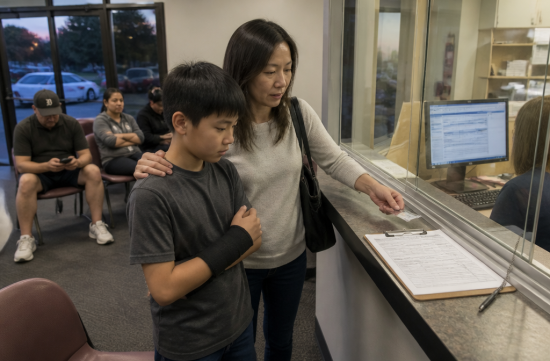
Last month in the evening, a friend called me. Her child had fallen and his wrist was swollen, and she wasn't sure if they should go to the ER or if urgent care would suffice.
I've asked that question myself several times. And to get straight to the point, the point at which hospital costs differ significantly is clearer than you might think.
First, it's important to note that the two places are legally very different. The emergency room is a facility attached to a hospital, while urgent care is mostly similar to outpatient clinics.
The emergency room is governed by a federal law called EMTALA. This law, established in 1986, requires emergency rooms in hospitals that participate in Medicare to evaluate and stabilize patients regardless of their ability to pay.
This means that even if you don't have insurance or are worried about costs, you won't be turned away at the emergency room door. Delaying evaluation to ask for insurance information is also not permitted.
However, this also means that the cost structure is heavier. The emergency room is staffed and equipped 24/7, so facility fees and physician charges are often billed separately.
So even for the same cold symptoms, going to the emergency room can lead to multiple charges on the bill. Honestly, I was quite shocked when I first received that statement.
Urgent care, on the other hand, typically bills primarily for the consultation. If you have insurance, you might see separate amounts for ER and urgent care on your copay section of your card.
The difference varies by plan, so I can't give you exact numbers. However, it's clear that most plans have higher costs associated with the emergency room, so check your plan tonight if you can.
So what are the criteria? What I've summarized is that it depends on what equipment is needed in this situation rather than just the symptoms.
If you experience chest pain, paralysis in one arm or leg, slurred speech, difficulty breathing, or uncontrolled bleeding, don't hesitate—call 911 or go to the emergency room. These are emergency signals commonly advised by public institutions.
On the other hand, symptoms like a fever from a cold, a mild sprained ankle, small wound sutures, or a burning sensation while urinating are often handled at urgent care.
Ambiguous cases, like a child who may have a broken bone, can be tricky. If the urgent care has X-ray capabilities, they may assess there first and refer you to the emergency room if necessary.
So it's a good idea to find out if your nearby urgent care has X-ray services and what their hours are. If you find yourself wandering in front of a clinic that closes at 9 PM, you'll end up going to the emergency room anyway.
Also, take a look at the back of your insurance card. Many plans have a 24-hour nurse consultation number listed, and if you ask where to go, they can help you determine the best option.
One thing many people overlook is the No Surprises Act. This federal law, which took effect in January 2022, requires that emergency care received at out-of-network hospitals be billed based on in-network rates.
In simple terms, when you're in an emergency and don't have the luxury to consider in-network hospitals, this law helps prevent you from being hit with a surprise bill later. Even care received after stabilization falls under this protection unless you provide written consent.
However, urgent care is a bit different. This protection applies to facilities licensed to provide emergency care, so regular visits to urgent care require you to check the network status yourself.
This can be a subtle trap. If you think urgent care will be cheaper than the emergency room and it turns out to be out-of-network, you might receive a larger bill than expected.
That's why I've saved two or three nearby in-network urgent care facilities as favorites in my insurance app. This is my personal strategy, but it's much faster than searching in an emergency.
If you don't have insurance or have high out-of-pocket costs, it's also good to know California law. AB 1020, which took effect in 2022, raised the income threshold for hospital financial assistance from 350% to 400% of the federal poverty level.
This law allows individuals to receive assistance if their out-of-pocket costs exceed 10% of their family's income.
Starting in 2025, AB 2297 will be implemented, preventing hospitals from considering assets like savings when determining eligibility, and deadlines for applications will also be eliminated.
This applies to hospital, or emergency room, bills. If you've already received an emergency room bill, don't panic and pay it right away—ask for a financial assistance application first.
When you receive a bill, it's also important to compare it line by line with your insurance company's EOB. If items don't match, you can request an itemized bill, and I've caught duplicate charges that way.
Both sides have valid points. Saying you should always go to urgent care to save money or insisting you should always go to the emergency room out of fear isn't the right answer either.
My conclusion is this: if it's a life-threatening signal, costs are a secondary concern, but otherwise, I believe it's best to go to in-network urgent care first.
However, symptom assessment varies from person to person. I recommend discussing with your regular doctor or pharmacist to establish criteria that suit your family in advance.
In the end, my friend's child went to an urgent care that could do X-rays, and it turned out to be a simple sprain. Having the information I gathered beforehand saved the night.
 AZCowboy




 Diana Blues |

 Dragon Lee |

 Churros Train Conductor |

 Tora Tora |

 neroyo |

 Korean Mom |


 Purple Moons, |

 My Carmen |

 LOVE IE |

 Asparagus Blog |
 Good Neighborhood, Wealthy District Information |
 Ro Ro Car |
 Amber H |
 new sugar |
 Palm 1000 |
 loran |
 donutfield |
 Tennis City |
 sunny7 |
 Questions about firearms while living in America |
 Shoot Me |
 mochifox |
 zucchini |
 Anna Life |
 Exciting FM Radio |
 pet dog |
 toodin |
 rosed |
 DeArizona Blog |
 river9 |