

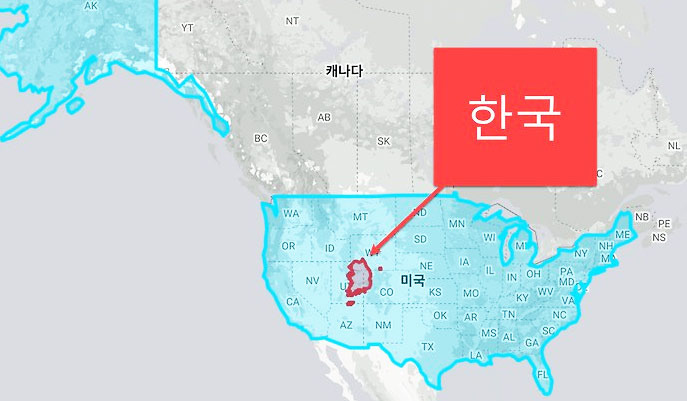
As everyone knows, in terms of total land area, Russia ranks first, followed by Canada in second place.
However, when considering the proportion of "usable land" that can be inhabited, the United States is the clear leader.
The total land area of the United States is about 9.83 million km², which is roughly 100 times larger than South Korea. It's a surprisingly vast expanse of land.
Endless plains that seem to stretch on forever, with cornfields and herds of cattle spread across them. And there are continuously emerging large and medium-sized cities.
This is not just a simple landscape; it is the source of national competitiveness.
Looking at the world map, Russia is overwhelmingly large, and Canada is also wider than the United States.
In terms of total area, Russia is about 17.1 million km², making it the largest in the world, Canada is about 9.98 million km², ranking second, and the United States is about 9.83 million km², ranking third.
However, a significant portion of Russia's territory is covered by the Siberian permafrost.
This means that the ground is frozen, making it difficult to farm or build structures.
About 90% of Canada's population is concentrated in a narrow area within 100 miles of the U.S. border, essentially a strip of land to the north of the United States.
Canada's northern regions are essentially uninhabited tundra and permafrost.
The Real Competitiveness of the United States: A Trio of Climate and Geography
First, the climate. A significant portion of U.S. territory falls under temperate climate. Excluding Alaska, the contiguous United States is almost entirely situated in cultivable climate zones.
Second, the Mississippi River basin. This area is one of the most fertile lands on Earth. It is the result of thousands of years of sediment deposited from the Ice Age. This is why the United States is one of the largest agricultural producers in the world. Corn, soybeans, wheat, cotton. These do not just appear out of nowhere.
Third, the navigable waterway network. Many people may not know this, but the United States has the most developed system of navigable rivers in the world. The Mississippi, Missouri, Ohio, and Tennessee Rivers form a massive logistics network. The ability to transport goods deep inland by boat was an enormous advantage during the industrial era, and it remains so today.
Permafrost is not just "cold land."
Civil engineering is extremely difficult, building foundations are unstable, and infrastructure maintenance costs are astronomical. If temperatures rise and the ground thaws, it can lead to subsidence issues. The reason Russia cannot build cities in Siberia is not due to a lack of will.
The same goes for northern Canada. There are mineral resources, but the extraction costs are enormous. To extract resources, infrastructure must first be built, and the cost of that infrastructure alone can easily negate any profits. It is beautiful land, but economically it is just a frozen warehouse.
Therefore, the fact that the United States has become a superpower is not a coincidence.
While Russia and Canada rank first and second in area, in terms of the "quality and quantity of usable land," the United States is the undisputed leader.
Temperate climate, fertile land, a strong inland waterway system, and natural defenses provided by the oceans on both sides.
Ranked third in area, but first in practicality. That is the true specification of the United States.







 Anova US Beauty Information |
 anchor |
 Korea Tiger News |
 Alpha and Omega World |
 Florida King |
 newyorker 101 |
 Encyclopedia of New York and Surrounding Areas |
 International Court |
 PPAP Pineapple Pen |
 Living in the Eastern United States |
  coffeee |
  |
|  Christopher |
  sylven |
  Sammy Beach |
  Bliss O |
  blue ocean |
  greenlight |
  Watanaka Karametibaksa |
  castle |
  xelton52 |
  carefree |
  vrixen73 |
  AZ Road Master |
  Victory 1988 |
  summita |
  business lim |
  Colorado Lee |
  Make My Day |