
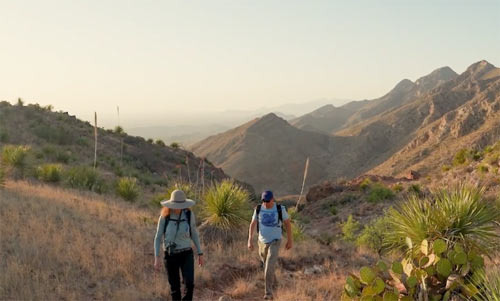
When talking about El Paso weather, it is definitely hot in the summer.
However, thinking of it as a city where you can wear short sleeves all year round is also incorrect.
El Paso is located at an elevation of about 3,700 feet, over 1,100m, so the weather differs between summer and winter.
The hottest period is from June to August. The average high temperature in June is about 96°F, around 36°C, and in July, it hovers around 95°F.
It is common for daytime temperatures to exceed 100°F, about 38°C. During this time, it is difficult to live indoors without air conditioning.
However, it feels different from summer in Korea. When it's 32°C in Seoul, if you go outside on a humid day, your clothes stick to your body and you sweat even when standing still.
In El Paso, even if it exceeds 38°C, it feels different when you step into the shade.
That doesn't mean it's "not hot because it's dry." It's more accurate to say that under the sun, your skin feels burning hot.
True to its desert nature, it's hard to say that summer nights are cool enough to sleep without air conditioning.
In winter, the average high temperature in January is about 58-60°F, around 14-16°C.
On sunny days, there are many days when you can get by with just a light jacket. But when the sun goes down, the story changes.
The average low temperature can drop to the mid-30s°F, and there are days when it falls below freezing. This is very cold weather.
So, if you're moving to El Paso, don't throw away your winter clothes.
You won't need to wear a heavy coat for months, but there are definitely days when a proper winter jacket is necessary in the mornings and evenings.
It does snow. The average annual snowfall in El Paso is about 2-3 inches, which isn't much.
Some winters, you might not see any snow at all, and when it does snow heavily, the city can turn white.
The problem is when the temperature drops after it snows, causing the roads to freeze. In an area not used to snow, you need to be extra careful when driving.
Rain is very scarce. The average annual precipitation in El Paso is about 9-10 inches, 230-250mm.
Considering that Seoul's annual precipitation is around 1,400mm, you can get a sense of how dry it is here.
That doesn't mean it rains a little throughout the year either.
The period when rain is relatively concentrated is during the North American monsoon from July to September.
In the morning, the sun might be shining, but suddenly dark clouds roll in by the afternoon, bringing heavy rain with thunder and lightning.
Because the ground is so dry, when strong rain falls in a short time, there can be sudden flooding in low-lying roads or areas with poor drainage.
If I had to pick the biggest characteristic of El Paso weather, it would definitely be the sunshine. It's rare to have several days of cloudy and damp weather.
Instead, it's best to think of sunglasses and sunscreen as essentials.
In conclusion, El Paso weather is hot in the summer, surprisingly cold in winter nights, very little rain, and occasional snow, typical of a high desert climate.
 SunnyForest74
 HappyOcean




 Smile Face |
 Helpful Life Stories |
 Casa Mia |
 Study Abroad Life Know-How Tips |
 pravix22 |
 Tomex Train Uncle |
 An ant castle |
 clarion |
 tredon |
 fortbliss |
  Sammy Beach |
  Bliss O |
  blue ocean |
  greenlight |
  Watanaka Karametibaksa |
  castle |
  xelton52 |
  carefree |
  vrixen73 |
  AZ Road Master |
  Victory 1988 |
  summita |
  business lim |
  Colorado Lee |
  Make My Day |
  Fros Pro |
  lioness |
  La Bean |
  American History This and That |
  Monte Sori |